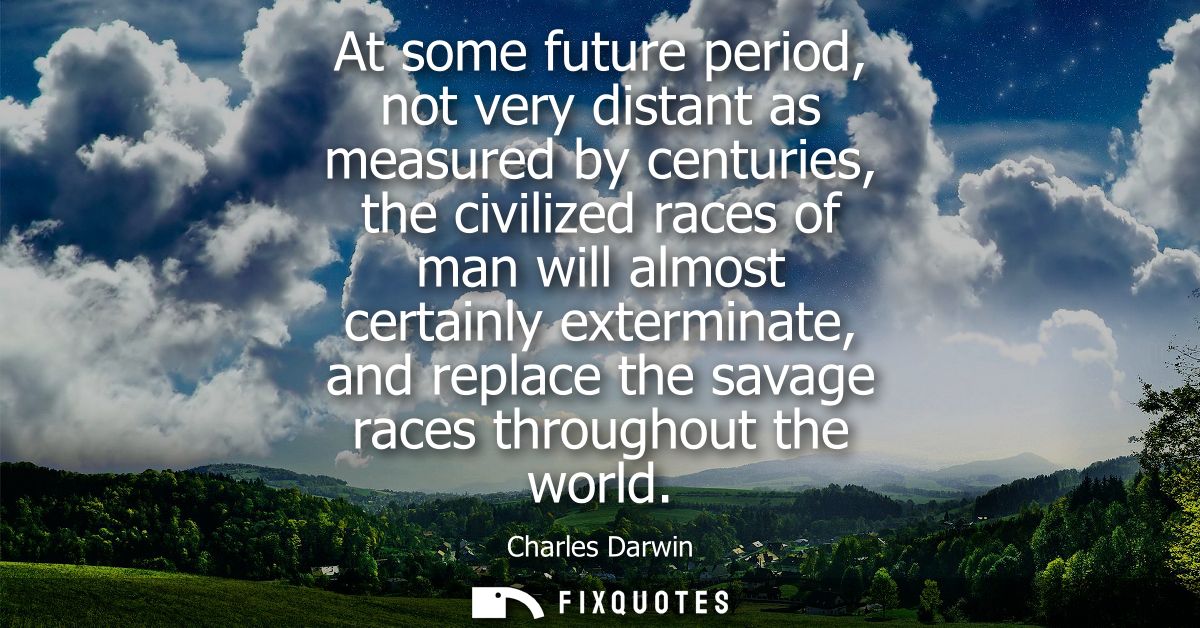
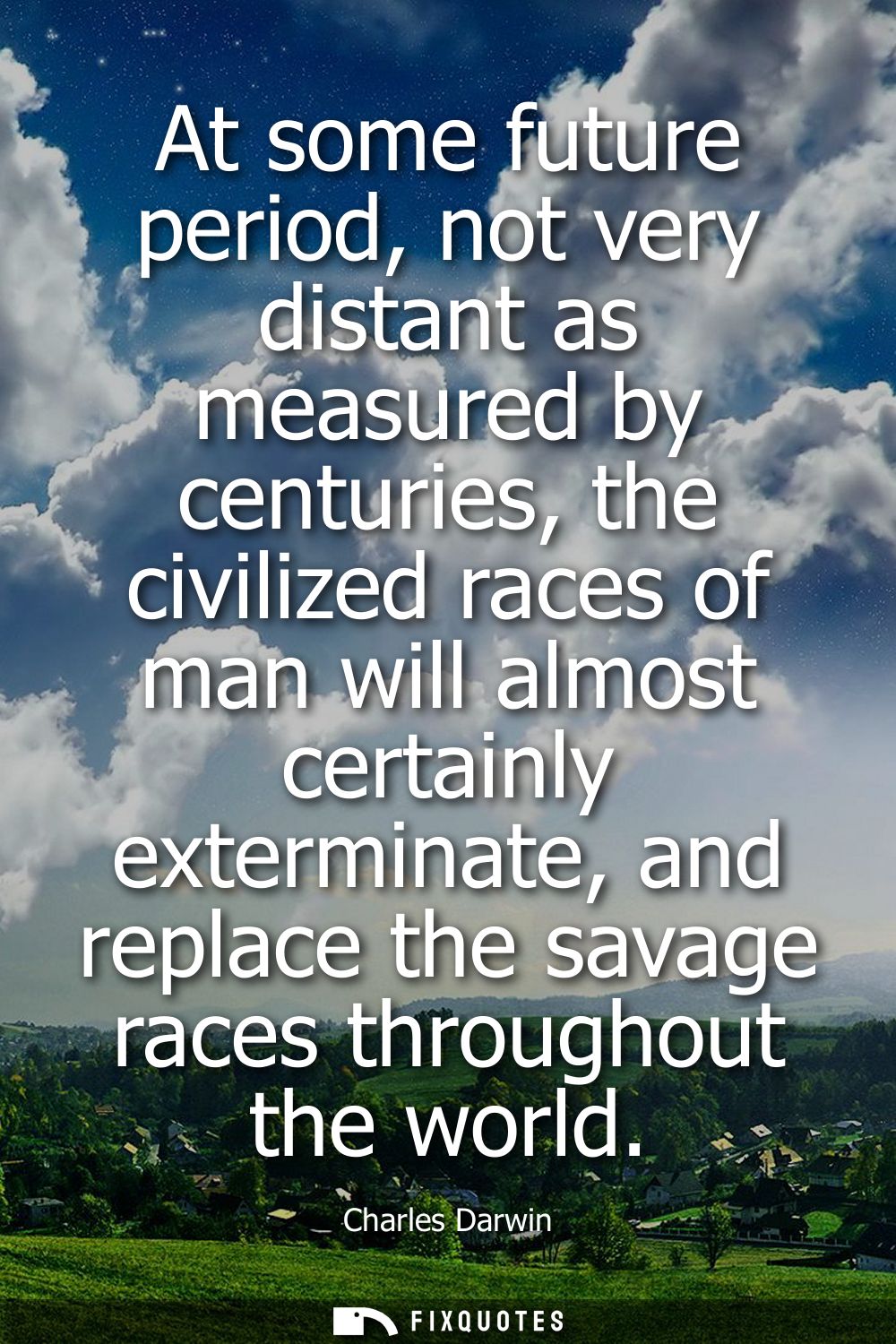
"At some future period, not very distant as measured by centuries, the civilized races of man will almost certainly exterminate and replace the savage races throughout the world"
About this Quote
Context sharpens the edge. Mid-19th-century Britain sat atop a global imperial project that regularly collapsed conquest into "civilization". Darwin is writing in a world where "civilized" and "savage" were not descriptive categories but political ones, built to justify dispossession. The quote doesn’t argue for extermination as a moral good; it normalizes it as the probable endpoint of contact between peoples. That distinction is precisely what makes it so revealing: the subtext is a shrug masquerading as a syllabus.
This is also a snapshot of how evolutionary thinking could be misread - or too easily read - as social destiny. Darwin’s biological framework, applied to human groups through the era’s racial hierarchies, becomes a story of replacement: one kind of human "outcompeting" another. The sentence is spare, almost bureaucratic, and that austerity is the tell. It’s the voice of a century learning to describe violence without sounding violent.
Quote Details
| Topic | Human Rights |
|---|---|
| Source | Verified source: The Descent of Man, and Selection in Relation to Sex (Vol... (Charles Darwin, 1871)
Evidence: At some future period, not very distant as measured by centuries, the civilised races of man will almost certainly exterminate and replace throughout the world the savage races. (Vol. I, Chapter VI ("On the Affinities and Genealogy of Man"), p. 201 (in the John Murray 1871 ed.; Gutenberg transcription shows page marker "201")). This sentence appears in Darwin’s own text in The Descent of Man (first edition, 1871), in Vol. I during Chapter VI. The commonly-circulated variant that omits “throughout the world” (i.e., “replace the savage races throughout the world”) is a slightly re-ordered paraphrase; the primary-source wording is “replace throughout the world the savage races.” The quote is part of a longer passage that continues immediately with a sentence about the likely extermination of “anthropomorphous apes.” Other candidates (1) The Mirage of Dignity on the Highways of Human ‘Progress’ (Lukman Harees, 2012) compilation98.6% ... Charles Darwin's ' On The Origin of Species ' ( 1859 ) ... At some future period , not very distant as measured b... |
| Cite |
Citation Formats
APA Style (7th ed.)
Darwin, Charles. (2026, February 26). At some future period, not very distant as measured by centuries, the civilized races of man will almost certainly exterminate and replace the savage races throughout the world. FixQuotes. https://fixquotes.com/quotes/at-some-future-period-not-very-distant-as-30481/
Chicago Style
Darwin, Charles. "At some future period, not very distant as measured by centuries, the civilized races of man will almost certainly exterminate and replace the savage races throughout the world." FixQuotes. February 26, 2026. https://fixquotes.com/quotes/at-some-future-period-not-very-distant-as-30481/.
MLA Style (9th ed.)
"At some future period, not very distant as measured by centuries, the civilized races of man will almost certainly exterminate and replace the savage races throughout the world." FixQuotes, 26 Feb. 2026, https://fixquotes.com/quotes/at-some-future-period-not-very-distant-as-30481/. Accessed 5 Mar. 2026.