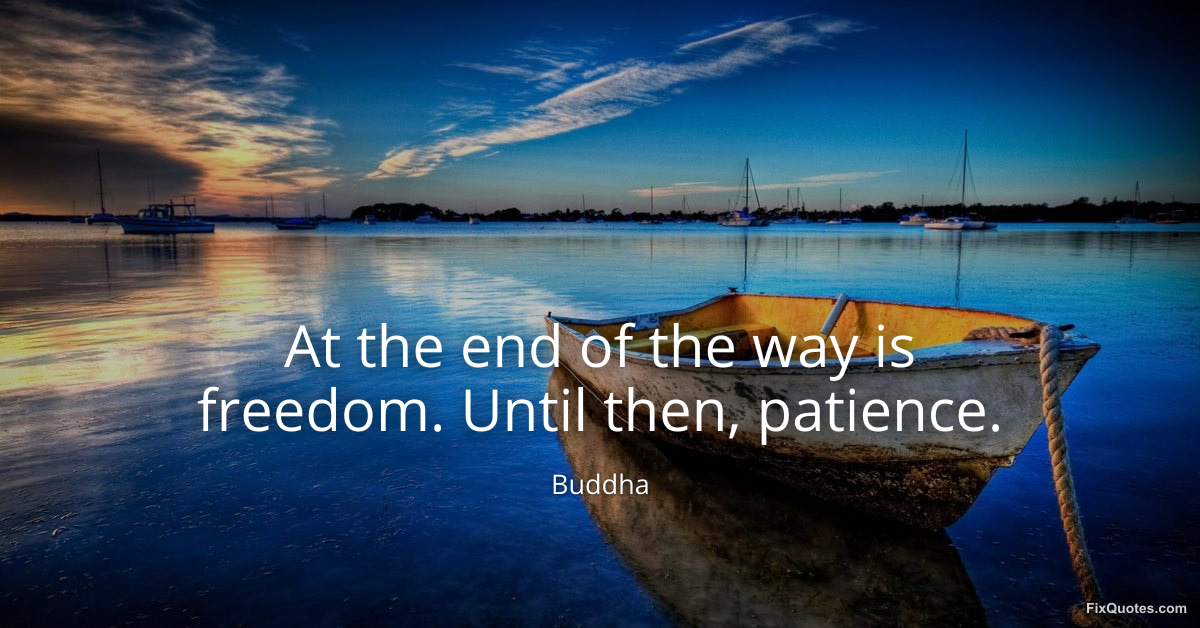
"At the end of the way is freedom. Until then, patience"
About this Quote
The line carries the calm authority of someone trying to redirect desire, not inflame it. "At the end of the way is freedom" offers a promise, but not the kind most political or military leaders trade in. This is not freedom as conquest, rights, or victory over an enemy. It is liberation from craving, attachment, and the mental habits that keep suffering in motion. The second sentence is where the discipline of the teaching lands: "Until then, patience". Not hope. Not passion. Patience.
That choice matters. Patience is anti-dramatic. It rejects the fantasy of sudden transformation, the modern appetite for breakthroughs, hacks, and instant awakening. The subtext is almost corrective: if you are desperate to be free, that desperation is itself part of the trap. The path cannot be rushed because the self that wants to rush is exactly what Buddhist practice is meant to loosen.
Historically, this sits inside a tradition built around training the mind through ethical conduct, meditation, and insight. The Buddha's authority comes from diagnosis rather than decree. He does not command belief; he prescribes a method. That gives the quote its unusual force. It sounds simple, but it quietly imposes a demanding view of human change: freedom is real, but it is procedural.
The rhetoric is spare and consequential. "The way" suggests a path already laid down, something walked rather than invented. "The end" gives shape to effort. "Patience" turns spiritual life into endurance. In eleven words, the quote binds consolation to discipline, promising release while denying immediacy.
That choice matters. Patience is anti-dramatic. It rejects the fantasy of sudden transformation, the modern appetite for breakthroughs, hacks, and instant awakening. The subtext is almost corrective: if you are desperate to be free, that desperation is itself part of the trap. The path cannot be rushed because the self that wants to rush is exactly what Buddhist practice is meant to loosen.
Historically, this sits inside a tradition built around training the mind through ethical conduct, meditation, and insight. The Buddha's authority comes from diagnosis rather than decree. He does not command belief; he prescribes a method. That gives the quote its unusual force. It sounds simple, but it quietly imposes a demanding view of human change: freedom is real, but it is procedural.
The rhetoric is spare and consequential. "The way" suggests a path already laid down, something walked rather than invented. "The end" gives shape to effort. "Patience" turns spiritual life into endurance. In eleven words, the quote binds consolation to discipline, promising release while denying immediacy.
Quote Details
| Topic | Wisdom |
|---|---|
| Source | Help us find the source |
| Cite |
Citation Formats
APA Style (7th ed.)
Buddha. (2026, March 10). At the end of the way is freedom. Until then, patience. FixQuotes. https://fixquotes.com/quotes/at-the-end-of-the-way-is-freedom-until-then-185907/
Chicago Style
Buddha. "At the end of the way is freedom. Until then, patience." FixQuotes. March 10, 2026. https://fixquotes.com/quotes/at-the-end-of-the-way-is-freedom-until-then-185907/.
MLA Style (9th ed.)
"At the end of the way is freedom. Until then, patience." FixQuotes, 10 Mar. 2026, https://fixquotes.com/quotes/at-the-end-of-the-way-is-freedom-until-then-185907/. Accessed 18 Mar. 2026.
More Quotes by Buddha
Add to List