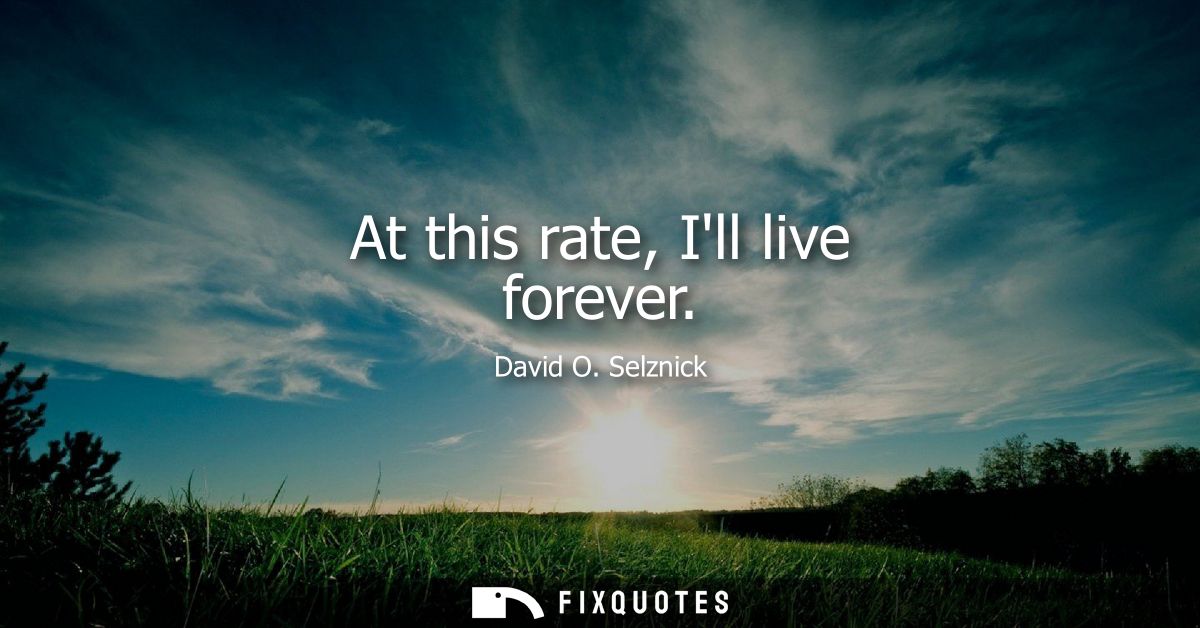
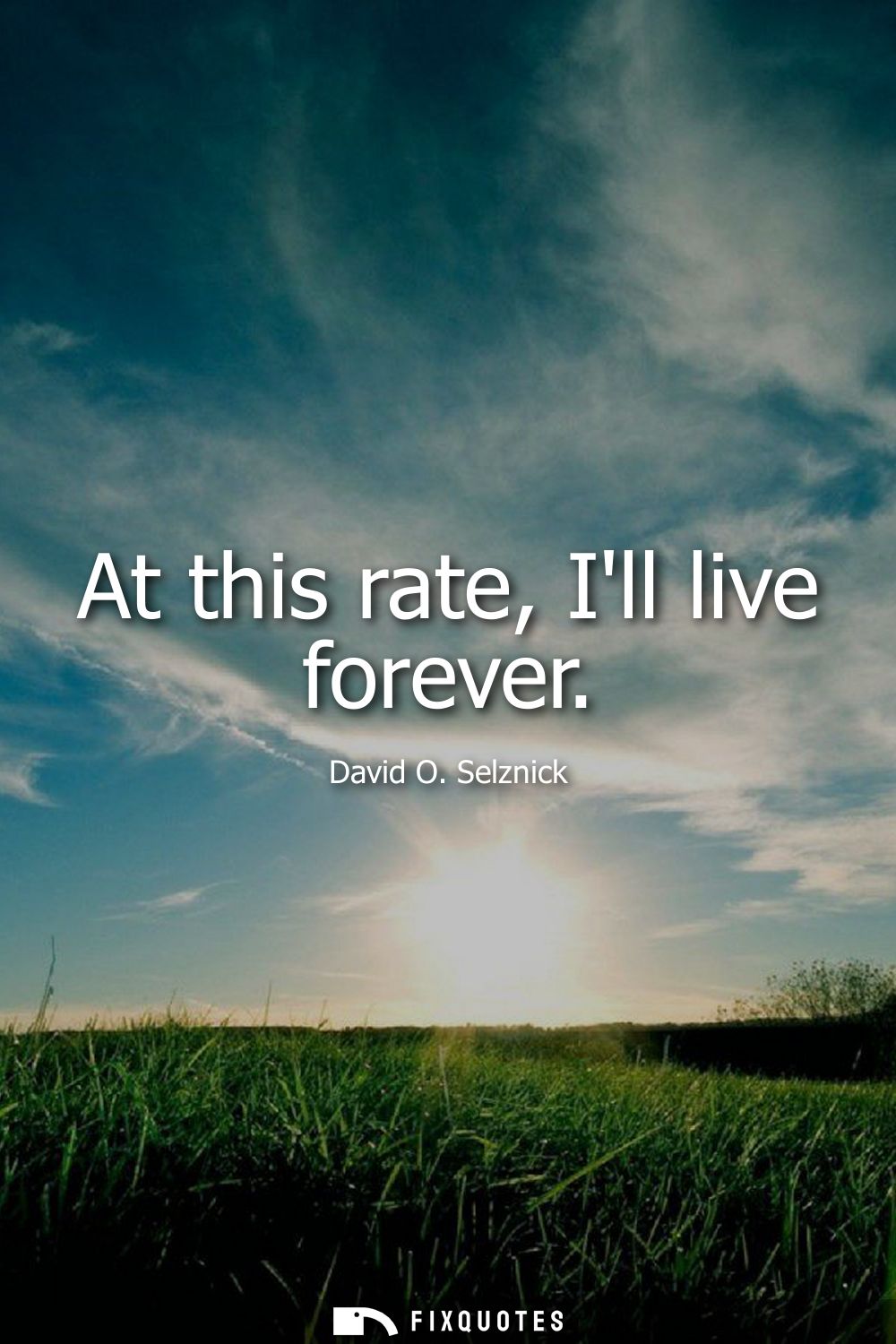
"At this rate, I'll live forever"
About this Quote
"At this rate, I'll live forever" is the kind of line only a Hollywood producer could toss off with a straight face and a knife behind the grin. David O. Selznick made a career out of turning stress into spectacle, and the joke lands because it’s a reversal of what everyone knows: the pace that keeps you “going” is usually the pace that kills you. The humor isn’t hopeful; it’s managerial gallows wit, the executive’s way of admitting the workload is unsustainable while still treating it as proof of vitality.
Selznick’s intent reads as self-mythmaking in miniature. Producers don’t get the romantic authorial aura of directors or stars, so they manufacture legend through stamina, control, and the ability to outlast chaos. “At this rate” is doing heavy lifting: it implies a punishing tempo, a production schedule measured in ulcers and all-nighters. Saying he’ll “live forever” isn’t literal; it’s a boast that his momentum is its own immortality, that he can outrun the clock by staying in perpetual motion.
The subtext is also a confession about the industry’s moral economy. In classic studio-era Hollywood, exhaustion was currency and overwork was recast as dedication. The line flatters that system even as it punctures it. Selznick is both proud and trapped: he’s aware the machine is chewing him up, and he can’t resist turning the grind into a punchline because that’s how power talks when it doesn’t want to admit vulnerability.
Selznick’s intent reads as self-mythmaking in miniature. Producers don’t get the romantic authorial aura of directors or stars, so they manufacture legend through stamina, control, and the ability to outlast chaos. “At this rate” is doing heavy lifting: it implies a punishing tempo, a production schedule measured in ulcers and all-nighters. Saying he’ll “live forever” isn’t literal; it’s a boast that his momentum is its own immortality, that he can outrun the clock by staying in perpetual motion.
The subtext is also a confession about the industry’s moral economy. In classic studio-era Hollywood, exhaustion was currency and overwork was recast as dedication. The line flatters that system even as it punctures it. Selznick is both proud and trapped: he’s aware the machine is chewing him up, and he can’t resist turning the grind into a punchline because that’s how power talks when it doesn’t want to admit vulnerability.
Quote Details
| Topic | Mortality |
|---|---|
| Source | Help us find the source |
| Cite |
Citation Formats
APA Style (7th ed.)
Selznick, David O. (2026, January 16). At this rate, I'll live forever. FixQuotes. https://fixquotes.com/quotes/at-this-rate-ill-live-forever-111260/
Chicago Style
Selznick, David O. "At this rate, I'll live forever." FixQuotes. January 16, 2026. https://fixquotes.com/quotes/at-this-rate-ill-live-forever-111260/.
MLA Style (9th ed.)
"At this rate, I'll live forever." FixQuotes, 16 Jan. 2026, https://fixquotes.com/quotes/at-this-rate-ill-live-forever-111260/. Accessed 25 Mar. 2026.
More Quotes by David
Add to List