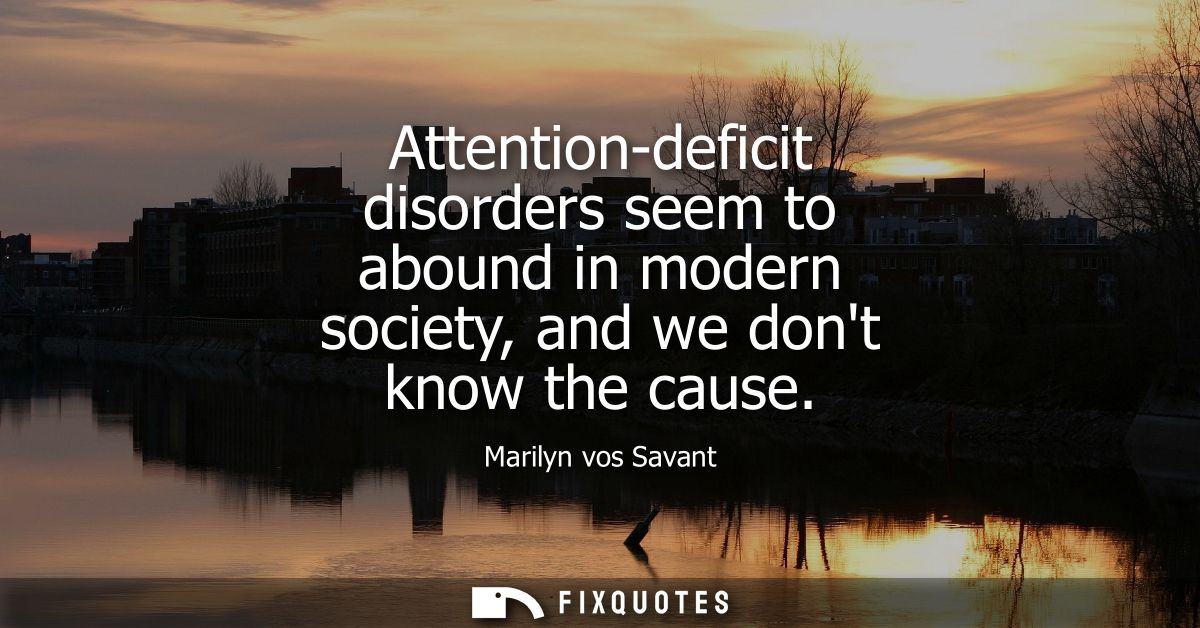
"Attention-deficit disorders seem to abound in modern society, and we don't know the cause"
About this Quote
The subtext isn’t anti-science so much as anti-complacency. “We don’t know the cause” sounds humble, but it also functions as an indictment of how quickly society converts complexity into categories. The “we” is broad and strategic: not just doctors or researchers, but parents, teachers, employers, and the media ecosystem that turns a clinical descriptor into a personality type. Vos Savant’s intent reads as a warning about narrative substitution - when causation is unknown, culture rushes in with ready-made stories: screens did it, sugar did it, parenting did it, capitalism did it.
Context matters because “modern society” is a loaded container. It points to environments engineered for distraction - notification economies, fragmented work, constant optimization - while leaving open the possibility that what’s “abounding” is partly recognition and diagnosis, not incidence. The line works because it refuses to let the diagnosis feel settled. It forces a discomforting question: are we witnessing a medical mystery, a cultural mirror, or both?
Quote Details
| Topic | Mental Health |
|---|---|
| Source | Help us find the source |
| Cite |
Citation Formats
APA Style (7th ed.)
Savant, Marilyn vos. (2026, January 15). Attention-deficit disorders seem to abound in modern society, and we don't know the cause. FixQuotes. https://fixquotes.com/quotes/attention-deficit-disorders-seem-to-abound-in-162425/
Chicago Style
Savant, Marilyn vos. "Attention-deficit disorders seem to abound in modern society, and we don't know the cause." FixQuotes. January 15, 2026. https://fixquotes.com/quotes/attention-deficit-disorders-seem-to-abound-in-162425/.
MLA Style (9th ed.)
"Attention-deficit disorders seem to abound in modern society, and we don't know the cause." FixQuotes, 15 Jan. 2026, https://fixquotes.com/quotes/attention-deficit-disorders-seem-to-abound-in-162425/. Accessed 4 Apr. 2026.