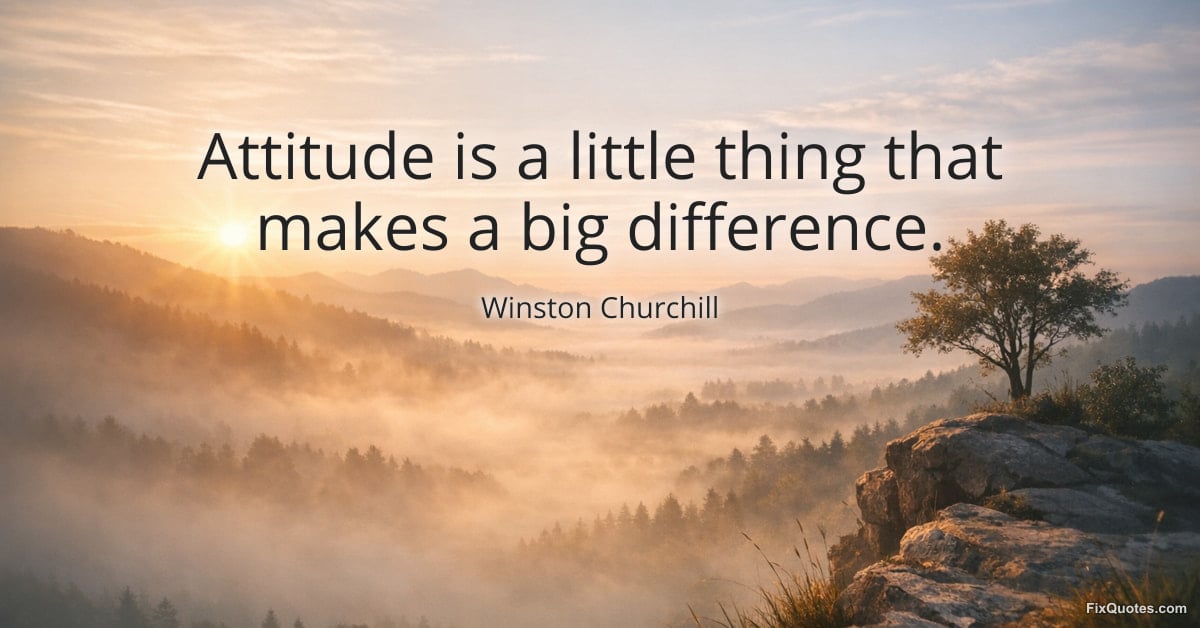
"Attitude is a little thing that makes a big difference"
About this Quote
Churchill’s line is a masterclass in wartime scaling: shrink the cause, magnify the consequence. “Attitude” is pitched as “a little thing” not because it’s trivial, but because it’s portable. You can lose territory, sleep, certainty; you can still carry your stance. In a century where Churchill watched institutions wobble and empires recede, the sentence works like a pocket-sized doctrine: when the outer world turns hostile, the inner posture becomes a strategic asset.
The subtext is bracingly unsentimental. Churchill isn’t selling optimism as a mood; he’s selling it as a discipline, a decision that precedes action. “Makes a big difference” hints at compounding effects: morale becomes endurance, endurance becomes coordination, coordination becomes victory. It’s the same logic behind his broader rhetoric during World War II, where he repeatedly converted private feeling into public fuel. Keep your chin up, yes, but also keep the machine running.
There’s a sly political instinct here, too. By emphasizing “attitude,” responsibility shifts from circumstance to character. That can be empowering (you’re not helpless) and coercive (if you falter, it’s on you). In Britain’s darkest hours, that ambiguity was useful: it offered comfort without softness, accountability without policy detail. The sentence is small, but it carries the weight of a leader who needed people to believe that the margin between collapse and survival could be fought for in the mind first.
The subtext is bracingly unsentimental. Churchill isn’t selling optimism as a mood; he’s selling it as a discipline, a decision that precedes action. “Makes a big difference” hints at compounding effects: morale becomes endurance, endurance becomes coordination, coordination becomes victory. It’s the same logic behind his broader rhetoric during World War II, where he repeatedly converted private feeling into public fuel. Keep your chin up, yes, but also keep the machine running.
There’s a sly political instinct here, too. By emphasizing “attitude,” responsibility shifts from circumstance to character. That can be empowering (you’re not helpless) and coercive (if you falter, it’s on you). In Britain’s darkest hours, that ambiguity was useful: it offered comfort without softness, accountability without policy detail. The sentence is small, but it carries the weight of a leader who needed people to believe that the margin between collapse and survival could be fought for in the mind first.
Quote Details
| Topic | Motivational |
|---|---|
| Source | Later attribution: The Knowledge (Michael Massey, 2003) modern compilationISBN: 9781904744030 · ID: lOuR0n-w-dgC
Evidence:
... Attitude is a little thing that makes a big difference ' Winston Churchill Your attitude reflects your state of mind and manifests itself in the manner of your behaviour . It is an extremely accurate barometer of how you truly feel a ... |
| Cite |
Citation Formats
APA Style (7th ed.)
Churchill, Winston. (2026, February 16). Attitude is a little thing that makes a big difference. FixQuotes. https://fixquotes.com/quotes/attitude-is-a-little-thing-that-makes-a-big-25074/
Chicago Style
Churchill, Winston. "Attitude is a little thing that makes a big difference." FixQuotes. February 16, 2026. https://fixquotes.com/quotes/attitude-is-a-little-thing-that-makes-a-big-25074/.
MLA Style (9th ed.)
"Attitude is a little thing that makes a big difference." FixQuotes, 16 Feb. 2026, https://fixquotes.com/quotes/attitude-is-a-little-thing-that-makes-a-big-25074/. Accessed 17 Feb. 2026.
More Quotes by Winston
Add to List