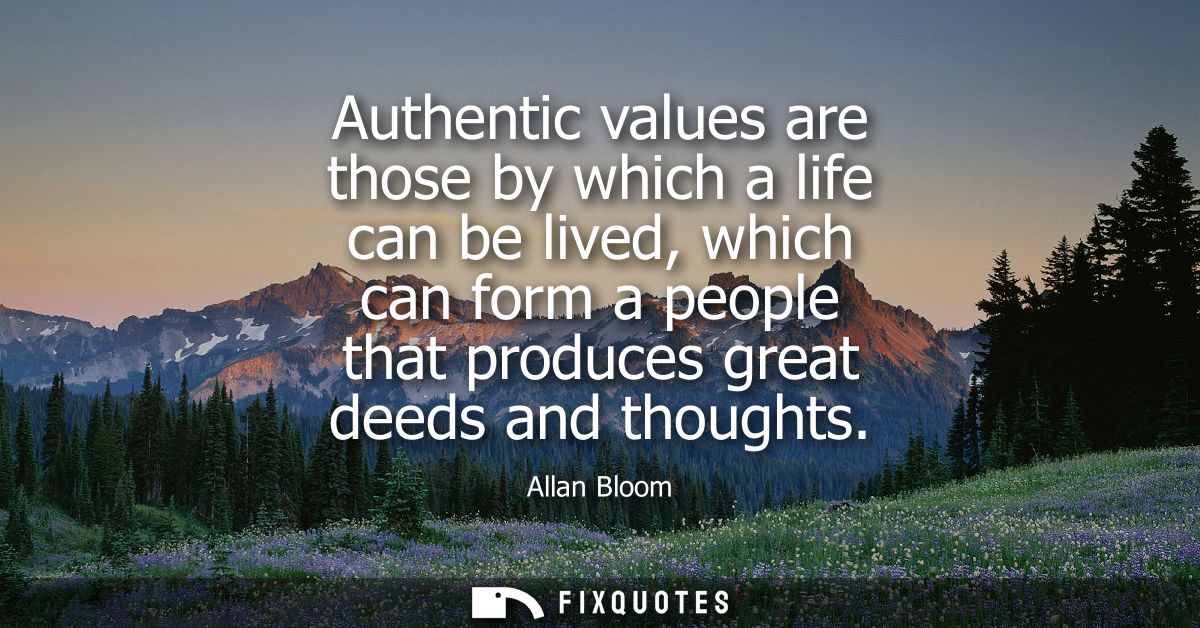
"Authentic values are those by which a life can be lived, which can form a people that produces great deeds and thoughts"
About this Quote
Bloom is smuggling a provocation into a seemingly high-minded definition: values aren’t “authentic” because they feel sincere or because they’re personally chosen, but because they hold up under the pressure of living. The line is built like a stress test. If a value can’t organize a life - not a mood, not an identity performance, but the messy continuity of decisions, sacrifice, and discipline - it fails Bloom’s audit.
The subtext is his long-running complaint about late-20th-century relativism: the campus mantra that all values are equal, all truths local, all commitments provisional. Bloom flips that posture by making authenticity public and consequential. It’s not enough that a value comforts the self; it must scale into a culture capable of “great deeds and thoughts.” That phrase is doing heavy normative work. “Great” isn’t neutral. It implies a hierarchy of achievements and a canon of standards, the very things Bloom believed universities were abandoning in favor of procedural openness and therapeutic self-expression.
Context matters: Bloom wrote in the shadow of post-1960s America, when liberation rhetoric collided with institutional skepticism, and when higher education increasingly treated moral claims as suspect. His sentence is a rebuttal to the idea that values are mere preferences. He’s arguing that civilizations are not assembled from vibes; they’re forged by shared commitments that demand something of people and, in return, make certain kinds of excellence possible.
It’s also a warning. If your values can’t produce deeds and thoughts worth inheriting, they’re not “authentic” - they’re just convenient.
The subtext is his long-running complaint about late-20th-century relativism: the campus mantra that all values are equal, all truths local, all commitments provisional. Bloom flips that posture by making authenticity public and consequential. It’s not enough that a value comforts the self; it must scale into a culture capable of “great deeds and thoughts.” That phrase is doing heavy normative work. “Great” isn’t neutral. It implies a hierarchy of achievements and a canon of standards, the very things Bloom believed universities were abandoning in favor of procedural openness and therapeutic self-expression.
Context matters: Bloom wrote in the shadow of post-1960s America, when liberation rhetoric collided with institutional skepticism, and when higher education increasingly treated moral claims as suspect. His sentence is a rebuttal to the idea that values are mere preferences. He’s arguing that civilizations are not assembled from vibes; they’re forged by shared commitments that demand something of people and, in return, make certain kinds of excellence possible.
It’s also a warning. If your values can’t produce deeds and thoughts worth inheriting, they’re not “authentic” - they’re just convenient.
Quote Details
| Topic | Ethics & Morality |
|---|
More Quotes by Allan
Add to List