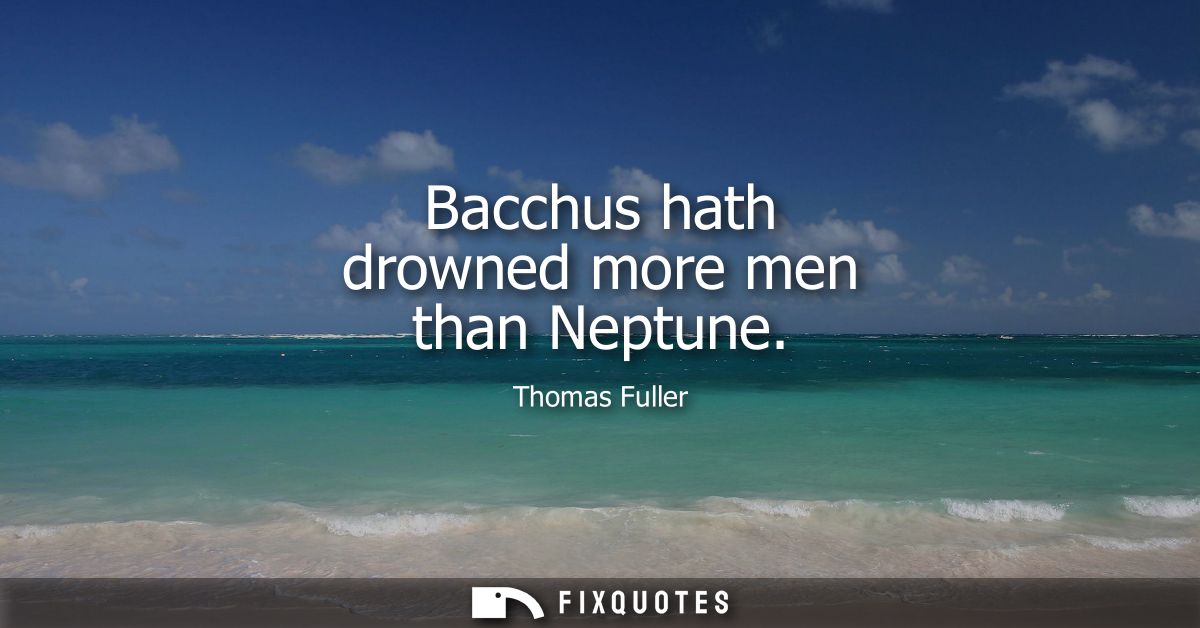
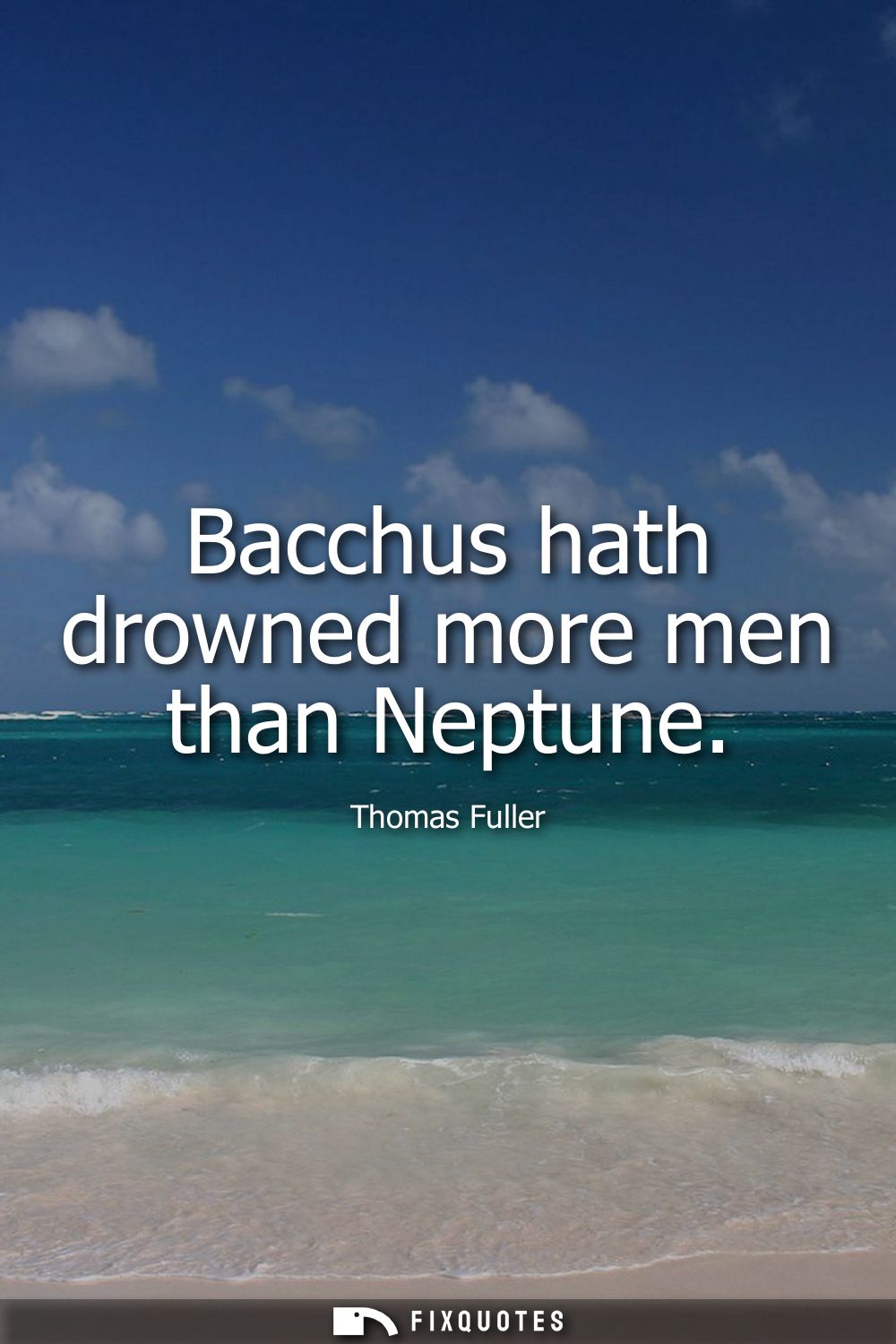
"Bacchus hath drowned more men than Neptune"
About this Quote
Bacchus and Neptune aren’t just mythological name-drops here; they’re a moral ledger. Fuller pits the god of wine against the god of the sea to deliver a grim punchline: alcohol kills more reliably than shipwrecks. It’s a cleric’s aphorism, sharpened by the era’s taste for classical allusion and its daily proximity to premature death. In 17th-century England, “drowning” wasn’t only a seafaring hazard; it was a familiar civic tragedy in rivers, canals, and harbors. Fuller’s twist is to move the scene indoors, to the tavern, where the drowning is slower, social, and often applauded.
The line works because it treats vice as a physical force, not an abstract failing. “Drowned” is the key verb: drink doesn’t merely tempt or corrupt; it submerges. Fuller smuggles spiritual diagnosis into bodily imagery, suggesting that intoxication overwhelms judgment the way water overwhelms lungs. That’s the subtext a clergyman would want: sin isn’t a theological debating point, it’s a mechanism with a predictable outcome.
There’s also a sly recognition of what makes drink so dangerous: it arrives disguised as pleasure and fellowship. Neptune is feared; Bacchus is invited. By measuring casualties, Fuller reframes temperance as pragmatic, not puritanical. His intent isn’t to scold for scolding’s sake, but to puncture the romance of convivial excess with a statistic-like comparison: the more lethal sea may not be the one outside the door.
The line works because it treats vice as a physical force, not an abstract failing. “Drowned” is the key verb: drink doesn’t merely tempt or corrupt; it submerges. Fuller smuggles spiritual diagnosis into bodily imagery, suggesting that intoxication overwhelms judgment the way water overwhelms lungs. That’s the subtext a clergyman would want: sin isn’t a theological debating point, it’s a mechanism with a predictable outcome.
There’s also a sly recognition of what makes drink so dangerous: it arrives disguised as pleasure and fellowship. Neptune is feared; Bacchus is invited. By measuring casualties, Fuller reframes temperance as pragmatic, not puritanical. His intent isn’t to scold for scolding’s sake, but to puncture the romance of convivial excess with a statistic-like comparison: the more lethal sea may not be the one outside the door.
Quote Details
| Topic | Wine |
|---|---|
| Source | Thomas Fuller , attributed: "Bacchus hath drowned more men than Neptune." (see Wikiquote: Thomas Fuller) |
| Cite |
Citation Formats
APA Style (7th ed.)
Fuller, Thomas. (2026, January 14). Bacchus hath drowned more men than Neptune. FixQuotes. https://fixquotes.com/quotes/bacchus-hath-drowned-more-men-than-neptune-10303/
Chicago Style
Fuller, Thomas. "Bacchus hath drowned more men than Neptune." FixQuotes. January 14, 2026. https://fixquotes.com/quotes/bacchus-hath-drowned-more-men-than-neptune-10303/.
MLA Style (9th ed.)
"Bacchus hath drowned more men than Neptune." FixQuotes, 14 Jan. 2026, https://fixquotes.com/quotes/bacchus-hath-drowned-more-men-than-neptune-10303/. Accessed 29 Mar. 2026.
More Quotes by Thomas
Add to List