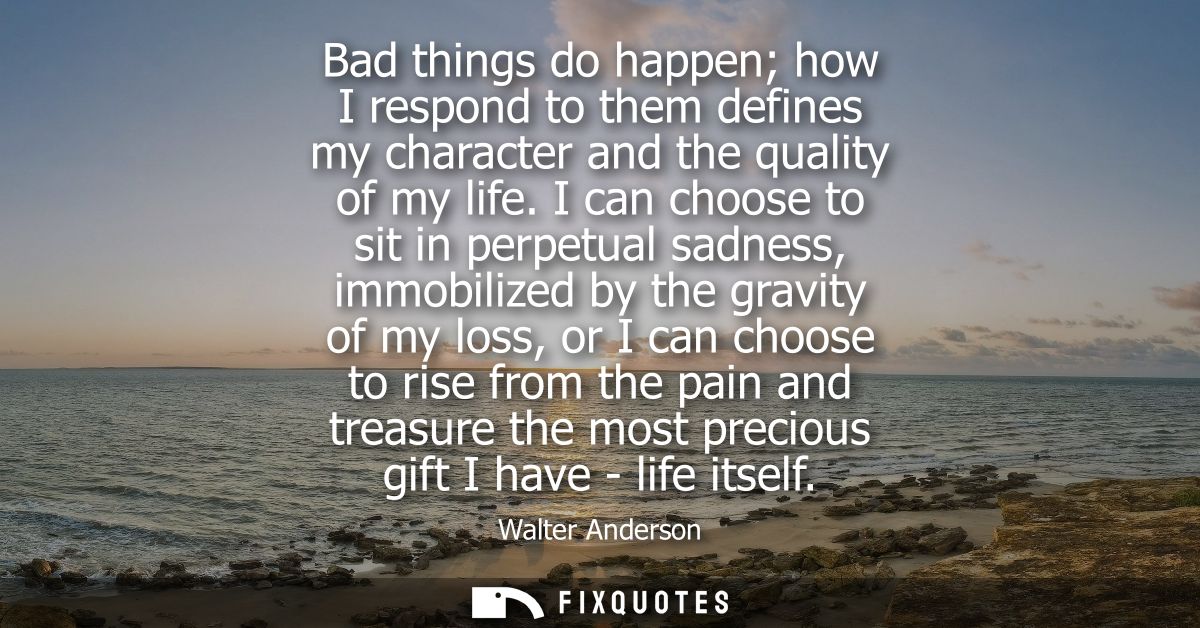
"Bad things do happen; how I respond to them defines my character and the quality of my life. I can choose to sit in perpetual sadness, immobilized by the gravity of my loss, or I can choose to rise from the pain and treasure the most precious gift I have - life itself"
About this Quote
Anderson’s line is a bracing piece of self-authorship: it takes the oldest human scandal - that suffering is real and often undeserved - and refuses to let it be the final editor of a life. The sentence structure performs the very pivot it argues for. First comes the blunt concession, “Bad things do happen,” a clause stripped of consolation or cosmic explanation. Then the control shifts to the speaker: “how I respond…defines.” The moral center is relocated from fate to agency, not in a naïve, positivity-poster way, but in a distinctly modern, psychological register where character is less inherited virtue than practiced choice.
The subtext is a quiet rebuke of both melodrama and victimhood-as-identity. “Perpetual sadness” and “immobilized by the gravity of my loss” don’t deny grief; they indict the way grief can harden into a permanent posture, a life organized around injury. That’s a controversial move because it implies responsibility even when the initial harm wasn’t chosen. Anderson threads that needle by framing choice not as denial of pain but as a decision about what pain gets to govern.
Contextually, a writer born in 1885 lived through wars, pandemics, and economic collapse - eras when “resilience” wasn’t a corporate buzzword but a daily necessity. The culminating phrase, “treasure the most precious gift…life itself,” is deliberately devotional, almost sermon-like. It works because it doesn’t promise redemption; it offers a smaller, tougher victory: getting back up, not because the world makes sense, but because you’re still here.
The subtext is a quiet rebuke of both melodrama and victimhood-as-identity. “Perpetual sadness” and “immobilized by the gravity of my loss” don’t deny grief; they indict the way grief can harden into a permanent posture, a life organized around injury. That’s a controversial move because it implies responsibility even when the initial harm wasn’t chosen. Anderson threads that needle by framing choice not as denial of pain but as a decision about what pain gets to govern.
Contextually, a writer born in 1885 lived through wars, pandemics, and economic collapse - eras when “resilience” wasn’t a corporate buzzword but a daily necessity. The culminating phrase, “treasure the most precious gift…life itself,” is deliberately devotional, almost sermon-like. It works because it doesn’t promise redemption; it offers a smaller, tougher victory: getting back up, not because the world makes sense, but because you’re still here.
Quote Details
| Topic | Resilience |
|---|
More Quotes by Walter
Add to List