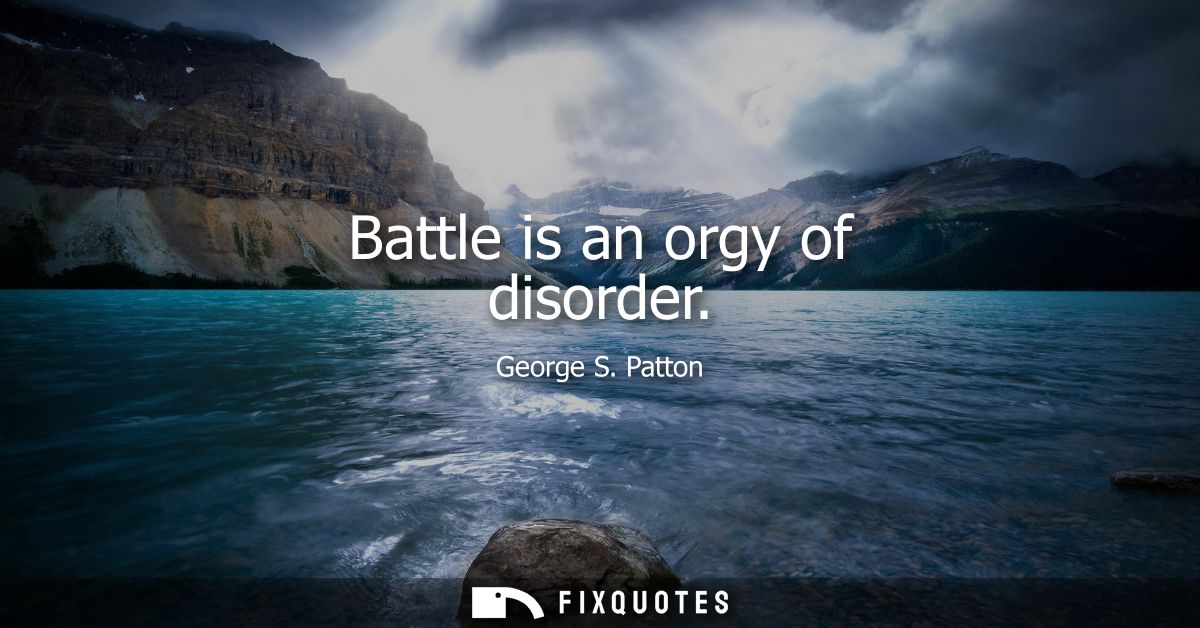
"Battle is an orgy of disorder"
About this Quote
Patton’s line lands like a slap because it refuses the clean, upholstered language that usually wraps war in honor. “Battle” isn’t “glory” or even “combat.” It’s an “orgy”: a word that yanks the listener out of martial pageantry and into something sweaty, compulsive, and indiscriminate. Then comes the real inversion: not an orgy of courage or sacrifice, but of “disorder.” Patton isn’t romanticizing chaos; he’s admitting its allure and its inevitability.
The intent is practical, not poetic. Patton spent his career trying to impose speed, discipline, and aggression on a medium that punishes planning. Calling battle an “orgy” is a way of inoculating soldiers against the fantasy of control. It’s also a warning to commanders: once the shooting starts, friction multiplies, information breaks, and “clean” decisions become dirty improvisations. If you expect order, you freeze; if you expect disorder, you move.
The subtext carries Patton’s most controversial edge: his fascination with war’s visceral charge. The line acknowledges that battle can intoxicate, that men can be pulled toward the surge of permission it grants - violence, risk, dominance, survival stripped of ordinary rules. That frankness is part of Patton’s rhetorical power and his moral hazard.
Context matters: a World War II general speaking from an era of mechanized slaughter and rapid maneuver. In that environment, disorder wasn’t a bug; it was the operating system. Patton’s genius was treating chaos as the terrain and making audacity a form of navigation.
The intent is practical, not poetic. Patton spent his career trying to impose speed, discipline, and aggression on a medium that punishes planning. Calling battle an “orgy” is a way of inoculating soldiers against the fantasy of control. It’s also a warning to commanders: once the shooting starts, friction multiplies, information breaks, and “clean” decisions become dirty improvisations. If you expect order, you freeze; if you expect disorder, you move.
The subtext carries Patton’s most controversial edge: his fascination with war’s visceral charge. The line acknowledges that battle can intoxicate, that men can be pulled toward the surge of permission it grants - violence, risk, dominance, survival stripped of ordinary rules. That frankness is part of Patton’s rhetorical power and his moral hazard.
Context matters: a World War II general speaking from an era of mechanized slaughter and rapid maneuver. In that environment, disorder wasn’t a bug; it was the operating system. Patton’s genius was treating chaos as the terrain and making audacity a form of navigation.
Quote Details
| Topic | War |
|---|---|
| Source | Help us find the source |
| Cite |
Citation Formats
APA Style (7th ed.)
Patton, George S. (2026, January 18). Battle is an orgy of disorder. FixQuotes. https://fixquotes.com/quotes/battle-is-an-orgy-of-disorder-17767/
Chicago Style
Patton, George S. "Battle is an orgy of disorder." FixQuotes. January 18, 2026. https://fixquotes.com/quotes/battle-is-an-orgy-of-disorder-17767/.
MLA Style (9th ed.)
"Battle is an orgy of disorder." FixQuotes, 18 Jan. 2026, https://fixquotes.com/quotes/battle-is-an-orgy-of-disorder-17767/. Accessed 28 Mar. 2026.
More Quotes by George
Add to List