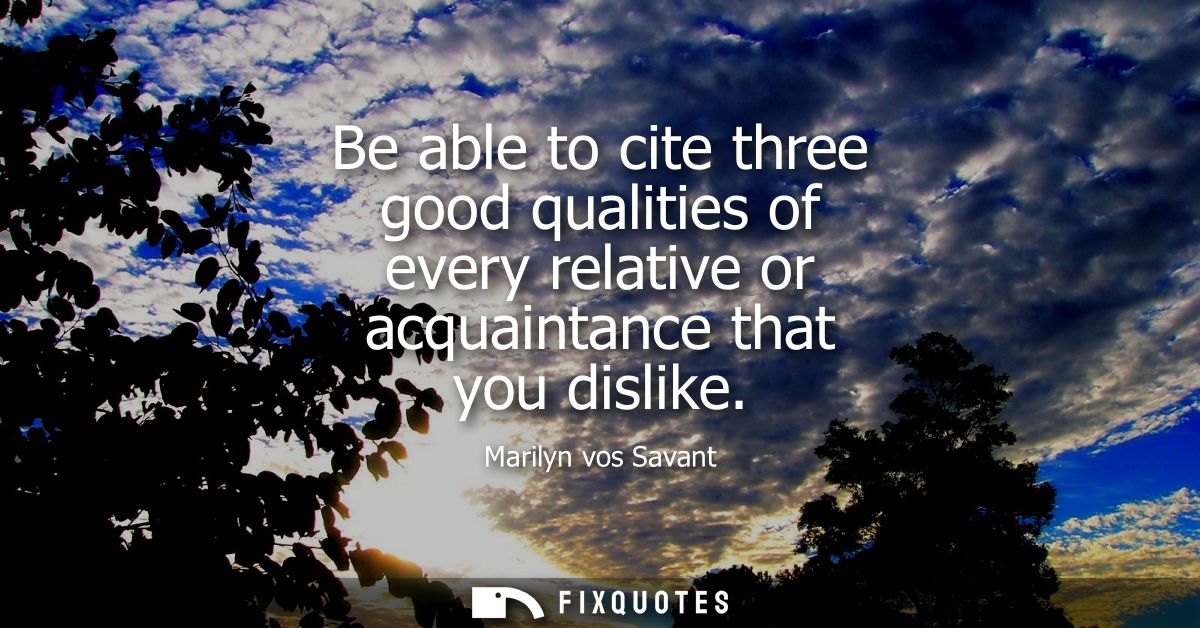
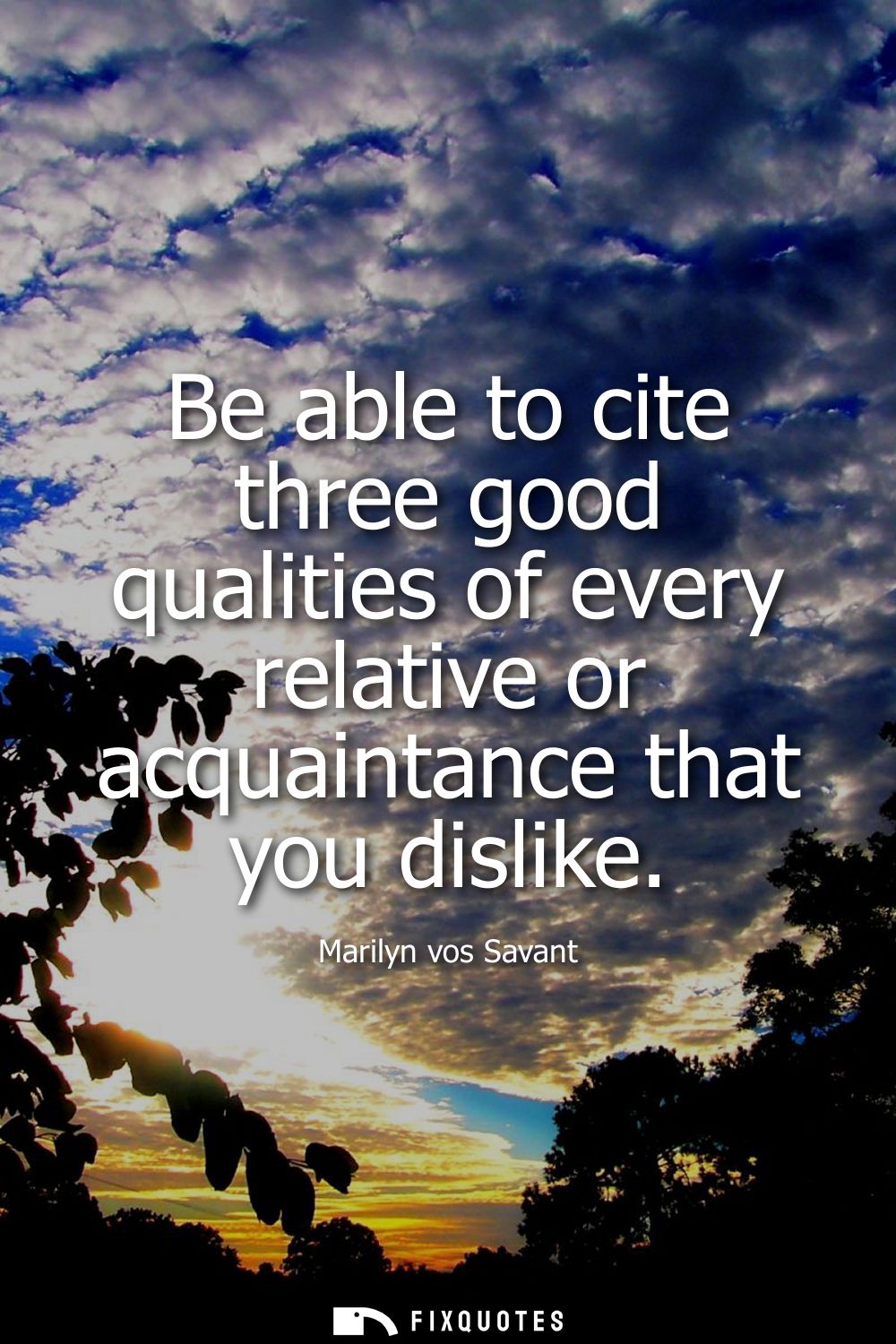
"Be able to cite three good qualities of every relative or acquaintance that you dislike"
About this Quote
The intent is self-defense as much as moral discipline. Dislike is addictive because it simplifies the social world: you get a villain, you get a story, you get to feel sharper than the room. “Be able to cite” treats your opinion like a claim you’d have to substantiate in public. It turns private loathing into something accountable, even falsifiable. You don’t have to approve of them; you have to demonstrate you’ve perceived them accurately.
The subtext is quietly skeptical about our certainty. Vos Savant, famous for being cast as a high-IQ oracle, uses that authority to puncture the smugness of being “right” about people. Intelligence here isn’t weaponry; it’s a discipline of attention. The quote also assumes the unavoidable social web of relatives and acquaintances, the people you can’t simply block. In that context, this is a strategy for living without constant psychic friction: if you can name their three good qualities, you can hold your boundaries without turning every gathering into a private referendum on your superiority.
It’s not forgiveness. It’s precision. And precision, in social life, is mercy with teeth.
Quote Details
| Topic | Forgiveness |
|---|---|
| Source | Help us find the source |
| Cite |
Citation Formats
APA Style (7th ed.)
Savant, Marilyn vos. (2026, January 15). Be able to cite three good qualities of every relative or acquaintance that you dislike. FixQuotes. https://fixquotes.com/quotes/be-able-to-cite-three-good-qualities-of-every-162426/
Chicago Style
Savant, Marilyn vos. "Be able to cite three good qualities of every relative or acquaintance that you dislike." FixQuotes. January 15, 2026. https://fixquotes.com/quotes/be-able-to-cite-three-good-qualities-of-every-162426/.
MLA Style (9th ed.)
"Be able to cite three good qualities of every relative or acquaintance that you dislike." FixQuotes, 15 Jan. 2026, https://fixquotes.com/quotes/be-able-to-cite-three-good-qualities-of-every-162426/. Accessed 8 Apr. 2026.