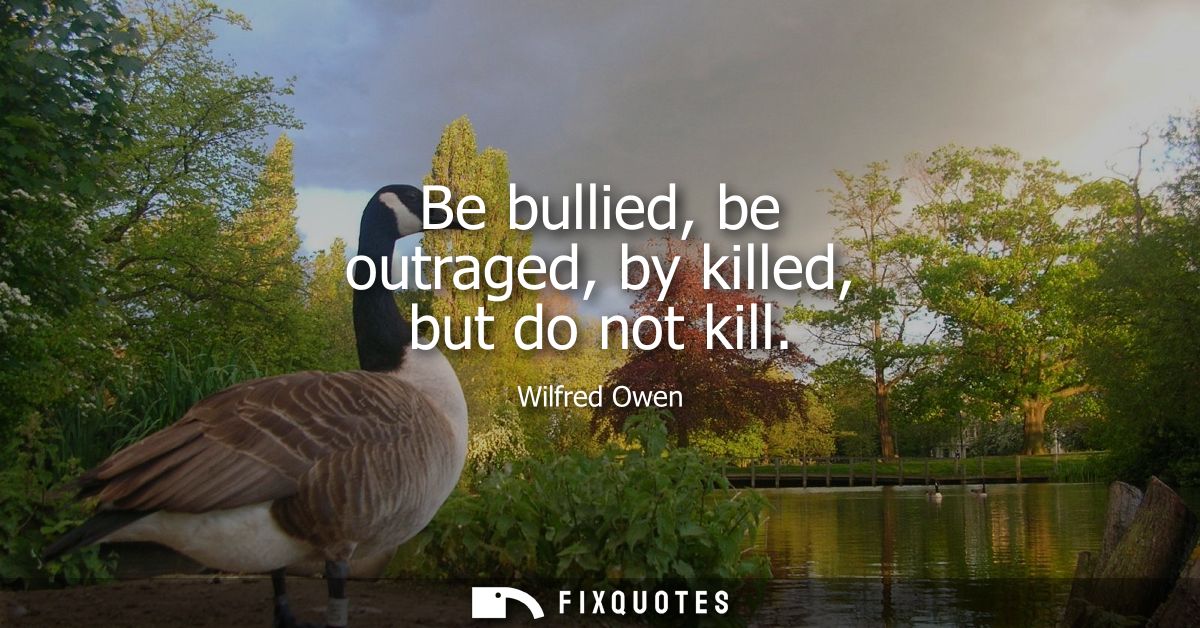
"Be bullied, be outraged, by killed, but do not kill"
About this Quote
Owen’s line refuses the clean moral symmetry war depends on. It’s not “turn the other cheek” as piety; it’s a trench-born rejection of the machine that converts frightened bodies into sanctioned killers. The phrasing is jagged, almost breathless: “Be bullied, be outraged, by killed” (with its likely intended “be killed”) piles humiliations into a single grim permission slip. Anything can happen to you - coercion, indignity, death - and still, he insists, do not cross the final threshold. That escalation is the point: he’s naming the full spectrum of violence a soldier is expected to absorb, then drawing one hard line against retaliation.
The subtext is an attack on the rhetoric of duty and honor that made murder feel like maturity. Owen, writing out of World War I’s industrialized slaughter, understood how quickly moral agency gets outsourced: orders, uniforms, slogans, the soft narcotic of “they started it.” His imperative doesn’t romanticize victimhood; it exposes how war moralizes killing by framing it as self-defense for nation, comrades, or civilization. He strips those justifications down to their raw exchange rate: your life for someone else’s, paid on command.
Context matters because Owen wasn’t preaching from safety. As a soldier-poet, he had to reconcile intimacy with death - the bodies beside him - with the larger lie that this was noble work. The line reads like an act of sabotage against recruitment posters: a refusal to let suffering be used as a coupon for cruelty.
The subtext is an attack on the rhetoric of duty and honor that made murder feel like maturity. Owen, writing out of World War I’s industrialized slaughter, understood how quickly moral agency gets outsourced: orders, uniforms, slogans, the soft narcotic of “they started it.” His imperative doesn’t romanticize victimhood; it exposes how war moralizes killing by framing it as self-defense for nation, comrades, or civilization. He strips those justifications down to their raw exchange rate: your life for someone else’s, paid on command.
Context matters because Owen wasn’t preaching from safety. As a soldier-poet, he had to reconcile intimacy with death - the bodies beside him - with the larger lie that this was noble work. The line reads like an act of sabotage against recruitment posters: a refusal to let suffering be used as a coupon for cruelty.
Quote Details
| Topic | Peace |
|---|---|
| Source | Help us find the source |
| Cite |
Citation Formats
APA Style (7th ed.)
Owen, Wilfred. (2026, January 15). Be bullied, be outraged, by killed, but do not kill. FixQuotes. https://fixquotes.com/quotes/be-bullied-be-outraged-by-killed-but-do-not-kill-24536/
Chicago Style
Owen, Wilfred. "Be bullied, be outraged, by killed, but do not kill." FixQuotes. January 15, 2026. https://fixquotes.com/quotes/be-bullied-be-outraged-by-killed-but-do-not-kill-24536/.
MLA Style (9th ed.)
"Be bullied, be outraged, by killed, but do not kill." FixQuotes, 15 Jan. 2026, https://fixquotes.com/quotes/be-bullied-be-outraged-by-killed-but-do-not-kill-24536/. Accessed 18 Mar. 2026.
More Quotes by Wilfred
Add to List