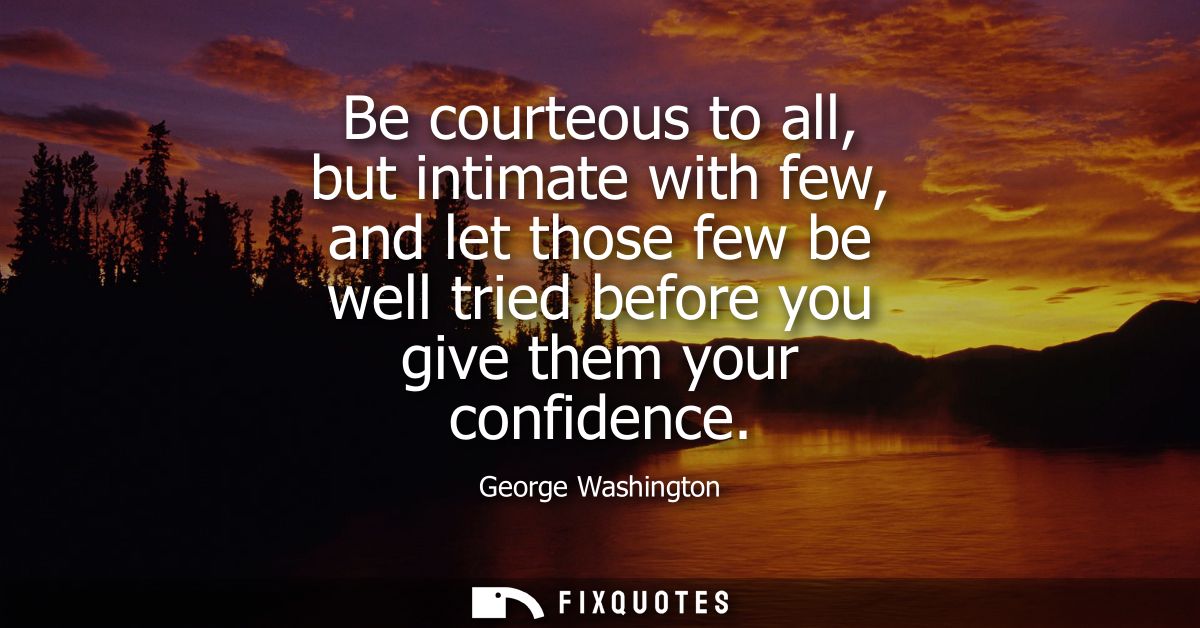
"Be courteous to all, but intimate with few, and let those few be well tried before you give them your confidence"
About this Quote
Courtesy is Washington’s velvet glove; control is the iron hand inside it. On the surface, he’s offering a clean piece of republican etiquette: treat everyone decently, keep your inner circle small, vet them hard. The deeper intent is governance-by-boundary. In a young nation where reputations were currency and politics ran on personal loyalty, “intimate with few” reads less like shyness than strategy: a warning that access is power, and power attracts opportunists.
The subtext is shaped by Washington’s entire career as a reluctant icon forced to manage ambition around him. He had watched factions form, watched wartime alliances fray, watched the costs of misplaced trust. “Well tried” is the key phrase: trust is not owed, it’s stress-tested. It’s also a quiet rebuke to charisma and impulsive camaraderie. Washington isn’t romantic about friendship; he’s managerial. Even intimacy is treated like an appointment you earn.
Context matters because early American political culture was intensely interpersonal. There were few stable institutions, no long-established parties at the start, and constant anxiety that the Revolution could be undone by vanity, foreign influence, or internal sabotage. Washington’s advice functions as civic self-defense: keep the public square civil so the experiment doesn’t devolve into vendetta, but don’t confuse politeness with permission. It’s a blueprint for leadership in a fragile republic: be accessible enough to unify, guarded enough to survive.
The subtext is shaped by Washington’s entire career as a reluctant icon forced to manage ambition around him. He had watched factions form, watched wartime alliances fray, watched the costs of misplaced trust. “Well tried” is the key phrase: trust is not owed, it’s stress-tested. It’s also a quiet rebuke to charisma and impulsive camaraderie. Washington isn’t romantic about friendship; he’s managerial. Even intimacy is treated like an appointment you earn.
Context matters because early American political culture was intensely interpersonal. There were few stable institutions, no long-established parties at the start, and constant anxiety that the Revolution could be undone by vanity, foreign influence, or internal sabotage. Washington’s advice functions as civic self-defense: keep the public square civil so the experiment doesn’t devolve into vendetta, but don’t confuse politeness with permission. It’s a blueprint for leadership in a fragile republic: be accessible enough to unify, guarded enough to survive.
Quote Details
| Topic | Friendship |
|---|---|
| Source | From "Rules of Civility & Decent Behaviour in Company and Conversation" , copied by George Washington in his youth (mid-18th century). |
More Quotes by George
Add to List