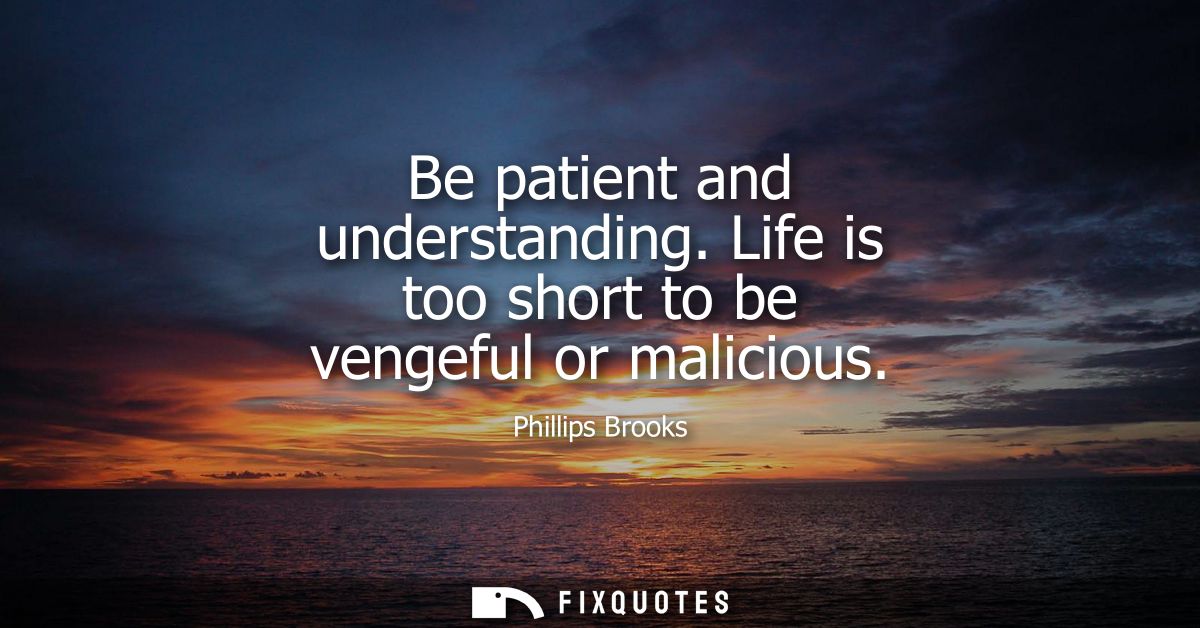
"Be patient and understanding. Life is too short to be vengeful or malicious"
About this Quote
The intent is pastoral triage. Brooks is addressing ordinary people, not saints, offering a portable ethic for daily frictions: family feuds, social slights, the slow burn of resentment. The subtext is that anger feels righteous, even energizing, but it quietly conscripts your limited attention. “Be patient and understanding” redirects that energy from punishment to perception, implying that most harms look different when you account for fear, ignorance, or pain on the other side.
Context matters: Brooks preached after the Civil War, in a country trying to stitch itself together while industrial life accelerated and social roles hardened. Forgiveness becomes not a private virtue but a stabilizing public posture. He’s also softening the hard edge of Christian moralism; rather than threatening hellfire, he appeals to mortality and wasted days. That’s why it works: it doesn’t merely demand goodness. It makes bitterness feel small.
Quote Details
| Topic | Forgiveness |
|---|---|
| Source | Help us find the source |
| Cite |
Citation Formats
APA Style (7th ed.)
Brooks, Phillips. (2026, January 15). Be patient and understanding. Life is too short to be vengeful or malicious. FixQuotes. https://fixquotes.com/quotes/be-patient-and-understanding-life-is-too-short-to-91432/
Chicago Style
Brooks, Phillips. "Be patient and understanding. Life is too short to be vengeful or malicious." FixQuotes. January 15, 2026. https://fixquotes.com/quotes/be-patient-and-understanding-life-is-too-short-to-91432/.
MLA Style (9th ed.)
"Be patient and understanding. Life is too short to be vengeful or malicious." FixQuotes, 15 Jan. 2026, https://fixquotes.com/quotes/be-patient-and-understanding-life-is-too-short-to-91432/. Accessed 13 Feb. 2026.