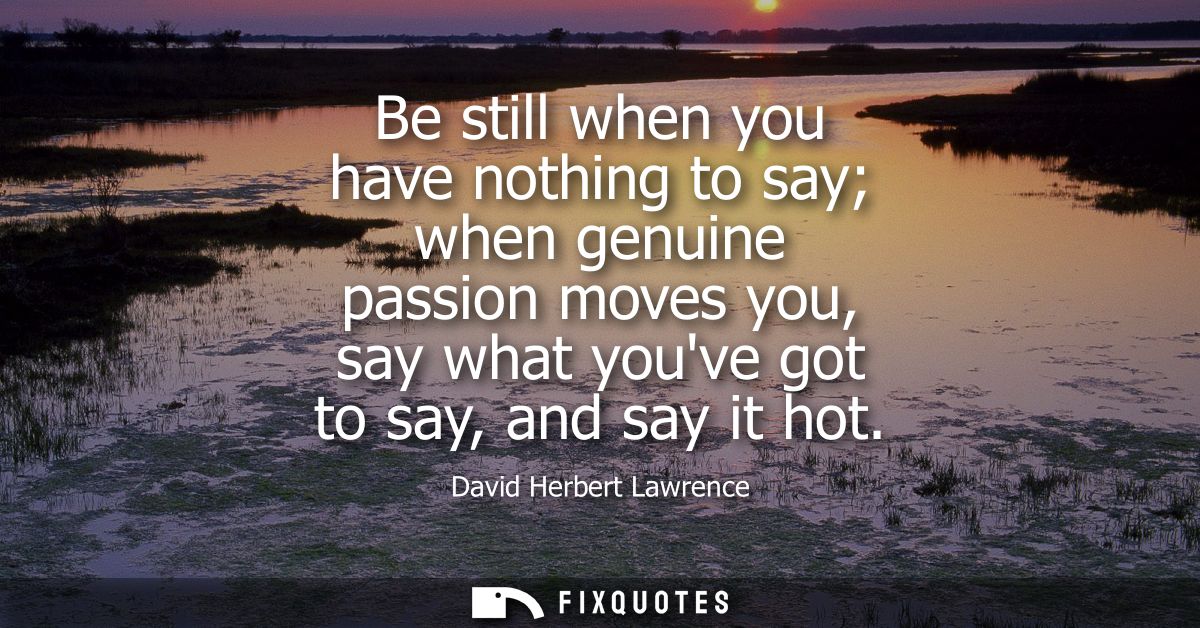
"Be still when you have nothing to say; when genuine passion moves you, say what you've got to say, and say it hot"
About this Quote
The phrasing matters. "Genuine" is doing defensive work, policing the difference between real feeling and the counterfeit emotions people deploy to be interesting, acceptable, or safe. Lawrence’s era was saturated with that safety. Writing against Victorian manners and the social machinery that kept desire and anger house-trained, he argues for speech that has body heat. "Say it hot" is his anti-decorum credo: don’t cool the sentence down to spare other people’s comfort, don’t sand off the sharpness that proves you mean it.
Subtextually, it’s also a warning about verbosity as cowardice. If you can always keep talking, you never have to risk saying the one thing that might cost you. Lawrence insists that the right to speak is earned by stakes. Silence isn’t passivity here; it’s the pressure building before the honest outburst. In a culture that prizes constant commentary, the quote still lands like a rebuke: either speak from the core, or don’t speak at all.
Quote Details
| Topic | Wisdom |
|---|---|
| Source | Help us find the source |
| Cite |
Citation Formats
APA Style (7th ed.)
Lawrence, David Herbert. (2026, January 18). Be still when you have nothing to say; when genuine passion moves you, say what you've got to say, and say it hot. FixQuotes. https://fixquotes.com/quotes/be-still-when-you-have-nothing-to-say-when-6482/
Chicago Style
Lawrence, David Herbert. "Be still when you have nothing to say; when genuine passion moves you, say what you've got to say, and say it hot." FixQuotes. January 18, 2026. https://fixquotes.com/quotes/be-still-when-you-have-nothing-to-say-when-6482/.
MLA Style (9th ed.)
"Be still when you have nothing to say; when genuine passion moves you, say what you've got to say, and say it hot." FixQuotes, 18 Jan. 2026, https://fixquotes.com/quotes/be-still-when-you-have-nothing-to-say-when-6482/. Accessed 12 Feb. 2026.