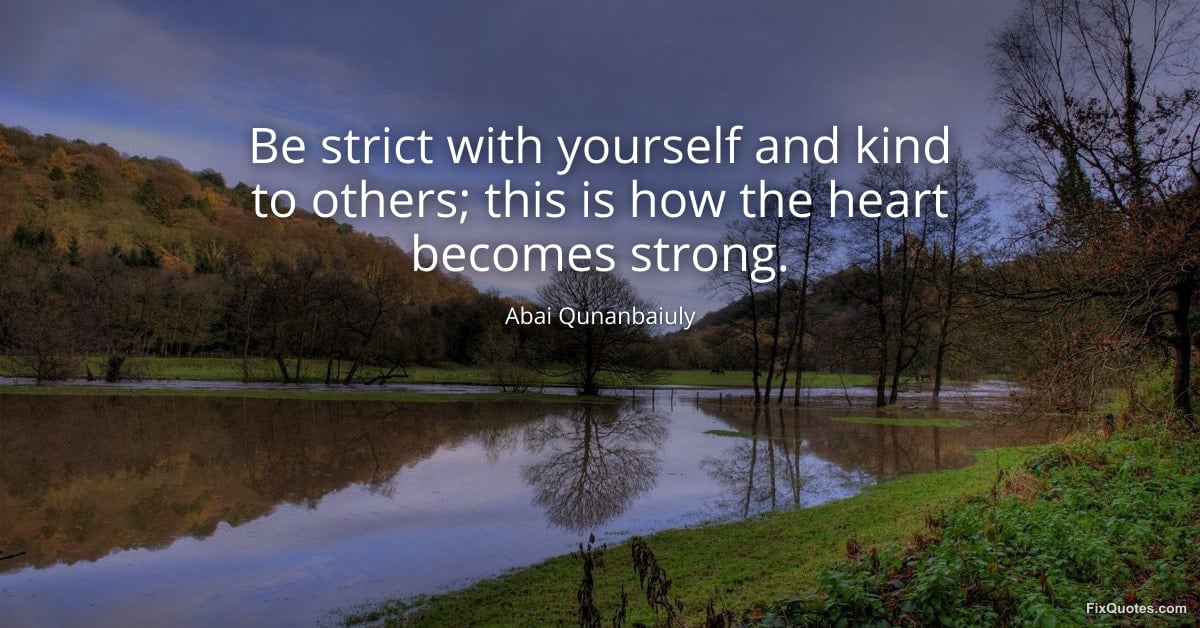
"Be strict with yourself and kind to others; this is how the heart becomes strong"
About this Quote
The subtext is quietly political. In a society shaped by hierarchy, clan pressure, and the temptations of status, “strict with yourself” reads as resistance to complacency and corruption: don’t outsource your conscience to custom. “Kind to others” blocks the other easy path, moral superiority, where self-improvement becomes a pretext to police everyone else. Abai stitches the two together because either virtue, alone, can become a vice: strictness without kindness curdles into tyranny; kindness without strictness becomes indulgence dressed up as goodness.
Context matters: Abai wrote at a cultural crossroads, pushing Kazakh society toward literacy, ethical self-scrutiny, and engagement with broader intellectual traditions. His “heart” isn’t sentimental; it’s the seat of moral perception. A “strong” heart is one that can see clearly and act cleanly even when ego, honor, or resentment would rather take the wheel. The line works because it makes strength legible as self-governance, not self-display.
Quote Details
| Topic | Self-Discipline |
|---|---|
| Source | The Book of Words (Kara Sozder), ethical guidance, 19th century. [translated] |
| Cite |
Citation Formats
APA Style (7th ed.)
Qunanbaiuly, Abai. (2026, February 14). Be strict with yourself and kind to others; this is how the heart becomes strong. FixQuotes. https://fixquotes.com/quotes/be-strict-with-yourself-and-kind-to-others-this-185315/
Chicago Style
Qunanbaiuly, Abai. "Be strict with yourself and kind to others; this is how the heart becomes strong." FixQuotes. February 14, 2026. https://fixquotes.com/quotes/be-strict-with-yourself-and-kind-to-others-this-185315/.
MLA Style (9th ed.)
"Be strict with yourself and kind to others; this is how the heart becomes strong." FixQuotes, 14 Feb. 2026, https://fixquotes.com/quotes/be-strict-with-yourself-and-kind-to-others-this-185315/. Accessed 28 Mar. 2026.