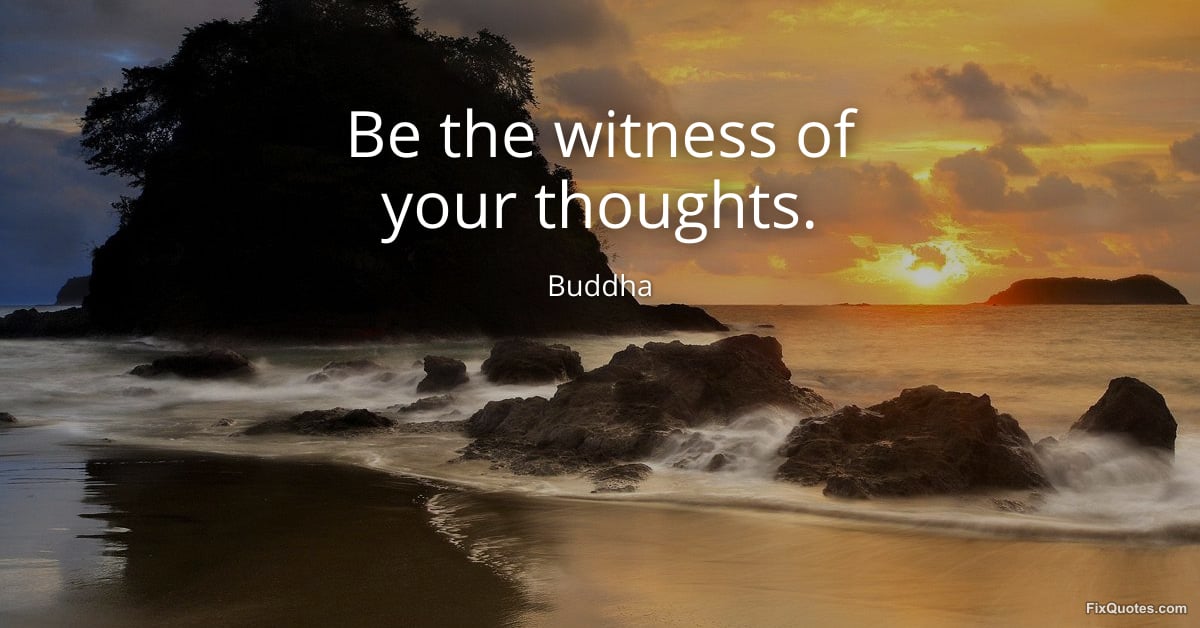
"Be the witness of your thoughts"
About this Quote
Four words, and an entire philosophy of freedom opens up.
"Be the witness of your thoughts" carries the authority of a leader, but not in the usual register of command or conquest. Buddha is not asking for belief; he is prescribing a discipline. The sentence turns on a quiet but radical separation: you are not your thoughts. You are the one who can observe them. That distinction is the engine of Buddhist practice, and it lands with unusual force because it cuts against ordinary human experience. Most of us do not watch thought; we live inside it, dragged around by fear, craving, resentment, fantasy.
The subtext is a critique of ego without ever naming ego. If thoughts can be witnessed, then anger, envy, or desire lose some of their claim to being the self. They become events, not identity. That is why the line has endured beyond religious context and migrated so easily into modern psychology, meditation apps, and therapeutic language. It offers a method for loosening suffering at its source: not by suppressing the mind, but by changing one's relationship to it.
Its rhetorical power comes from its simplicity. "Witness" is a morally charged word. A witness does not immediately interfere, justify, or embellish; a witness attends. In a culture that rewards reaction, performance, and instant certainty, the line feels almost rebellious. Its original context is the Buddha's broader project of liberation from attachment and illusion. The deeper promise is not calm for its own sake, but clarity - the kind that makes compassion and self-mastery possible.
"Be the witness of your thoughts" carries the authority of a leader, but not in the usual register of command or conquest. Buddha is not asking for belief; he is prescribing a discipline. The sentence turns on a quiet but radical separation: you are not your thoughts. You are the one who can observe them. That distinction is the engine of Buddhist practice, and it lands with unusual force because it cuts against ordinary human experience. Most of us do not watch thought; we live inside it, dragged around by fear, craving, resentment, fantasy.
The subtext is a critique of ego without ever naming ego. If thoughts can be witnessed, then anger, envy, or desire lose some of their claim to being the self. They become events, not identity. That is why the line has endured beyond religious context and migrated so easily into modern psychology, meditation apps, and therapeutic language. It offers a method for loosening suffering at its source: not by suppressing the mind, but by changing one's relationship to it.
Its rhetorical power comes from its simplicity. "Witness" is a morally charged word. A witness does not immediately interfere, justify, or embellish; a witness attends. In a culture that rewards reaction, performance, and instant certainty, the line feels almost rebellious. Its original context is the Buddha's broader project of liberation from attachment and illusion. The deeper promise is not calm for its own sake, but clarity - the kind that makes compassion and self-mastery possible.
Quote Details
| Topic | Meditation |
|---|---|
| Source | Gautama Buddha (2017). “Zen Kittens”, p.35, Mango Media Inc. |
| Cite |
Citation Formats
APA Style (7th ed.)
Buddha. (2026, March 10). Be the witness of your thoughts. FixQuotes. https://fixquotes.com/quotes/be-the-witness-of-your-thoughts-185965/
Chicago Style
Buddha. "Be the witness of your thoughts." FixQuotes. March 10, 2026. https://fixquotes.com/quotes/be-the-witness-of-your-thoughts-185965/.
MLA Style (9th ed.)
"Be the witness of your thoughts." FixQuotes, 10 Mar. 2026, https://fixquotes.com/quotes/be-the-witness-of-your-thoughts-185965/. Accessed 3 Apr. 2026.
More Quotes by Buddha
Add to List