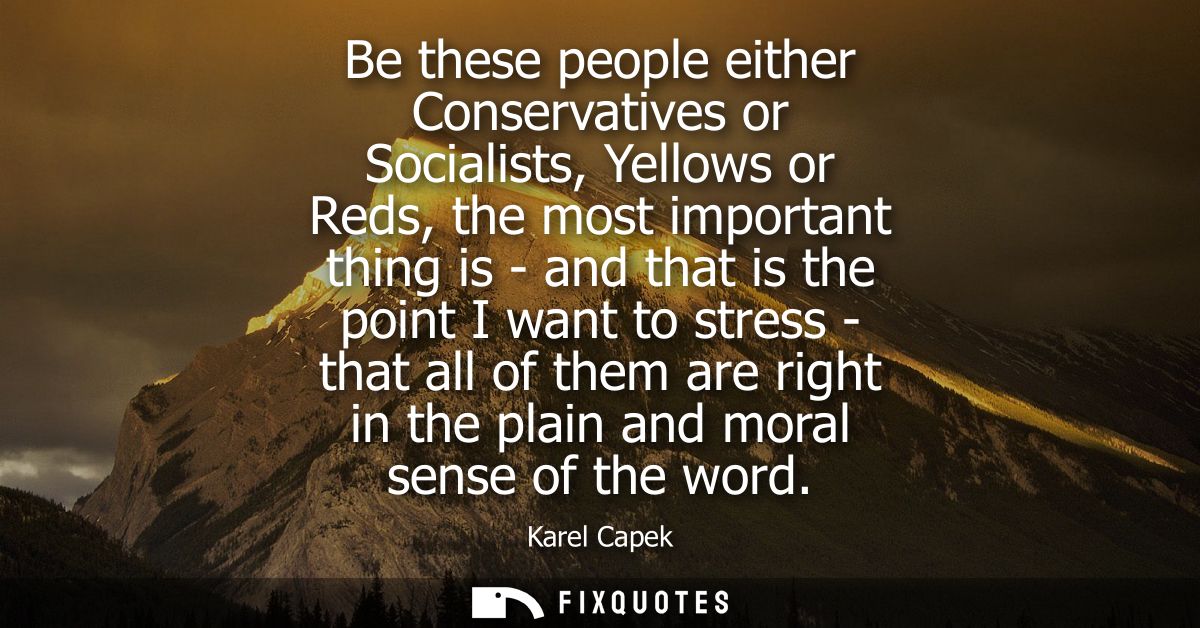
"Be these people either Conservatives or Socialists, Yellows or Reds, the most important thing is - and that is the point I want to stress - that all of them are right in the plain and moral sense of the word"
About this Quote
The intent is not naïve pluralism; it’s a warning about how easy it is to outsource conscience to a camp. Capek, writing in an interwar Europe where ideologies were rapidly hardening into totalizing identities, understands that people often enter movements from recognizably moral motives: fairness, security, solidarity, dignity. His emphasis (“and that is the point I want to stress”) performs impatience with pundit logic, the kind that treats opposing voters as either dupes or monsters.
The subtext is double-edged. Granting moral sincerity to all sides is both generous and accusatory: generous because it humanizes opponents; accusatory because it implies that moral sincerity is precisely what makes mass politics dangerous. When everyone feels “right,” compromise looks like betrayal and violence can start to feel like ethics. Capek’s craft is to praise “plain” morality while quietly suggesting that, unexamined, it can be the raw material of catastrophe.
Quote Details
| Topic | Ethics & Morality |
|---|---|
| Source | Help us find the source |
| Cite |
Citation Formats
APA Style (7th ed.)
Capek, Karel. (2026, January 17). Be these people either Conservatives or Socialists, Yellows or Reds, the most important thing is - and that is the point I want to stress - that all of them are right in the plain and moral sense of the word. FixQuotes. https://fixquotes.com/quotes/be-these-people-either-conservatives-or-62278/
Chicago Style
Capek, Karel. "Be these people either Conservatives or Socialists, Yellows or Reds, the most important thing is - and that is the point I want to stress - that all of them are right in the plain and moral sense of the word." FixQuotes. January 17, 2026. https://fixquotes.com/quotes/be-these-people-either-conservatives-or-62278/.
MLA Style (9th ed.)
"Be these people either Conservatives or Socialists, Yellows or Reds, the most important thing is - and that is the point I want to stress - that all of them are right in the plain and moral sense of the word." FixQuotes, 17 Jan. 2026, https://fixquotes.com/quotes/be-these-people-either-conservatives-or-62278/. Accessed 2 Apr. 2026.