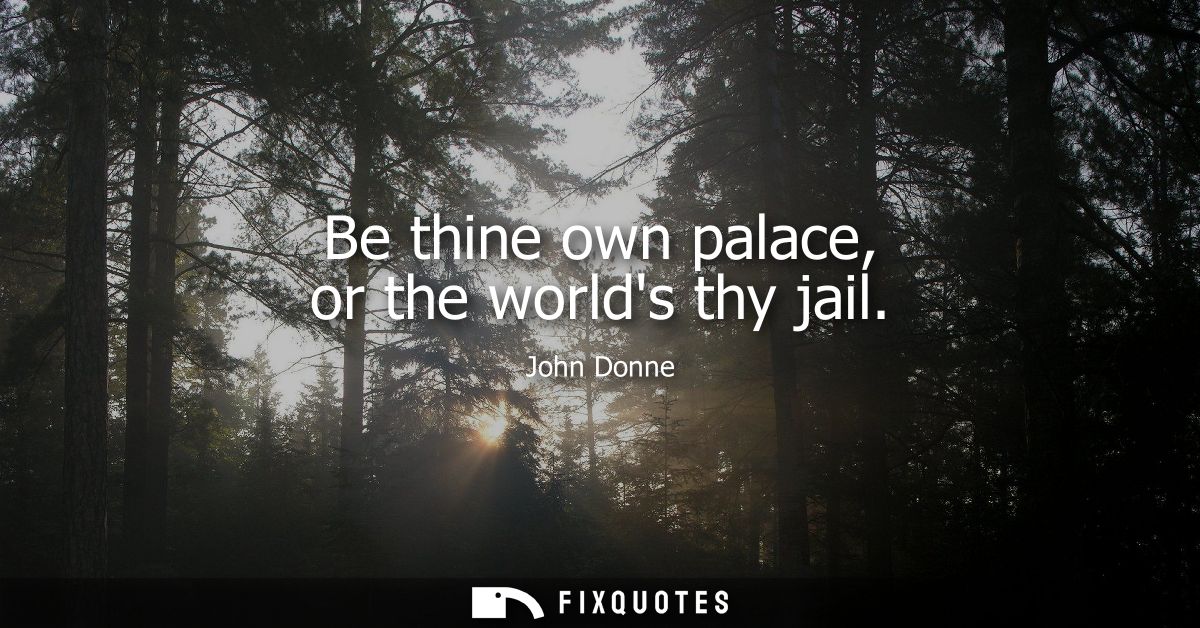
"Be thine own palace, or the world's thy jail"
About this Quote
Self-rule or captivity: Donne compresses an entire spiritual biography into a single hinge of a line. "Be thine own palace" isn’t just self-help before self-help; it’s a demand for inner sovereignty in a world that loves to define you by rank, institution, and surveillance. The alternative lands hard: "the world’s thy jail". Donne’s genius is the blunt conditional. If you don’t build an interior realm sturdy enough to live in, the exterior realm will happily supply bars, rules, and wardens.
The word "palace" matters. It’s not a cottage of modest contentment; it’s architecture, discipline, governance. A palace implies rooms you control, a court you preside over, boundaries that keep chaos out. Donne, writing in an England crowded with religious tests, political intrigue, and public punishment, knew how quickly the social order could turn claustrophobic. His own life moved through real precarity: a Catholic upbringing under Protestant power, professional ambition tangled with faith, later the authority of the pulpit. He’s speaking as someone who’s felt the state, the church, and gossip press in.
Subtext: freedom is not granted by the world; it’s cultivated against the world. The line flatters no one. Donne implies that captivity isn’t only imposed; it’s often invited by dependence, conformity, and the craving for external permission. The couplet-sized threat is what makes it work: become your own seat of power, or prepare to live in someone else’s system.
The word "palace" matters. It’s not a cottage of modest contentment; it’s architecture, discipline, governance. A palace implies rooms you control, a court you preside over, boundaries that keep chaos out. Donne, writing in an England crowded with religious tests, political intrigue, and public punishment, knew how quickly the social order could turn claustrophobic. His own life moved through real precarity: a Catholic upbringing under Protestant power, professional ambition tangled with faith, later the authority of the pulpit. He’s speaking as someone who’s felt the state, the church, and gossip press in.
Subtext: freedom is not granted by the world; it’s cultivated against the world. The line flatters no one. Donne implies that captivity isn’t only imposed; it’s often invited by dependence, conformity, and the craving for external permission. The couplet-sized threat is what makes it work: become your own seat of power, or prepare to live in someone else’s system.
Quote Details
| Topic | Wisdom |
|---|
More Quotes by John
Add to List