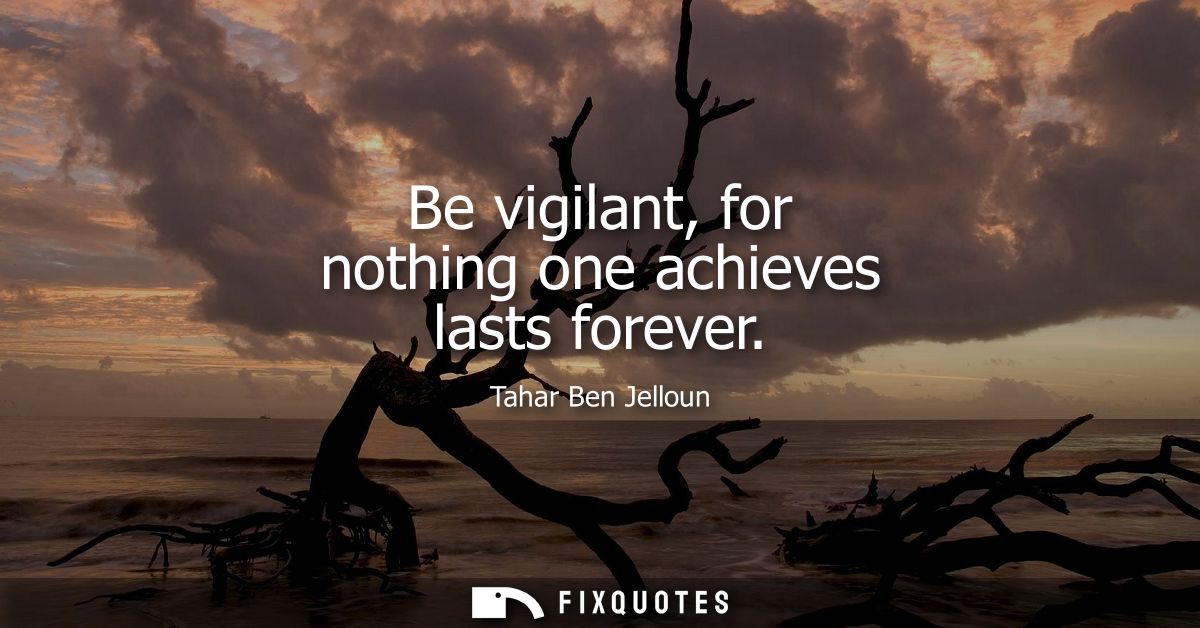
"Be vigilant, for nothing one achieves lasts forever"
About this Quote
“Be vigilant” lands like a hand on the shoulder: not a warm reassurance but a bracing correction to our culture’s addiction to milestones. Ben Jelloun, a poet who’s spent decades writing about displacement, identity, and the quiet violences of power, chooses vigilance over hope because hope can be passive. Vigilance implies upkeep: the daily, sometimes exhausting labor of defending what you’ve built, whether that’s a relationship, a reputation, a political gain, or a hard-won inner peace.
The second clause is the sting: “nothing one achieves lasts forever.” It isn’t nihilism so much as a refusal of the trophy mentality. Achievements are usually framed as endpoints; Ben Jelloun treats them as temporary shelters. The subtext is political as much as personal: rights can be rolled back, democracies can rot from within, social progress can be reversed by the next news cycle’s fear campaign. That’s a familiar lesson in postcolonial contexts, where “independence” doesn’t magically end exploitation, and where memory itself is contested terrain.
There’s also a poet’s instinct for time as an antagonist. The line quietly mocks the modern self-help fantasy of permanent arrival: the idea that if you grind hard enough, you get to stop being afraid. Ben Jelloun insists the opposite: permanence is a comforting myth, and myths are where complacency breeds. Vigilance, then, isn’t paranoia; it’s lucidity. It asks you to treat every victory as provisional, not to cheapen it, but to keep it alive.
The second clause is the sting: “nothing one achieves lasts forever.” It isn’t nihilism so much as a refusal of the trophy mentality. Achievements are usually framed as endpoints; Ben Jelloun treats them as temporary shelters. The subtext is political as much as personal: rights can be rolled back, democracies can rot from within, social progress can be reversed by the next news cycle’s fear campaign. That’s a familiar lesson in postcolonial contexts, where “independence” doesn’t magically end exploitation, and where memory itself is contested terrain.
There’s also a poet’s instinct for time as an antagonist. The line quietly mocks the modern self-help fantasy of permanent arrival: the idea that if you grind hard enough, you get to stop being afraid. Ben Jelloun insists the opposite: permanence is a comforting myth, and myths are where complacency breeds. Vigilance, then, isn’t paranoia; it’s lucidity. It asks you to treat every victory as provisional, not to cheapen it, but to keep it alive.
Quote Details
| Topic | Wisdom |
|---|
More Quotes by Tahar
Add to List