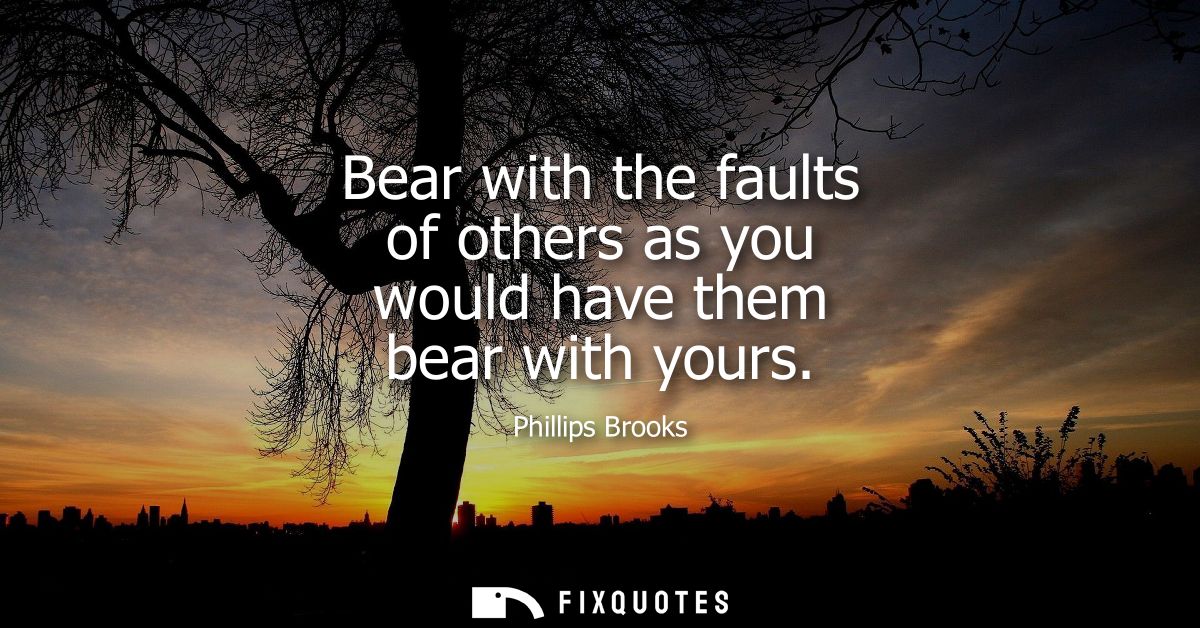
"Bear with the faults of others, as you would have them bear with yours"
About this Quote
The subtext is an argument about symmetry. Brooks collapses the distance we like to keep between our mistakes (complicated, understandable, contextual) and other people’s mistakes (character flaws, proof of badness). He smuggles in a demand for moral imagination: picture yourself as the person who needs patience, not the person dispensing it. That’s hard precisely because it threatens a cherished identity - being the competent one, the considerate one, the one who’s right.
Context matters: Brooks preached during a period of booming cities, sharpened class distinctions, and thick social codes. In that world, “faults” were not just private quirks; they were social liabilities. His sentence works because it reframes tolerance as a form of self-knowledge. If you want mercy to be part of the ecosystem you live in, you have to seed it. The ethic isn’t sentimental; it’s pragmatic, almost ecological: grace survives only when it’s practiced, especially when it’s least convenient.
Quote Details
| Topic | Forgiveness |
|---|---|
| Source | Help us find the source |
| Cite |
Citation Formats
APA Style (7th ed.)
Brooks, Phillips. (2026, February 18). Bear with the faults of others, as you would have them bear with yours. FixQuotes. https://fixquotes.com/quotes/bear-with-the-faults-of-others-as-you-would-have-84688/
Chicago Style
Brooks, Phillips. "Bear with the faults of others, as you would have them bear with yours." FixQuotes. February 18, 2026. https://fixquotes.com/quotes/bear-with-the-faults-of-others-as-you-would-have-84688/.
MLA Style (9th ed.)
"Bear with the faults of others, as you would have them bear with yours." FixQuotes, 18 Feb. 2026, https://fixquotes.com/quotes/bear-with-the-faults-of-others-as-you-would-have-84688/. Accessed 1 Apr. 2026.