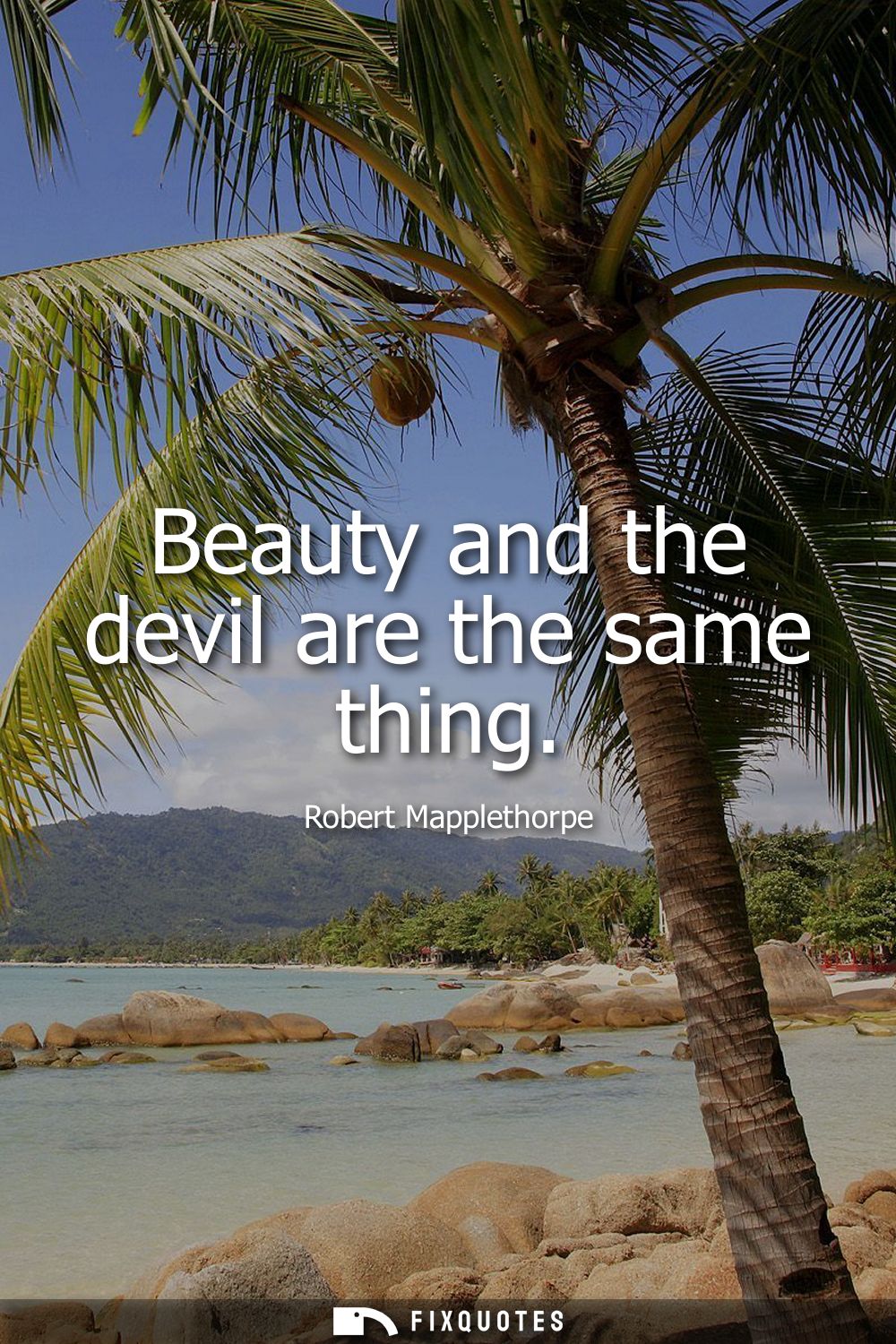
"Beauty and the devil are the same thing"
About this Quote
Mapplethorpe’s line lands like a clean blade: beauty isn’t a safe zone, it’s a contact high. Coming from a photographer who built his career on exquisitely lit flowers and exquisitely lit bodies, it reads less like goth provocation than an aesthetic principle. He’s naming the way “the beautiful” often arrives with heat, risk, and a little moral vertigo - the same electricity that cultures have historically stapled to the “devil” when desire won’t stay domesticated.
The intent is partly defensive and partly accusatory. Mapplethorpe was attacked not because his work lacked craft, but because it had too much of it: formal perfection applied to BDSM, queer sex, and Black male nudes. The subtext is: you don’t get to denounce the subject and keep the pleasure. If a photograph is ravishing, the viewer’s body responds before their politics do. That involuntary response is the “devil” - not Satan as theology, but temptation as evidence.
It also functions as a reversal of the old bargain where beauty is redeemed by purity. Mapplethorpe refuses to launder desire into acceptability; he insists the allure is inseparable from what polite society calls transgression. In the late-’80s culture wars around NEA funding and obscenity, this becomes a pointed cultural diagnosis: the scandal was never simply sex. It was the realization that classical composition, museum-grade elegance, and taboo can be identical - and that the border between art and “sin” is often just a bureaucratic line drawn after the fact.
The intent is partly defensive and partly accusatory. Mapplethorpe was attacked not because his work lacked craft, but because it had too much of it: formal perfection applied to BDSM, queer sex, and Black male nudes. The subtext is: you don’t get to denounce the subject and keep the pleasure. If a photograph is ravishing, the viewer’s body responds before their politics do. That involuntary response is the “devil” - not Satan as theology, but temptation as evidence.
It also functions as a reversal of the old bargain where beauty is redeemed by purity. Mapplethorpe refuses to launder desire into acceptability; he insists the allure is inseparable from what polite society calls transgression. In the late-’80s culture wars around NEA funding and obscenity, this becomes a pointed cultural diagnosis: the scandal was never simply sex. It was the realization that classical composition, museum-grade elegance, and taboo can be identical - and that the border between art and “sin” is often just a bureaucratic line drawn after the fact.
Quote Details
| Topic | Deep |
|---|---|
| Source | Help us find the source |
| Cite |
Citation Formats
APA Style (7th ed.)
Mapplethorpe, Robert. (2026, January 18). Beauty and the devil are the same thing. FixQuotes. https://fixquotes.com/quotes/beauty-and-the-devil-are-the-same-thing-4079/
Chicago Style
Mapplethorpe, Robert. "Beauty and the devil are the same thing." FixQuotes. January 18, 2026. https://fixquotes.com/quotes/beauty-and-the-devil-are-the-same-thing-4079/.
MLA Style (9th ed.)
"Beauty and the devil are the same thing." FixQuotes, 18 Jan. 2026, https://fixquotes.com/quotes/beauty-and-the-devil-are-the-same-thing-4079/. Accessed 23 Mar. 2026.
More Quotes by Robert
Add to List