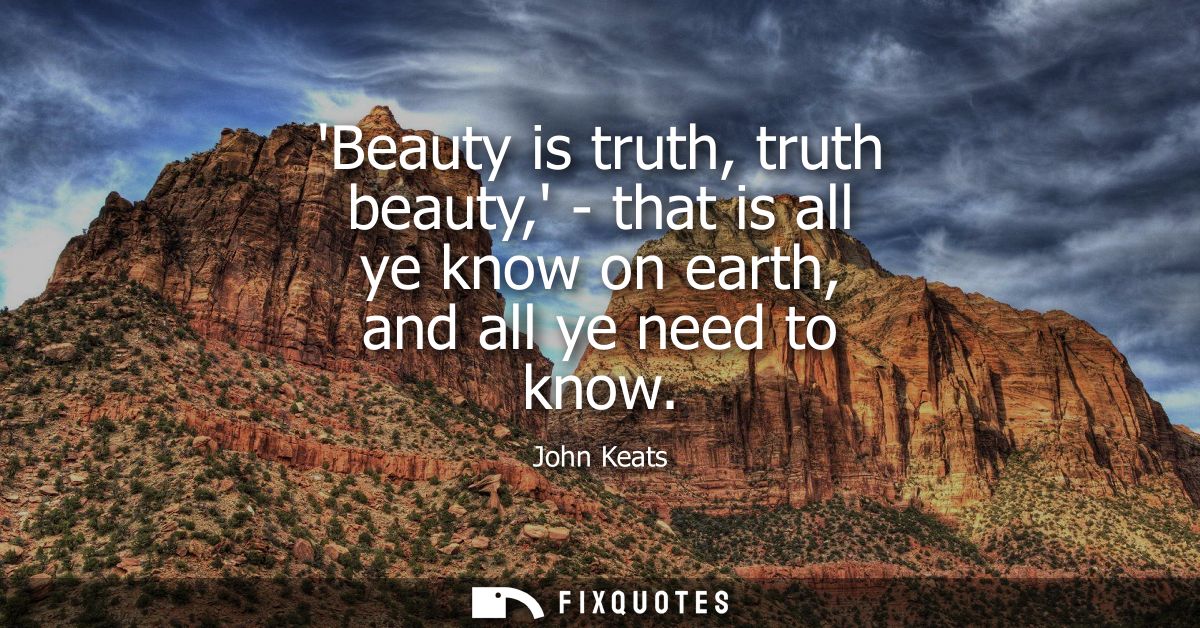
"'Beauty is truth, truth beauty,' - that is all ye know on earth, and all ye need to know"
About this Quote
The subtext is defensive as much as it is visionary. Keats is writing in a culture where scientific progress and industrial modernity are remaking what counts as knowledge. His move is to claim a rival epistemology: feeling, perception, and art aren’t ornamental; they’re foundational. The archaic “ye” helps stage this as pronouncement rather than opinion, a bit like scripture for people who’d rather kneel at a museum than a pulpit.
Context sharpens the provocation. The line appears at the end of “Ode on a Grecian Urn,” a poem about frozen scenes that outlast their makers. The urn offers no data, no narrative closure - just enduring form. Keats turns that limitation into a thesis: art’s stillness isn’t ignorance; it’s a different kind of knowing. The quote’s power comes from its audacity and its ambiguity, a mantra that keeps sounding profound even as you argue with it.
Quote Details
| Topic | Truth |
|---|---|
| Source | John Keats, Ode on a Grecian Urn (1819), final lines: 'Beauty is truth, truth beauty, that is all Ye know on earth, and all ye need to know.' |
| Cite |
Citation Formats
APA Style (7th ed.)
Keats, John. (2026, January 18). 'Beauty is truth, truth beauty,' - that is all ye know on earth, and all ye need to know. FixQuotes. https://fixquotes.com/quotes/beauty-is-truth-truth-beauty-that-is-all-ye-14690/
Chicago Style
Keats, John. "'Beauty is truth, truth beauty,' - that is all ye know on earth, and all ye need to know." FixQuotes. January 18, 2026. https://fixquotes.com/quotes/beauty-is-truth-truth-beauty-that-is-all-ye-14690/.
MLA Style (9th ed.)
"'Beauty is truth, truth beauty,' - that is all ye know on earth, and all ye need to know." FixQuotes, 18 Jan. 2026, https://fixquotes.com/quotes/beauty-is-truth-truth-beauty-that-is-all-ye-14690/. Accessed 10 Mar. 2026.