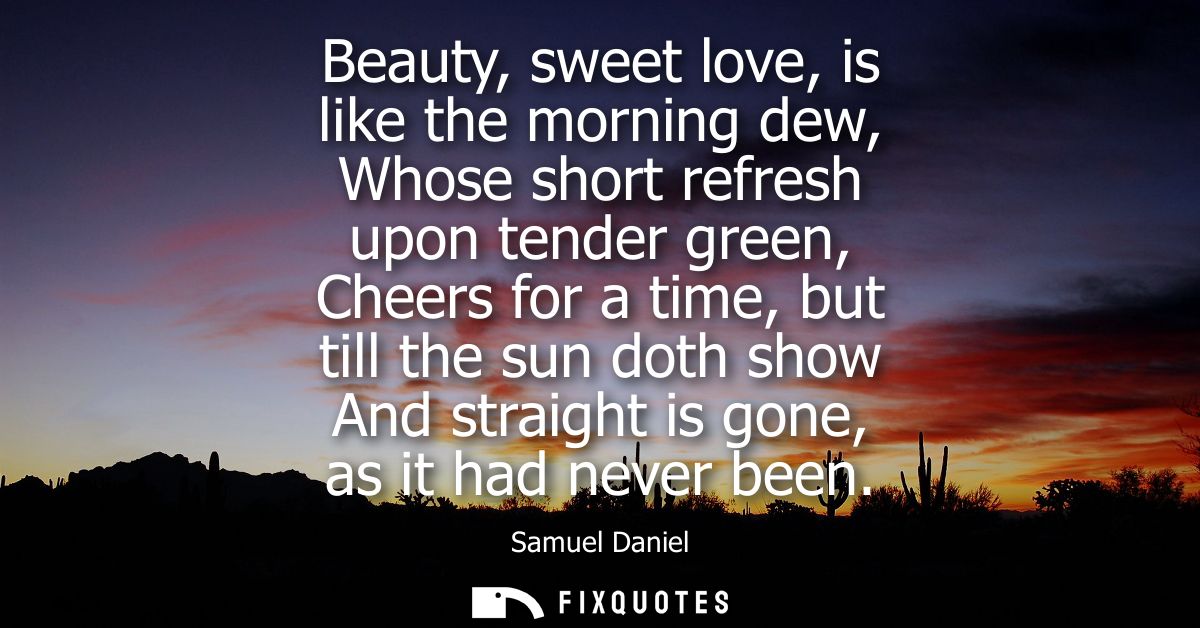
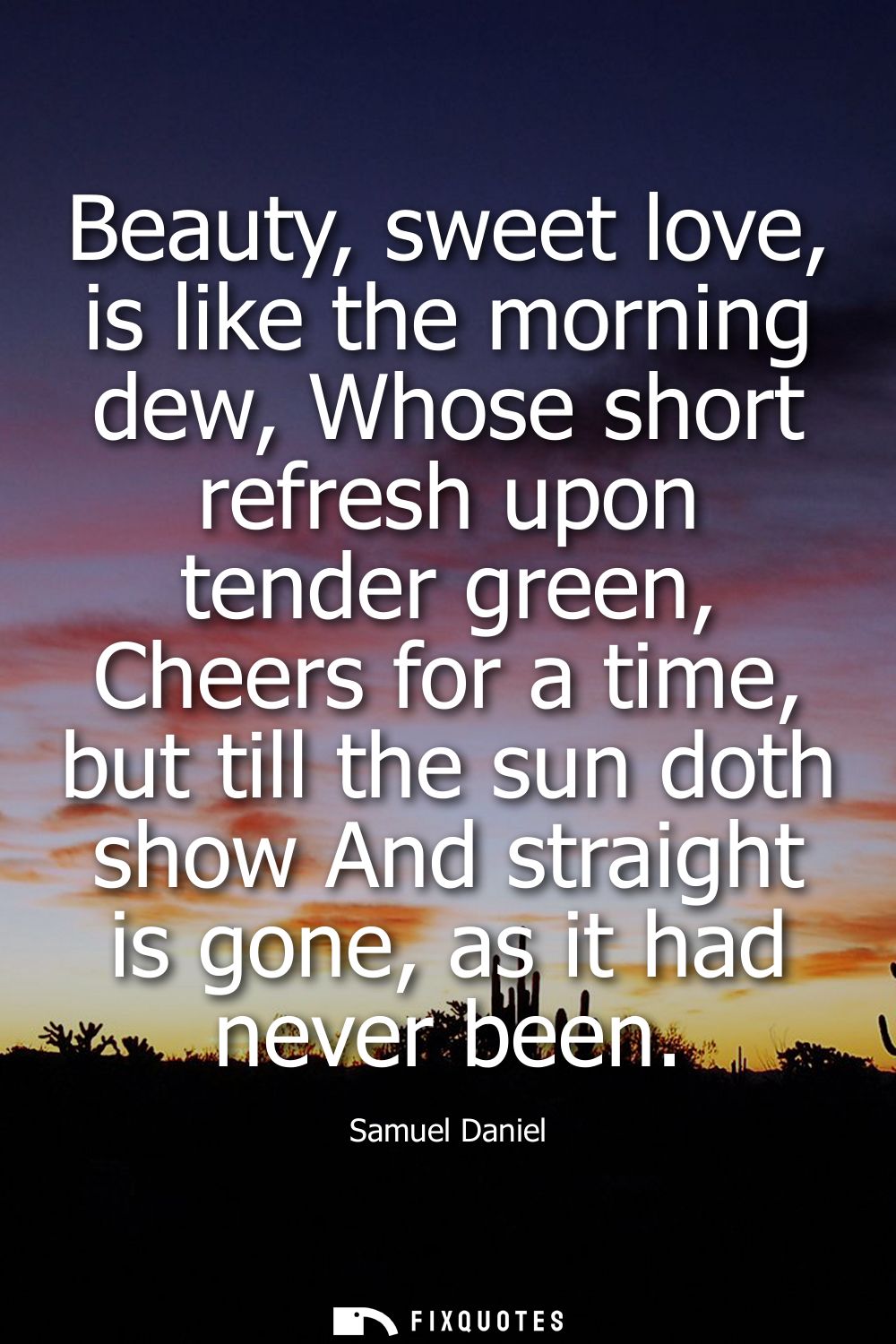
"Beauty, sweet love, is like the morning dew, Whose short refresh upon tender green, Cheers for a time, but till the sun doth show And straight is gone, as it had never been"
About this Quote
The intent isn’t to sneer at love but to strip away its decorative rhetoric. “Sweet love” opens like a courtly compliment, then the metaphor undercuts the sweetness with duration: “short refresh.” Beauty here isn’t a moral virtue or a divine sign; it’s a physiological lift, a chill on “tender green,” the body’s immediate yes to what feels new. The subtext is sharper: the thing we call beauty is partly an effect of timing and light. When “the sun doth show” - clarity, daylight, public reality - the glamour dissolves. That’s not just aging or loss; it’s exposure. The world’s ordinary illumination is enough to erase what felt urgent at dawn.
Context matters. Writing in a late-Elizabethan culture obsessed with poetic immortality (the lover promising to preserve the beloved in verse), Daniel offers a more skeptical music: the lyric voice can witness transience, not defeat it. The final sting, “as it had never been,” captures the emotional violence of impermanence: not merely that beauty ends, but that it rewrites our memory, making yesterday’s intensity feel almost embarrassing, like a dream you can’t quite defend in daylight.
Quote Details
| Topic | Heartbreak |
|---|---|
| Source | Verified source: Delia. Containing Certaine Sonnets (Samuel Daniel, 1592)
Evidence: Beauty, sweet love, is like the morning dew, Whose short refresh upon the tender green Cheers for a time but till the sun doth show, And straight 'tis gone as it had never been. (Sonnet XLVII (47) (page number varies by edition)). This text is Sonnet XLVII of Samuel Daniel’s sonnet sequence "Delia". The earliest authorized publication of "Delia" was in 1592 (as "Delia. Containing Certaine Sonnets: With the Complaint of Rosamond" / "Delia" editions issued that year). Your commonly-circulated wording matches the opening quatrain of Sonnet 47, with minor punctuation/orthography differences across editions (e.g., "upon tender green" vs "upon the tender green," "'tis" vs "is"). I was able to verify the primary-work placement (Delia, Sonnet 47), but I did not retrieve a scanned 1592 title-page or signature/page reference from the original print in this search session; page numbering is not stable across early printings and later reprints. Other candidates (1) Treasury of Wisdom, Wit and Humor, Odd Comparisons and Pr... (Adam Wooléver, 1878) compilation98.6% ... Beauty , sweet love , is like the morning dew , Whose short refresh upon tender green , Cheers for a time , but t... |
| Cite |
Citation Formats
APA Style (7th ed.)
Daniel, Samuel. (2026, February 22). Beauty, sweet love, is like the morning dew, Whose short refresh upon tender green, Cheers for a time, but till the sun doth show And straight is gone, as it had never been. FixQuotes. https://fixquotes.com/quotes/beauty-sweet-love-is-like-the-morning-dew-whose-110189/
Chicago Style
Daniel, Samuel. "Beauty, sweet love, is like the morning dew, Whose short refresh upon tender green, Cheers for a time, but till the sun doth show And straight is gone, as it had never been." FixQuotes. February 22, 2026. https://fixquotes.com/quotes/beauty-sweet-love-is-like-the-morning-dew-whose-110189/.
MLA Style (9th ed.)
"Beauty, sweet love, is like the morning dew, Whose short refresh upon tender green, Cheers for a time, but till the sun doth show And straight is gone, as it had never been." FixQuotes, 22 Feb. 2026, https://fixquotes.com/quotes/beauty-sweet-love-is-like-the-morning-dew-whose-110189/. Accessed 10 Mar. 2026.