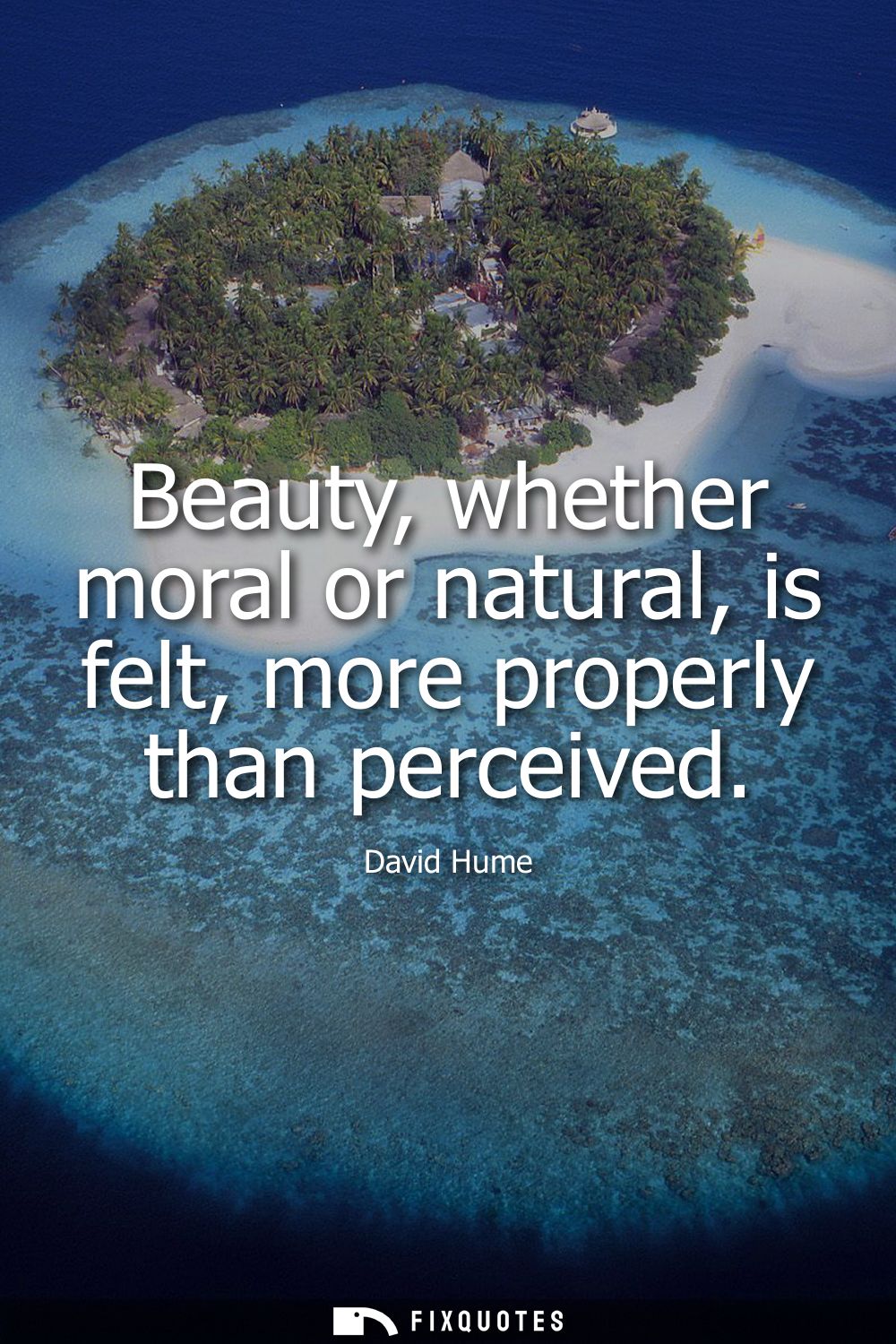
"Beauty, whether moral or natural, is felt more properly than perceived"
About this Quote
Hume slips a quiet grenade into the Enlightenment faith that the world can be cleanly inventoried by reason. When he says beauty is "felt, more properly than perceived", he’s not indulging mysticism; he’s putting aesthetics (and morality) on the same psychological footing. Beauty is not a property you detect like weight or color. It’s an experience that happens in you, a response generated by human sensibility. The line works because it denies the reader a comforting option: if beauty isn’t straightforwardly perceived, you can’t claim to possess it as a fact, only to undergo it as a reaction.
The pairing of "moral or natural" is the tell. Hume is collapsing the hierarchy that treats nature as objective and ethics as airy opinion. Moral beauty, like a landscape’s beauty, arrives as sentiment - approval, warmth, uplift - rather than as a conclusion you deduce. That’s classic Hume: reason can sort means, but it can’t supply the ends; it can’t manufacture value out of cold observation.
Context sharpens the edge. Writing against rationalists who wanted moral truths to behave like geometry, Hume builds a human-centered account of judgment: tastes vary, yet they’re not random. Because our feelings are shaped by shared human nature, education, habit, and social life, we can argue about beauty and character without pretending we’re measuring them with a ruler. The subtext is democratic and destabilizing at once: the authority to judge doesn’t live in objects or commandments, but in cultivated, fallible people.
The pairing of "moral or natural" is the tell. Hume is collapsing the hierarchy that treats nature as objective and ethics as airy opinion. Moral beauty, like a landscape’s beauty, arrives as sentiment - approval, warmth, uplift - rather than as a conclusion you deduce. That’s classic Hume: reason can sort means, but it can’t supply the ends; it can’t manufacture value out of cold observation.
Context sharpens the edge. Writing against rationalists who wanted moral truths to behave like geometry, Hume builds a human-centered account of judgment: tastes vary, yet they’re not random. Because our feelings are shaped by shared human nature, education, habit, and social life, we can argue about beauty and character without pretending we’re measuring them with a ruler. The subtext is democratic and destabilizing at once: the authority to judge doesn’t live in objects or commandments, but in cultivated, fallible people.
Quote Details
| Topic | Wisdom |
|---|---|
| Source | Help us find the source |
| Cite |
Citation Formats
APA Style (7th ed.)
Hume, David. (2026, February 16). Beauty, whether moral or natural, is felt more properly than perceived. FixQuotes. https://fixquotes.com/quotes/beauty-whether-moral-or-natural-is-felt-more-155168/
Chicago Style
Hume, David. "Beauty, whether moral or natural, is felt more properly than perceived." FixQuotes. February 16, 2026. https://fixquotes.com/quotes/beauty-whether-moral-or-natural-is-felt-more-155168/.
MLA Style (9th ed.)
"Beauty, whether moral or natural, is felt more properly than perceived." FixQuotes, 16 Feb. 2026, https://fixquotes.com/quotes/beauty-whether-moral-or-natural-is-felt-more-155168/. Accessed 31 Mar. 2026.
More Quotes by David
Add to List