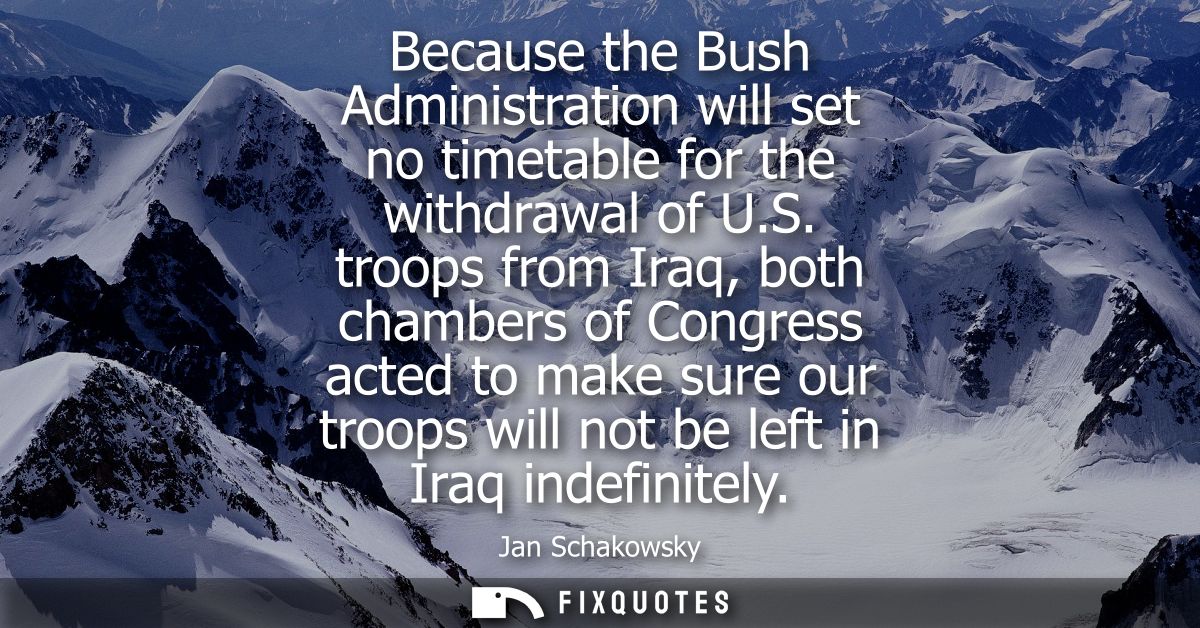
"Because the Bush Administration will set no timetable for the withdrawal of U.S. troops from Iraq, both chambers of Congress acted to make sure our troops will not be left in Iraq indefinitely"
About this Quote
The line is a legislative two-step dressed up as moral urgency: Schakowsky frames Congress not as second-guessing a war, but as rescuing the military from an executive branch that refuses to name an ending. The keyword is "indefinitely" - a term that turns policy ambiguity into a kind of quiet cruelty. It suggests not just strategic drift, but an almost bureaucratic abandonment of the people doing the fighting.
Her intent is tactical and reputational at once. Tactically, she’s justifying congressional intervention as a necessity created by the Bush Administration’s refusal to commit to a timetable. Reputationally, she’s claiming the pro-troops high ground, a crucial move in the Iraq-era messaging war where opposition could be caricatured as weakness. Notice how the sentence builds a chain of responsibility: the administration won’t act, so Congress must. That structure positions legislators as the adults in the room without openly accusing the president of bad faith.
The subtext: timetables aren’t merely calendars; they’re accountability mechanisms. A withdrawal plan implies benchmarks, costs, and political ownership. By emphasizing "both chambers", she underscores institutional legitimacy and bipartisan seriousness, even if the vote math was messy. The context is the mid-2000s Iraq backlash, when "stay the course" started reading less like resolve and more like denial. Schakowsky’s language converts a strategic debate into a bounded ethical claim: wars can be argued over, but open-ended deployment is unacceptable. The rhetoric works because it narrows the argument to a principle most voters recognize - no one should be sent into limbo.
Her intent is tactical and reputational at once. Tactically, she’s justifying congressional intervention as a necessity created by the Bush Administration’s refusal to commit to a timetable. Reputationally, she’s claiming the pro-troops high ground, a crucial move in the Iraq-era messaging war where opposition could be caricatured as weakness. Notice how the sentence builds a chain of responsibility: the administration won’t act, so Congress must. That structure positions legislators as the adults in the room without openly accusing the president of bad faith.
The subtext: timetables aren’t merely calendars; they’re accountability mechanisms. A withdrawal plan implies benchmarks, costs, and political ownership. By emphasizing "both chambers", she underscores institutional legitimacy and bipartisan seriousness, even if the vote math was messy. The context is the mid-2000s Iraq backlash, when "stay the course" started reading less like resolve and more like denial. Schakowsky’s language converts a strategic debate into a bounded ethical claim: wars can be argued over, but open-ended deployment is unacceptable. The rhetoric works because it narrows the argument to a principle most voters recognize - no one should be sent into limbo.
Quote Details
| Topic | War |
|---|
More Quotes by Jan
Add to List