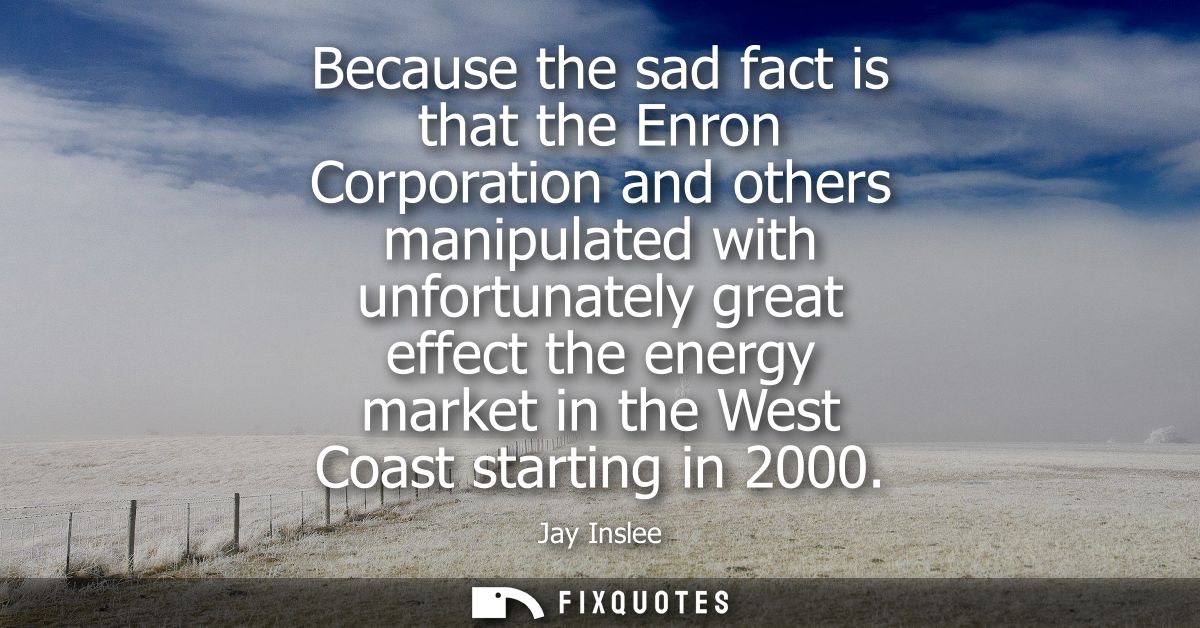
"Because the sad fact is that the Enron Corporation and others manipulated, with unfortunately great effect, the energy market in the West Coast starting in 2000"
About this Quote
The phrase “manipulated with unfortunately great effect” is the tightest pivot. “Unfortunately” feigns sorrow, but “great effect” is the sharper blade: it concedes competence to the perpetrators, implying the market didn’t merely fail, it was outplayed. That wording nudges the listener away from abstract “market volatility” and toward intent, strategy, and culpability. Inslee isn’t just condemning Enron; he’s arguing that the system’s architecture allowed a few actors to weaponize it.
Context matters: “the West Coast starting in 2000” locates this in the California energy crisis era, when rolling blackouts and price spikes collided with deregulation politics. By broadening it to “Enron Corporation and others,” he avoids the too-easy scapegoat, hinting at a wider ecosystem of profiteers and enablers. The subtext is a policy brief in a sentence: if manipulation can have “great effect,” then regulation, oversight, and market design aren’t optional technocratic details; they’re moral necessities.
Quote Details
| Topic | Justice |
|---|---|
| Source | Help us find the source |
| Cite |
Citation Formats
APA Style (7th ed.)
Inslee, Jay. (2026, February 18). Because the sad fact is that the Enron Corporation and others manipulated, with unfortunately great effect, the energy market in the West Coast starting in 2000. FixQuotes. https://fixquotes.com/quotes/because-the-sad-fact-is-that-the-enron-99114/
Chicago Style
Inslee, Jay. "Because the sad fact is that the Enron Corporation and others manipulated, with unfortunately great effect, the energy market in the West Coast starting in 2000." FixQuotes. February 18, 2026. https://fixquotes.com/quotes/because-the-sad-fact-is-that-the-enron-99114/.
MLA Style (9th ed.)
"Because the sad fact is that the Enron Corporation and others manipulated, with unfortunately great effect, the energy market in the West Coast starting in 2000." FixQuotes, 18 Feb. 2026, https://fixquotes.com/quotes/because-the-sad-fact-is-that-the-enron-99114/. Accessed 4 Apr. 2026.