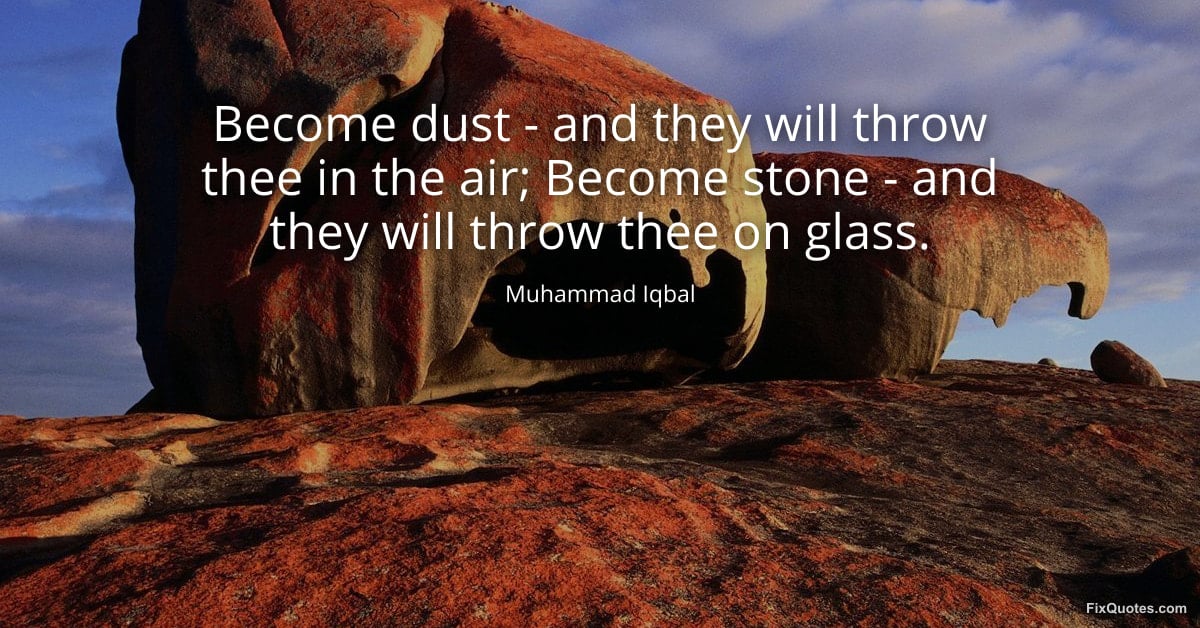
"Become dust - and they will throw thee in the air; Become stone - and they will throw thee on glass"
About this Quote
The subtext is a critique of social utility: people don’t reward essence, they reward what they can do with you. Softness becomes spectacle; strength becomes a projectile. Iqbal, writing in a colonized India anxious about selfhood, modernity, and political agency, is obsessed with khudi (the self) not as a private mood but as a moral posture. This couplet pressures the reader to notice how communities - and empires - instrumentalize bodies and beliefs. The “they” is doing a lot of work: a faceless public, a patron, a ruler, even tradition itself.
It’s also a warning against chasing approval. Whether you reduce yourself to dust or harden into stone, you’re still being thrown. The real challenge, Iqbal implies, is not choosing a material that earns applause, but refusing to become material at all.
Quote Details
| Topic | Wisdom |
|---|---|
| Source | Help us find the source |
| Cite |
Citation Formats
APA Style (7th ed.)
Iqbal, Muhammad. (2026, January 16). Become dust - and they will throw thee in the air; Become stone - and they will throw thee on glass. FixQuotes. https://fixquotes.com/quotes/become-dust-and-they-will-throw-thee-in-the-air-130389/
Chicago Style
Iqbal, Muhammad. "Become dust - and they will throw thee in the air; Become stone - and they will throw thee on glass." FixQuotes. January 16, 2026. https://fixquotes.com/quotes/become-dust-and-they-will-throw-thee-in-the-air-130389/.
MLA Style (9th ed.)
"Become dust - and they will throw thee in the air; Become stone - and they will throw thee on glass." FixQuotes, 16 Jan. 2026, https://fixquotes.com/quotes/become-dust-and-they-will-throw-thee-in-the-air-130389/. Accessed 12 Feb. 2026.