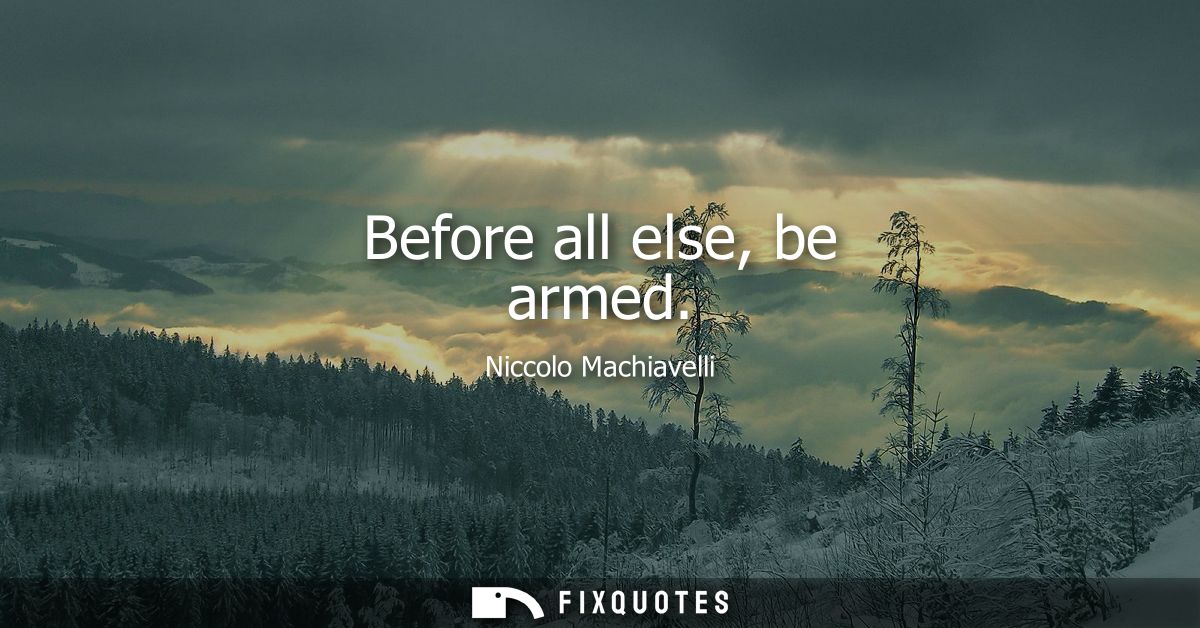
"Before all else, be armed"
About this Quote
A threat disguised as housekeeping: Machiavelli’s "Before all else, be armed" is less a call to masculinity than a diagnostic of politics as a contact sport. The line works because it refuses the comforting idea that legitimacy, law, or virtue can float free of force. In Machiavelli’s world, power isn’t secured by being right; it’s secured by being hard to remove.
The intent is practical and predictive. "Be armed" means literal weapons, yes, but also the infrastructure of coercion: loyal troops, enforceable command, the capacity to act without begging permission. It’s a preemptive strike against dependence. Machiavelli despised rulers who outsourced violence to mercenaries or allies, because borrowed force comes with strings, invoices, and sudden betrayals. If your safety relies on someone else’s sword, you’re living on credit.
The subtext is colder: politics begins where persuasion ends. Ideals are useful, even necessary, but they don’t survive first contact with an ambitious rival unless they’re backed by something sturdier than rhetoric. "Before all else" is the tell; it demotes morality and policy to second-order concerns, not because Machiavelli can’t imagine better governance, but because he’s describing the price of getting to govern at all.
Context sharpens the cynicism. Renaissance Italy was a patchwork of city-states, foreign invasions, shifting alliances, and spectacular collapses. Machiavelli watched Florence fall, watched leaders trust treaties and reputations, watched them lose. The sentence lands like a corrective: history doesn’t forgive the unprepared, it simply replaces them.
The intent is practical and predictive. "Be armed" means literal weapons, yes, but also the infrastructure of coercion: loyal troops, enforceable command, the capacity to act without begging permission. It’s a preemptive strike against dependence. Machiavelli despised rulers who outsourced violence to mercenaries or allies, because borrowed force comes with strings, invoices, and sudden betrayals. If your safety relies on someone else’s sword, you’re living on credit.
The subtext is colder: politics begins where persuasion ends. Ideals are useful, even necessary, but they don’t survive first contact with an ambitious rival unless they’re backed by something sturdier than rhetoric. "Before all else" is the tell; it demotes morality and policy to second-order concerns, not because Machiavelli can’t imagine better governance, but because he’s describing the price of getting to govern at all.
Context sharpens the cynicism. Renaissance Italy was a patchwork of city-states, foreign invasions, shifting alliances, and spectacular collapses. Machiavelli watched Florence fall, watched leaders trust treaties and reputations, watched them lose. The sentence lands like a corrective: history doesn’t forgive the unprepared, it simply replaces them.
Quote Details
| Topic | War |
|---|
More Quotes by Niccolo
Add to List