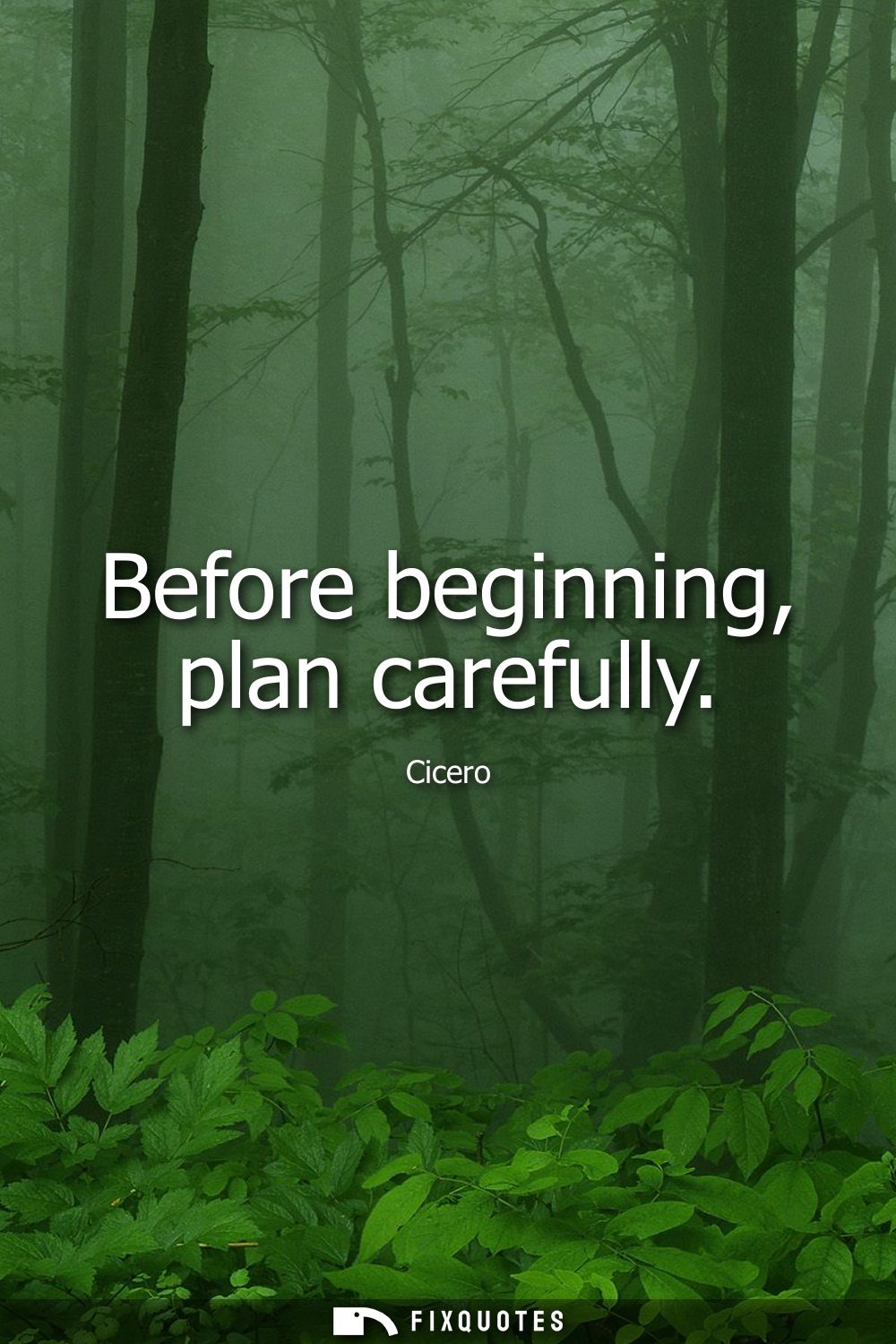
"Before beginning, plan carefully"
About this Quote
“Before beginning, plan carefully” lands with the brisk authority of someone who watched the Roman Republic crack under the weight of bad judgment and rushed ambition. Cicero isn’t offering a cute productivity tip; he’s laying down a civic ethic. In a culture where public life was performance and policy at once - speeches in the Forum, alliances stitched together over dinners, military decisions made with reputations on the line - improvisation could be lethal. Planning, here, is less about neat to-do lists and more about moral and political foresight: weigh consequences, anticipate reactions, know what you’re committing yourself to once your words leave your mouth.
The intent is practical, but the subtext is defensive. Cicero’s career was built on rhetoric - starting is easy when you can speak beautifully. The harder part is steering that eloquence toward an outcome you can live with. Planning becomes a check on vanity: don’t let momentum, ego, or the crowd’s appetite substitute for strategy. It’s also a quiet rebuke to Rome’s recurring problem: leaders who mistake decisiveness for wisdom, action for competence.
Context matters because Cicero wrote and spoke in an era of collapsing norms, when procedural guardrails were being bulldozed by strongmen and opportunists. “Before beginning” implies a point of no return; once you enter the arena, events accelerate, and your options narrow. The line works because it compresses a whole philosophy of agency into a single pivot: the future doesn’t reward your intentions, it audits your preparation.
The intent is practical, but the subtext is defensive. Cicero’s career was built on rhetoric - starting is easy when you can speak beautifully. The harder part is steering that eloquence toward an outcome you can live with. Planning becomes a check on vanity: don’t let momentum, ego, or the crowd’s appetite substitute for strategy. It’s also a quiet rebuke to Rome’s recurring problem: leaders who mistake decisiveness for wisdom, action for competence.
Context matters because Cicero wrote and spoke in an era of collapsing norms, when procedural guardrails were being bulldozed by strongmen and opportunists. “Before beginning” implies a point of no return; once you enter the arena, events accelerate, and your options narrow. The line works because it compresses a whole philosophy of agency into a single pivot: the future doesn’t reward your intentions, it audits your preparation.
Quote Details
| Topic | Decision-Making |
|---|---|
| Source | Help us find the source |
| Cite |
Citation Formats
APA Style (7th ed.)
Cicero. (2026, January 18). Before beginning, plan carefully. FixQuotes. https://fixquotes.com/quotes/before-beginning-plan-carefully-14808/
Chicago Style
Cicero. "Before beginning, plan carefully." FixQuotes. January 18, 2026. https://fixquotes.com/quotes/before-beginning-plan-carefully-14808/.
MLA Style (9th ed.)
"Before beginning, plan carefully." FixQuotes, 18 Jan. 2026, https://fixquotes.com/quotes/before-beginning-plan-carefully-14808/. Accessed 1 Mar. 2026.
More Quotes by Cicero
Add to List