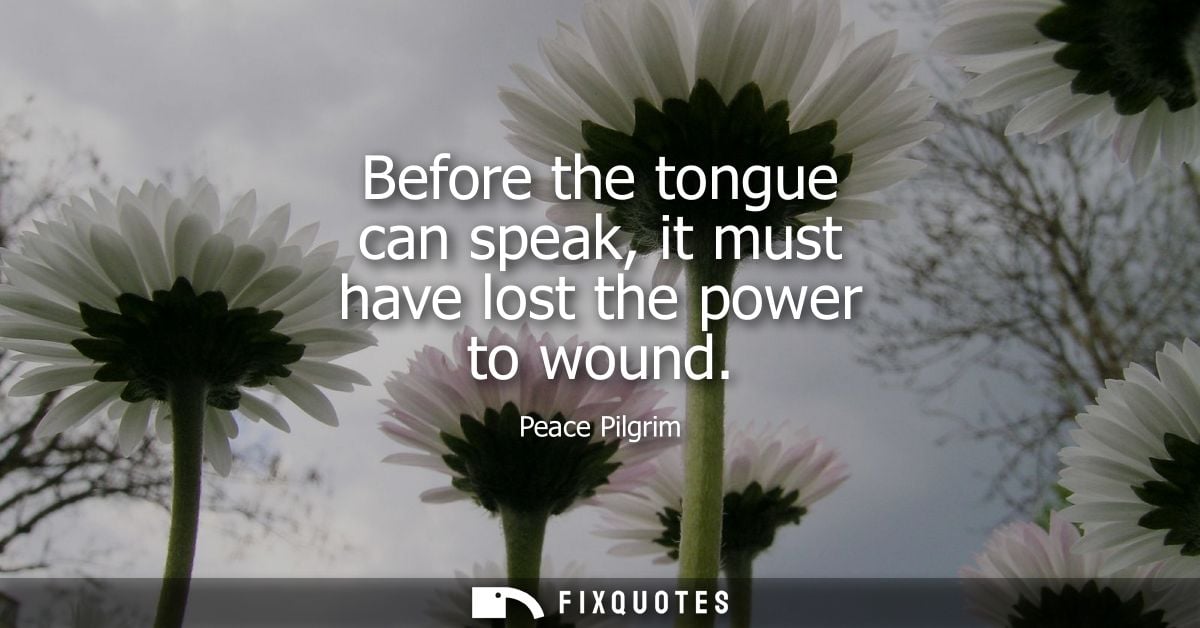
"Before the tongue can speak, it must have lost the power to wound"
About this Quote
It’s a disarming little booby trap for anyone who prides themselves on “speaking their truth.” Peace Pilgrim isn’t praising silence; she’s demanding a moral disarmament so complete that speech can no longer be used as a weapon. The line turns the tongue from a tool of self-expression into an instrument of harm reduction. You don’t earn the right to speak by having something to say. You earn it by removing the impulse to cut.
The phrasing matters. “Before” makes this a prerequisite, not a nice-to-have. “Must have lost” suggests a stripping away, like surrendering a blade. And “the power to wound” points beyond profanity or rudeness to the deeper violences language can carry: humiliation disguised as honesty, correction as domination, sarcasm as social policing. The subtext is that most speech in conflict isn’t communication; it’s control. Peace Pilgrim’s ethic insists that words should arrive only after the ego’s appetite for winning has been starved.
Context sharpens the intent. As an activist and itinerant peace advocate walking across mid-century America, she operated in an era thick with ideological certainty: Cold War posturing, civil rights clashes, religious and political absolutism. In that atmosphere, rhetoric was often a proxy battlefield. Her quote reads like spiritual discipline aimed at public life: if your voice still knows how to injure, it will, especially when you’re sure you’re right.
The challenge isn’t to speak softly. It’s to become someone for whom cruelty is no longer available as a rhetorical option. That’s not etiquette. That’s transformation.
The phrasing matters. “Before” makes this a prerequisite, not a nice-to-have. “Must have lost” suggests a stripping away, like surrendering a blade. And “the power to wound” points beyond profanity or rudeness to the deeper violences language can carry: humiliation disguised as honesty, correction as domination, sarcasm as social policing. The subtext is that most speech in conflict isn’t communication; it’s control. Peace Pilgrim’s ethic insists that words should arrive only after the ego’s appetite for winning has been starved.
Context sharpens the intent. As an activist and itinerant peace advocate walking across mid-century America, she operated in an era thick with ideological certainty: Cold War posturing, civil rights clashes, religious and political absolutism. In that atmosphere, rhetoric was often a proxy battlefield. Her quote reads like spiritual discipline aimed at public life: if your voice still knows how to injure, it will, especially when you’re sure you’re right.
The challenge isn’t to speak softly. It’s to become someone for whom cruelty is no longer available as a rhetorical option. That’s not etiquette. That’s transformation.
Quote Details
| Topic | Kindness |
|---|---|
| Source | Help us find the source |
| Cite |
Citation Formats
APA Style (7th ed.)
Pilgrim, Peace. (2026, January 17). Before the tongue can speak, it must have lost the power to wound. FixQuotes. https://fixquotes.com/quotes/before-the-tongue-can-speak-it-must-have-lost-the-79350/
Chicago Style
Pilgrim, Peace. "Before the tongue can speak, it must have lost the power to wound." FixQuotes. January 17, 2026. https://fixquotes.com/quotes/before-the-tongue-can-speak-it-must-have-lost-the-79350/.
MLA Style (9th ed.)
"Before the tongue can speak, it must have lost the power to wound." FixQuotes, 17 Jan. 2026, https://fixquotes.com/quotes/before-the-tongue-can-speak-it-must-have-lost-the-79350/. Accessed 3 Apr. 2026.
More Quotes by Peace
Add to List