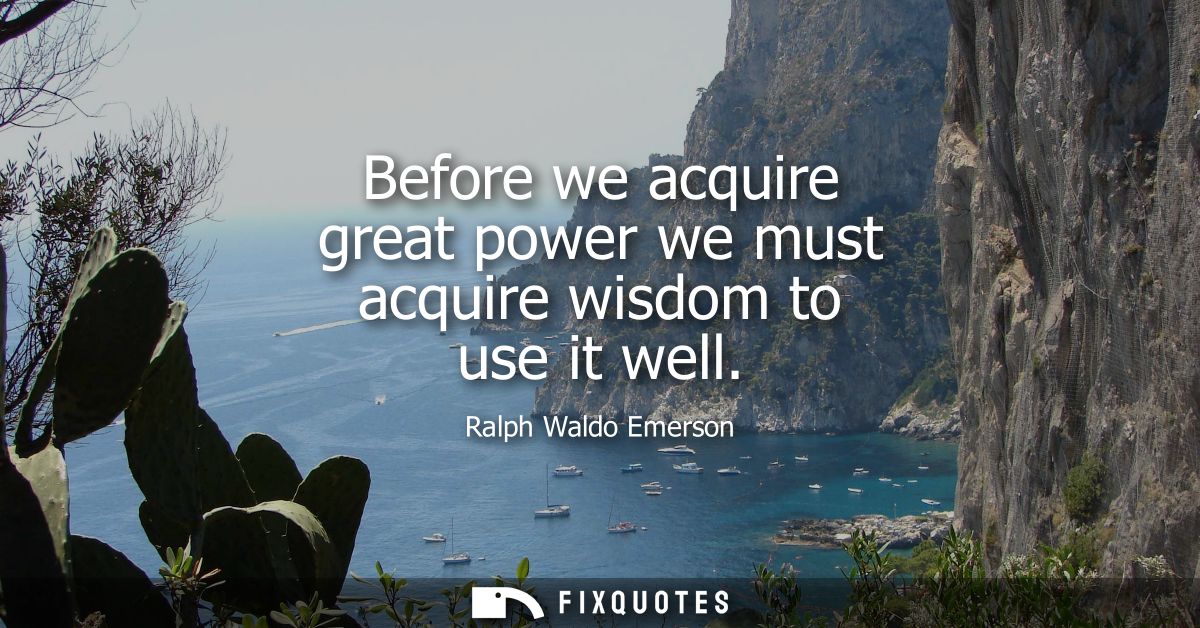
"Before we acquire great power we must acquire wisdom to use it well"
About this Quote
Power is the intoxicant Emerson refuses to romanticize. The line reads like a clean piece of moral hygiene: before the world hands you leverage, you need the inner equipment to handle it without turning brutal, vain, or merely efficient. Emerson, writing out of the 19th-century American boom in industry, expansion, and self-confidence, aims a quiet warning at a culture learning how to scale. New institutions, new wealth, new technologies: the national mood says, Take more. Emerson’s counterweight is character.
The specific intent is preventative. He’s not asking the powerful to become nicer; he’s insisting that power acquired ahead of judgment produces its own disasters. Wisdom here isn’t bookishness or a checklist of ethics. It’s the harder, Emersonian self-reliance: a disciplined conscience, an ability to see beyond immediate appetite, a practiced sense of limits. The subtext is almost diagnostic: you can’t count on power to educate you. It amplifies what’s already there. If you’re shallow, it makes you dangerous; if you’re principled, it makes you effective.
Why it works rhetorically is its sequencing. “Before” forces a timeline, not a wish. It also smuggles in a critique of American merit myths: getting power isn’t proof you deserve it. Wisdom is framed as a prerequisite, not a trophy. In a century that often treated progress as self-justifying, Emerson plants a stubborn idea: capability without discernment is not advancement, it’s acceleration toward mistake.
The specific intent is preventative. He’s not asking the powerful to become nicer; he’s insisting that power acquired ahead of judgment produces its own disasters. Wisdom here isn’t bookishness or a checklist of ethics. It’s the harder, Emersonian self-reliance: a disciplined conscience, an ability to see beyond immediate appetite, a practiced sense of limits. The subtext is almost diagnostic: you can’t count on power to educate you. It amplifies what’s already there. If you’re shallow, it makes you dangerous; if you’re principled, it makes you effective.
Why it works rhetorically is its sequencing. “Before” forces a timeline, not a wish. It also smuggles in a critique of American merit myths: getting power isn’t proof you deserve it. Wisdom is framed as a prerequisite, not a trophy. In a century that often treated progress as self-justifying, Emerson plants a stubborn idea: capability without discernment is not advancement, it’s acceleration toward mistake.
Quote Details
| Topic | Wisdom |
|---|
More Quotes by Ralph
Add to List