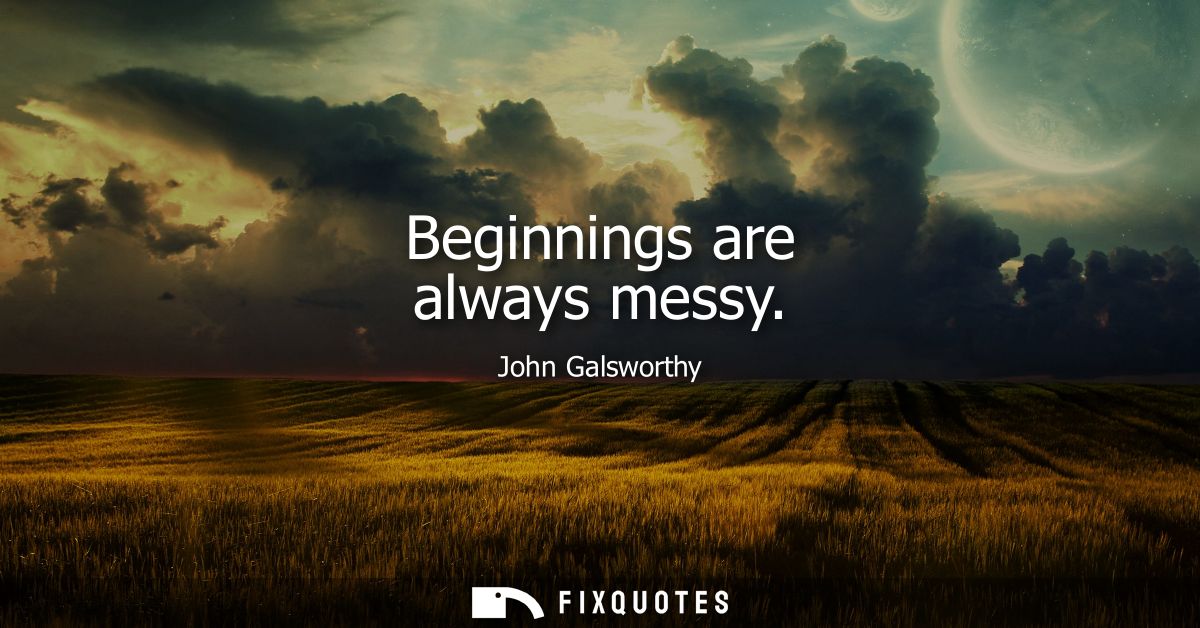
"Beginnings are always messy"
About this Quote
“Beginnings are always messy” is the kind of sentence that flatters our chaos by giving it a pedigree. Galsworthy, the quietly unsparing chronicler of respectable people behaving badly, isn’t selling a motivational poster so much as dismantling the fantasy of clean origin stories. In his world, nothing truly starts with a trumpet blast; it starts with a compromise, a misunderstanding, a half-suppressed desire that will later be retroactively edited into “destiny.”
The line works because it compresses a social critique into a domestic image. “Messy” is a word from households, not parliaments or courts, which is exactly the point: the forces that shape lives and institutions begin in rooms where people are touchy, defensive, vain, afraid. Galsworthy wrote in the long shadow of Victorian moral certainty, watching Edwardian society pretend it was stable while it was actually mid-rearrangement. The Forsyte Saga thrives on this tension: property, marriage, reputation - all the polished surfaces - are built atop unruly appetites and unacknowledged resentments.
Subtextually, it’s also a warning about narrative. We love to treat beginnings as pure: first love, a new era, a fresh start. Galsworthy suggests that “fresh” is a story we tell after we’ve cleaned up the evidence. Real change arrives dragging loose ends behind it, implicating everyone. If you want transformation without disorder, he implies, you don’t want a beginning; you want a sequel.
The line works because it compresses a social critique into a domestic image. “Messy” is a word from households, not parliaments or courts, which is exactly the point: the forces that shape lives and institutions begin in rooms where people are touchy, defensive, vain, afraid. Galsworthy wrote in the long shadow of Victorian moral certainty, watching Edwardian society pretend it was stable while it was actually mid-rearrangement. The Forsyte Saga thrives on this tension: property, marriage, reputation - all the polished surfaces - are built atop unruly appetites and unacknowledged resentments.
Subtextually, it’s also a warning about narrative. We love to treat beginnings as pure: first love, a new era, a fresh start. Galsworthy suggests that “fresh” is a story we tell after we’ve cleaned up the evidence. Real change arrives dragging loose ends behind it, implicating everyone. If you want transformation without disorder, he implies, you don’t want a beginning; you want a sequel.
Quote Details
| Topic | New Beginnings |
|---|---|
| Source | Help us find the source |
| Cite |
Citation Formats
APA Style (7th ed.)
Galsworthy, John. (2026, January 18). Beginnings are always messy. FixQuotes. https://fixquotes.com/quotes/beginnings-are-always-messy-23696/
Chicago Style
Galsworthy, John. "Beginnings are always messy." FixQuotes. January 18, 2026. https://fixquotes.com/quotes/beginnings-are-always-messy-23696/.
MLA Style (9th ed.)
"Beginnings are always messy." FixQuotes, 18 Jan. 2026, https://fixquotes.com/quotes/beginnings-are-always-messy-23696/. Accessed 12 Feb. 2026.
More Quotes by John
Add to List