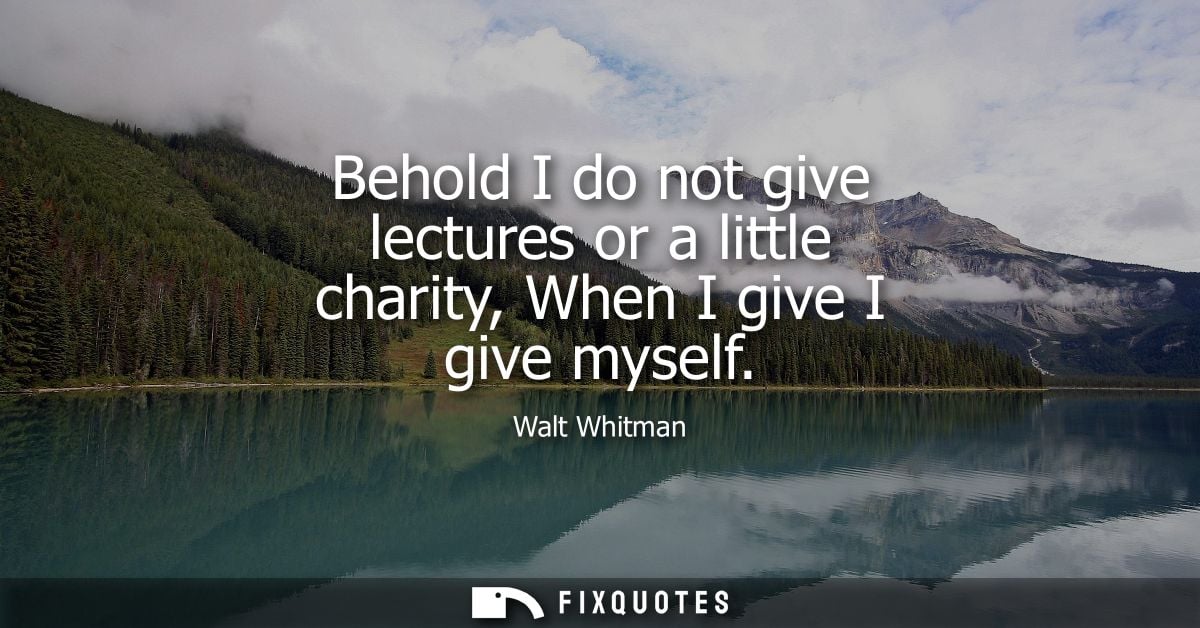
"Behold, I do not give lectures or a little charity, when I give I give myself"
About this Quote
“When I give I give myself” is classic Whitman bravado, but it’s also strategy. He collapses the distance between speaker and audience, turning the poem into a kind of handshake that refuses gloves. The verb “behold” matters, too. It’s not a humble confession; it’s a command to witness a new ethic in real time. That theatricality is the point: he’s building a public self large enough to include strangers, laborers, lovers, and readers who will never meet him. Giving becomes an act of presence, not a transaction.
Context sharpens the edge. Writing in the mid-19th century, as America was hardening around industrial power, abolitionist conflict, and moral crusades, Whitman offers a counter-politics rooted in the body and the ordinary citizen. His “gift” is democratic intimacy: an insistence that dignity isn’t dispensed from above, it’s shared sideways. The subtext is almost a dare: if you want my compassion, you also get my equality, my attention, my full unruly humanity.
Quote Details
| Topic | Love |
|---|---|
| Source | Walt Whitman — "Song of Myself" (in Leaves of Grass). Line commonly rendered: "I do not give lectures or a little charity; When I give, I give myself." Leaves of Grass (first ed. 1855; included in later editions). |
| Cite |
Citation Formats
APA Style (7th ed.)
Whitman, Walt. (2026, February 20). Behold, I do not give lectures or a little charity, when I give I give myself. FixQuotes. https://fixquotes.com/quotes/behold-i-do-not-give-lectures-or-a-little-charity-26778/
Chicago Style
Whitman, Walt. "Behold, I do not give lectures or a little charity, when I give I give myself." FixQuotes. February 20, 2026. https://fixquotes.com/quotes/behold-i-do-not-give-lectures-or-a-little-charity-26778/.
MLA Style (9th ed.)
"Behold, I do not give lectures or a little charity, when I give I give myself." FixQuotes, 20 Feb. 2026, https://fixquotes.com/quotes/behold-i-do-not-give-lectures-or-a-little-charity-26778/. Accessed 1 Apr. 2026.