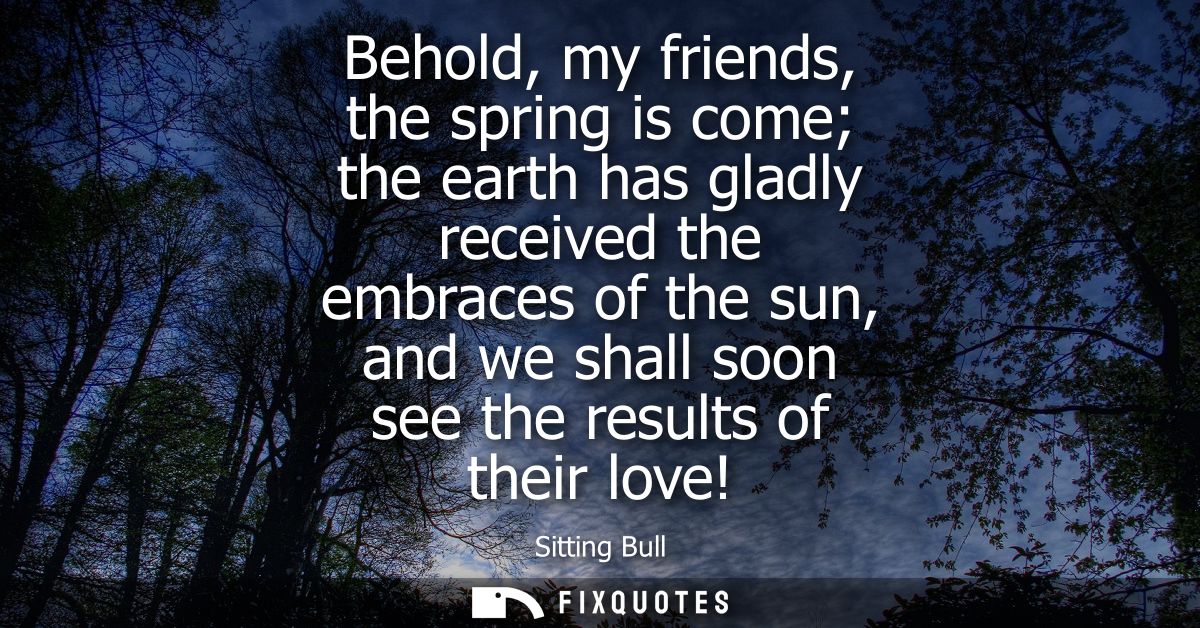
"Behold, my friends, the spring is come; the earth has gladly received the embraces of the sun, and we shall soon see the results of their love!"
About this Quote
The erotic warmth of “embraces” and “love” isn’t decorative. It’s rhetorical pressure. By sexualizing the relationship between sun and soil, he makes fertility feel intimate and inevitable, something you protect rather than exploit. The promise that “we shall soon see the results” turns romance into consequence: nourishment, growth, and survival. It’s a community argument disguised as natural observation.
In context, Sitting Bull was navigating a world where U.S. expansion, broken treaties, and forced reservation life were tightening like a vise. Invoking spring becomes a quiet insistence that Indigenous time - cyclical, place-based, relational - remains real even when colonial time arrives as deadlines, rations, and paperwork. The subtext is both comfort and defiance: the land still knows how to renew itself, and so do the people bound to it. The sentence offers hope without naivete, rooting morale in something the state can’t easily legislate away.
Quote Details
| Topic | Spring |
|---|---|
| Source | Help us find the source |
| Cite |
Citation Formats
APA Style (7th ed.)
Bull, Sitting. (2026, January 15). Behold, my friends, the spring is come; the earth has gladly received the embraces of the sun, and we shall soon see the results of their love! FixQuotes. https://fixquotes.com/quotes/behold-my-friends-the-spring-is-come-the-earth-22533/
Chicago Style
Bull, Sitting. "Behold, my friends, the spring is come; the earth has gladly received the embraces of the sun, and we shall soon see the results of their love!" FixQuotes. January 15, 2026. https://fixquotes.com/quotes/behold-my-friends-the-spring-is-come-the-earth-22533/.
MLA Style (9th ed.)
"Behold, my friends, the spring is come; the earth has gladly received the embraces of the sun, and we shall soon see the results of their love!" FixQuotes, 15 Jan. 2026, https://fixquotes.com/quotes/behold-my-friends-the-spring-is-come-the-earth-22533/. Accessed 31 Mar. 2026.