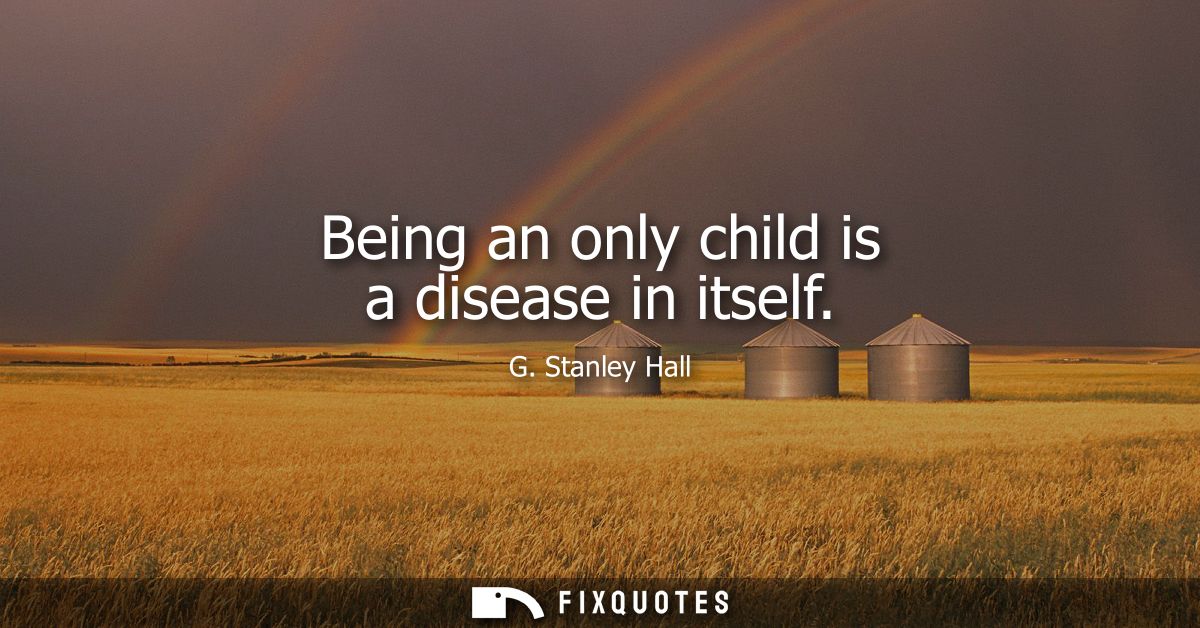
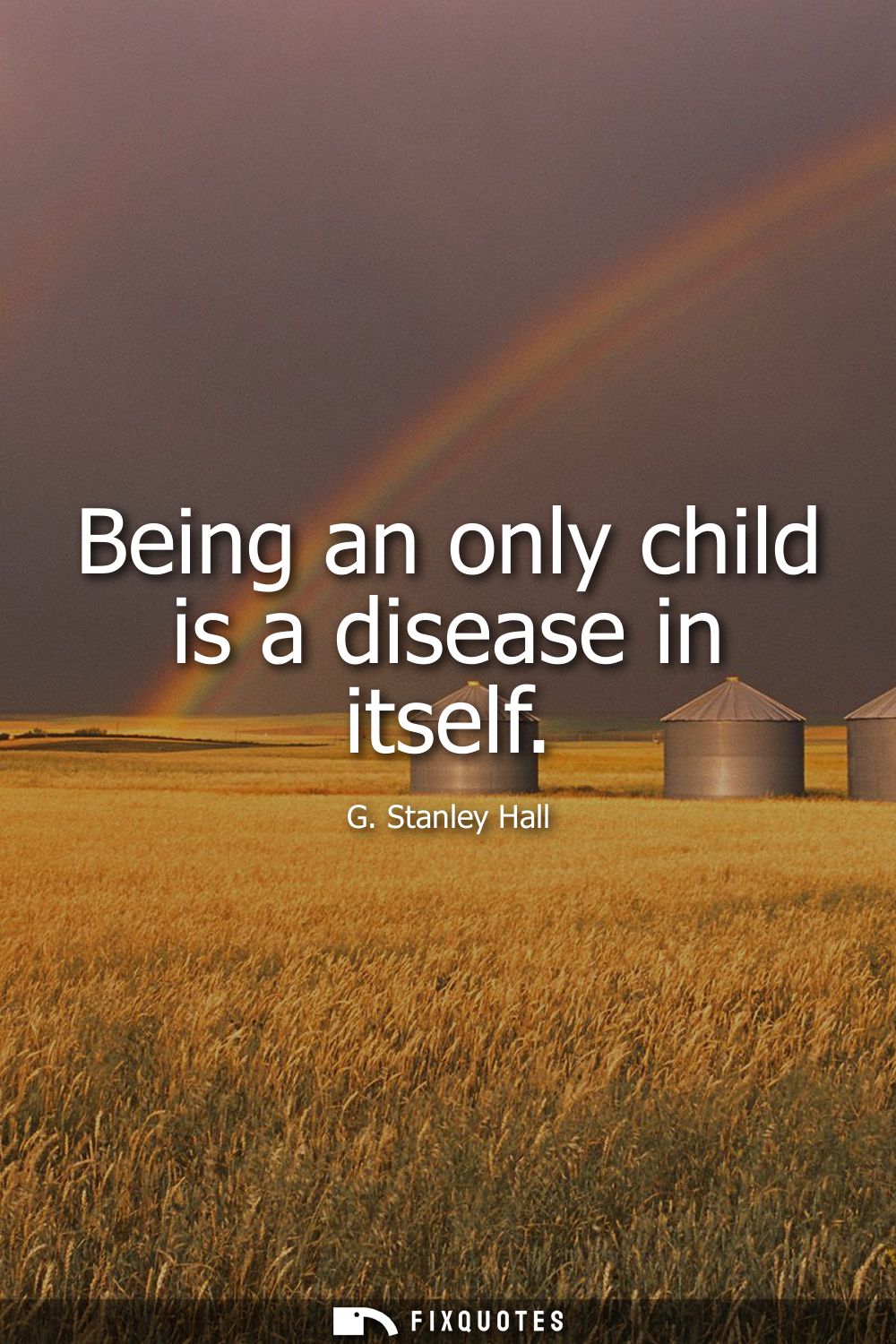
"Being an only child is a disease in itself"
About this Quote
“Being an only child is a disease in itself” lands with the blunt certitude of an era that loved turning social anxieties into diagnoses. G. Stanley Hall wasn’t just tossing off a rude generalization; he was speaking from the late-19th/early-20th century moment when psychology was busy inventing its authority by medicalizing temperament, family life, even morality. If you can name a “disease,” you can position yourself as the expert who detects it, explains it, and (ideally) treats it.
The line’s intent is disciplinary. It pressures parents toward a particular family model - the multi-child household as a factory for proper socialization. The subtext is that solitude breeds deviance: selfishness, fragility, overattachment to adults, insufficient peer training. “Only child” becomes a shorthand for a whole cluster of supposed defects, less an observation than a warning label. Calling it a disease also smuggles in inevitability: not “may face challenges,” but “is” pathological, as if birth order were fate.
Context matters: Hall was a leading figure in early American psychology, deeply invested in developmental stages and “normal” growth. In that world, statistical nuance and cultural variation got bulldozed by sweeping typologies. The quote works rhetorically because it’s categorical and moralizing at once - it doesn’t argue, it diagnoses. Today it reads like a case study in how science can launder bias: anxieties about modernity, shrinking families, and changing domestic life recast as objective psychological truth.
The line’s intent is disciplinary. It pressures parents toward a particular family model - the multi-child household as a factory for proper socialization. The subtext is that solitude breeds deviance: selfishness, fragility, overattachment to adults, insufficient peer training. “Only child” becomes a shorthand for a whole cluster of supposed defects, less an observation than a warning label. Calling it a disease also smuggles in inevitability: not “may face challenges,” but “is” pathological, as if birth order were fate.
Context matters: Hall was a leading figure in early American psychology, deeply invested in developmental stages and “normal” growth. In that world, statistical nuance and cultural variation got bulldozed by sweeping typologies. The quote works rhetorically because it’s categorical and moralizing at once - it doesn’t argue, it diagnoses. Today it reads like a case study in how science can launder bias: anxieties about modernity, shrinking families, and changing domestic life recast as objective psychological truth.
Quote Details
| Topic | Family |
|---|---|
| Source | Help us find the source |
| Cite |
Citation Formats
APA Style (7th ed.)
Hall, G. Stanley. (2026, January 15). Being an only child is a disease in itself. FixQuotes. https://fixquotes.com/quotes/being-an-only-child-is-a-disease-in-itself-61395/
Chicago Style
Hall, G. Stanley. "Being an only child is a disease in itself." FixQuotes. January 15, 2026. https://fixquotes.com/quotes/being-an-only-child-is-a-disease-in-itself-61395/.
MLA Style (9th ed.)
"Being an only child is a disease in itself." FixQuotes, 15 Jan. 2026, https://fixquotes.com/quotes/being-an-only-child-is-a-disease-in-itself-61395/. Accessed 11 Feb. 2026.
More Quotes by Stanley Hall
Add to List