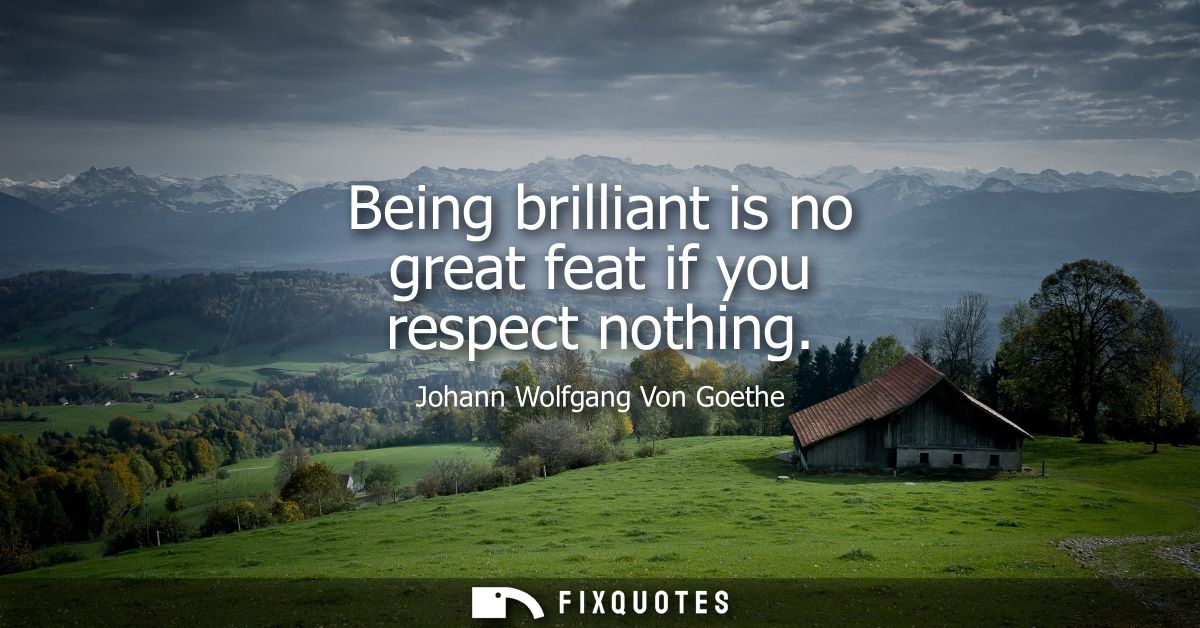
"Being brilliant is no great feat if you respect nothing"
About this Quote
Brilliance, Goethe implies, is cheap when it’s untethered from reverence. The line cuts against the romantic myth of the genius as a holy outlaw: the mind that demolishes every norm, sneers at every institution, and calls the wreckage “truth.” Goethe isn’t praising obedience; he’s warning that intelligence without respect becomes a kind of social vandalism, impressive in technique and empty in moral yield.
The craft of the sentence is its trapdoor. “No great feat” deliberately deflates what culture often inflates. He treats brilliance as a raw capacity - a talent you can possess the way you possess perfect pitch - while “respect nothing” names the real measure of a person: what they’re willing to honor, preserve, or be humbled by. Respect here isn’t civility; it’s an ethical attention, a recognition that other minds, traditions, and living beings are not merely obstacles for your cleverness to outmaneuver.
In Goethe’s world, that distinction mattered. He lived at the hinge between Enlightenment confidence and Romantic intensity, in an era when criticism was becoming a sport and skepticism a posture. He’d seen how easily intellect can become a performance: scorched-earth irony, contrarianism mistaken for courage, the pleasure of negation passing as depth. The subtext is a cultural rebuke: if your brilliance only proves you can dismiss everything, it hasn’t proven much at all. The harder feat is building a mind sharp enough to judge and generous enough to value.
The craft of the sentence is its trapdoor. “No great feat” deliberately deflates what culture often inflates. He treats brilliance as a raw capacity - a talent you can possess the way you possess perfect pitch - while “respect nothing” names the real measure of a person: what they’re willing to honor, preserve, or be humbled by. Respect here isn’t civility; it’s an ethical attention, a recognition that other minds, traditions, and living beings are not merely obstacles for your cleverness to outmaneuver.
In Goethe’s world, that distinction mattered. He lived at the hinge between Enlightenment confidence and Romantic intensity, in an era when criticism was becoming a sport and skepticism a posture. He’d seen how easily intellect can become a performance: scorched-earth irony, contrarianism mistaken for courage, the pleasure of negation passing as depth. The subtext is a cultural rebuke: if your brilliance only proves you can dismiss everything, it hasn’t proven much at all. The harder feat is building a mind sharp enough to judge and generous enough to value.
Quote Details
| Topic | Respect |
|---|---|
| Source | Help us find the source |
| Cite |
Citation Formats
APA Style (7th ed.)
Goethe, Johann Wolfgang Von. (2026, January 18). Being brilliant is no great feat if you respect nothing. FixQuotes. https://fixquotes.com/quotes/being-brilliant-is-no-great-feat-if-you-respect-19723/
Chicago Style
Goethe, Johann Wolfgang Von. "Being brilliant is no great feat if you respect nothing." FixQuotes. January 18, 2026. https://fixquotes.com/quotes/being-brilliant-is-no-great-feat-if-you-respect-19723/.
MLA Style (9th ed.)
"Being brilliant is no great feat if you respect nothing." FixQuotes, 18 Jan. 2026, https://fixquotes.com/quotes/being-brilliant-is-no-great-feat-if-you-respect-19723/. Accessed 24 Mar. 2026.
More Quotes by Johann
Add to List