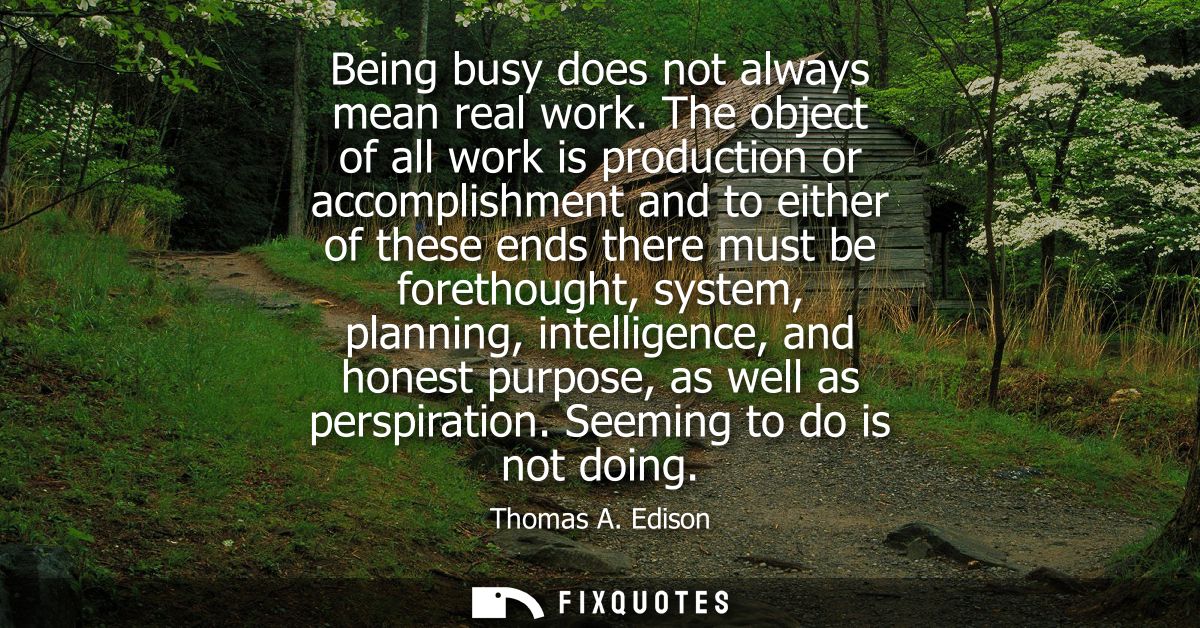
"Being busy does not always mean real work. The object of all work is production or accomplishment and to either of these ends there must be forethought, system, planning, intelligence, and honest purpose, as well as perspiration. Seeming to do is not doing"
About this Quote
The subtext is both moral and disciplinary. Edison isn’t just describing efficiency, he’s drawing a boundary around legitimacy. “Honest purpose” sneaks ethics into what could be a purely mechanical argument: busyness can be a kind of fraud, a performance staged to look necessary, virtuous, indispensable. “Seeming to do is not doing” is the dagger - a compact rebuke to people who curate effort because effort is easier to display than accomplishment.
Context matters: Edison ran labs, managed teams, chased patents, and marketed invention as production. In that world, “busy” could mean endless tinkering, meetings, and motion without a deliverable that could be manufactured, sold, or defended in court. His quote reads like an industrial-era antidote to vanity metrics. It’s also self-mythmaking: Edison positioning himself as the patron saint of practical genius, where intelligence is proven not by ideas, but by what ships.
What makes it work is its impatience. It’s not motivational; it’s prosecutorial.
Quote Details
| Topic | Work Ethic |
|---|---|
| Source | Help us find the source |
| Cite |
Citation Formats
APA Style (7th ed.)
Edison, Thomas. (2026, January 18). Being busy does not always mean real work. The object of all work is production or accomplishment and to either of these ends there must be forethought, system, planning, intelligence, and honest purpose, as well as perspiration. Seeming to do is not doing. FixQuotes. https://fixquotes.com/quotes/being-busy-does-not-always-mean-real-work-the-1994/
Chicago Style
Edison, Thomas. "Being busy does not always mean real work. The object of all work is production or accomplishment and to either of these ends there must be forethought, system, planning, intelligence, and honest purpose, as well as perspiration. Seeming to do is not doing." FixQuotes. January 18, 2026. https://fixquotes.com/quotes/being-busy-does-not-always-mean-real-work-the-1994/.
MLA Style (9th ed.)
"Being busy does not always mean real work. The object of all work is production or accomplishment and to either of these ends there must be forethought, system, planning, intelligence, and honest purpose, as well as perspiration. Seeming to do is not doing." FixQuotes, 18 Jan. 2026, https://fixquotes.com/quotes/being-busy-does-not-always-mean-real-work-the-1994/. Accessed 12 Feb. 2026.