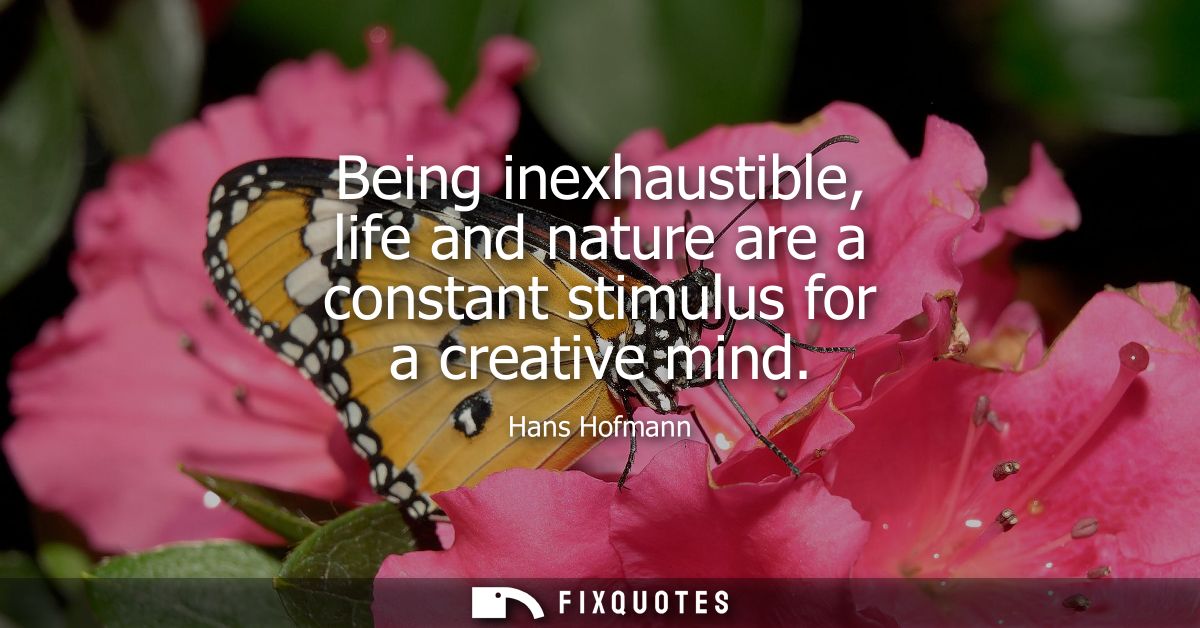
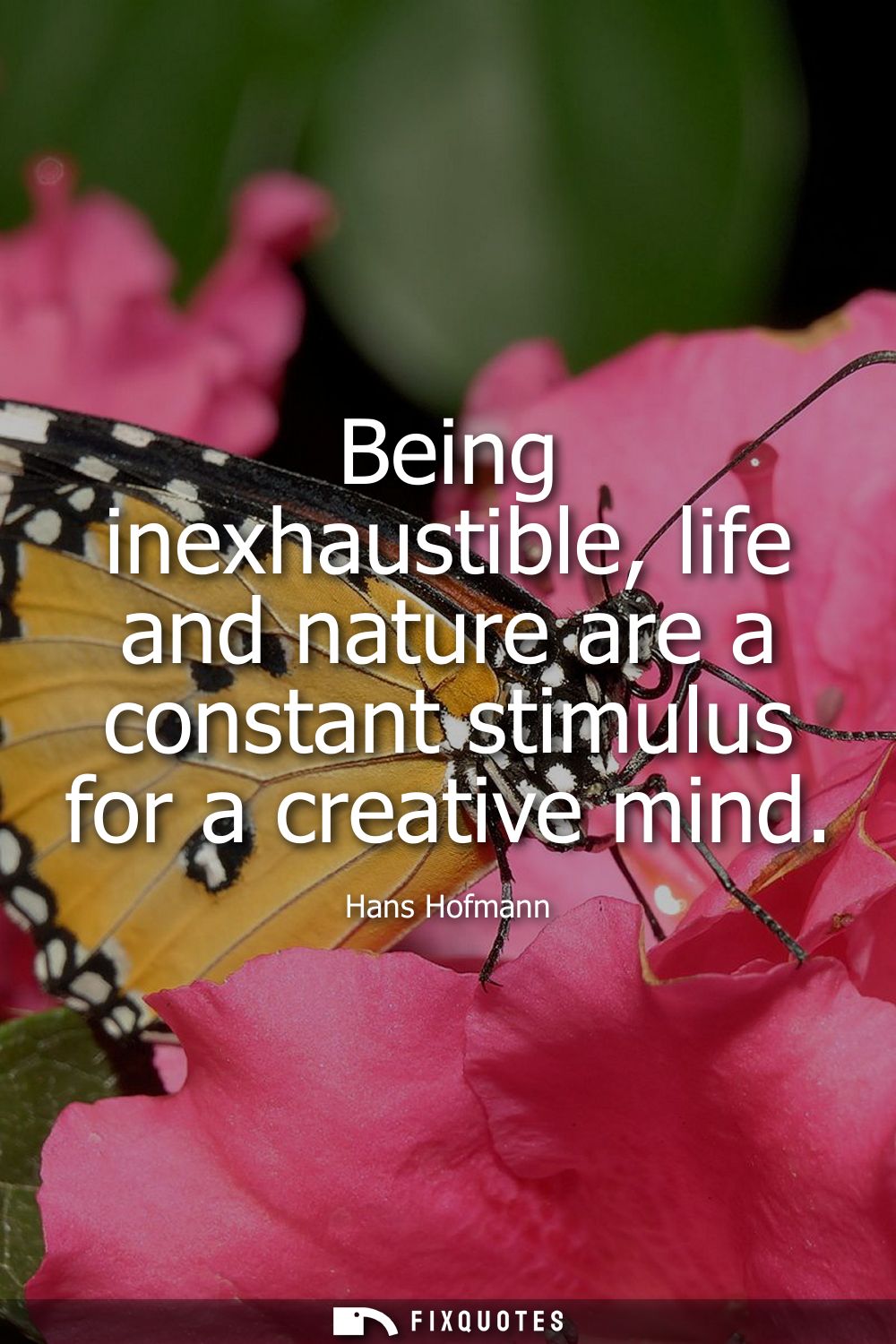
"Being inexhaustible, life and nature are a constant stimulus for a creative mind"
About this Quote
The line also smuggles in a theory of attention. “Constant stimulus” doesn’t mean passive inspiration drifting in like a scent. It’s pressure. It implies discipline: the creative mind isn’t merely talented, it’s porous and trained to keep receiving, translating, reordering. Hofmann’s broader philosophy - especially his “push-pull” idea of dynamic tension on the canvas - turns observation into energy. Nature is not a backdrop to copy; it’s a generator of forces (color, space, movement) that the artist reconstitutes into a new reality.
Context matters: Hofmann taught during a moment when abstraction was often framed as a break from nature, even a rejection of it. His formulation refuses that binary. He grants modern art its freedom while anchoring it in something older and sturdier: the inexhaustible complexity of perception. The subtext is quietly ethical, too: if life keeps offering material, then the artist’s job is to stay awake to it - and to make that wakefulness visible.
Quote Details
| Topic | Art |
|---|---|
| Source | Help us find the source |
| Cite |
Citation Formats
APA Style (7th ed.)
Hofmann, Hans. (2026, January 17). Being inexhaustible, life and nature are a constant stimulus for a creative mind. FixQuotes. https://fixquotes.com/quotes/being-inexhaustible-life-and-nature-are-a-72373/
Chicago Style
Hofmann, Hans. "Being inexhaustible, life and nature are a constant stimulus for a creative mind." FixQuotes. January 17, 2026. https://fixquotes.com/quotes/being-inexhaustible-life-and-nature-are-a-72373/.
MLA Style (9th ed.)
"Being inexhaustible, life and nature are a constant stimulus for a creative mind." FixQuotes, 17 Jan. 2026, https://fixquotes.com/quotes/being-inexhaustible-life-and-nature-are-a-72373/. Accessed 12 Feb. 2026.