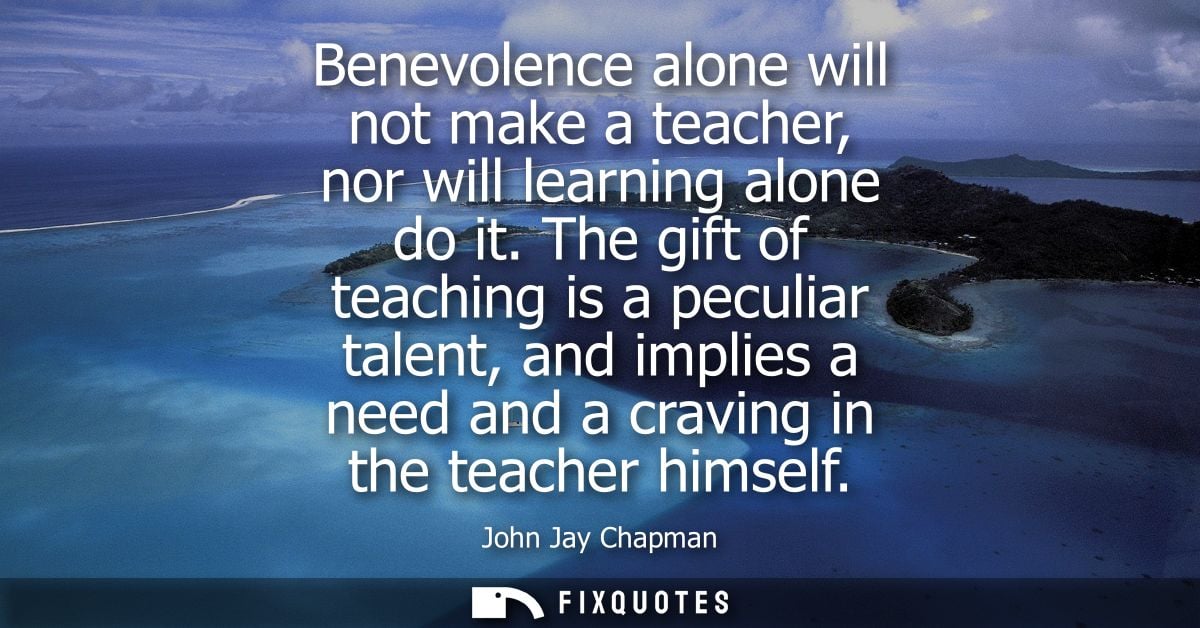
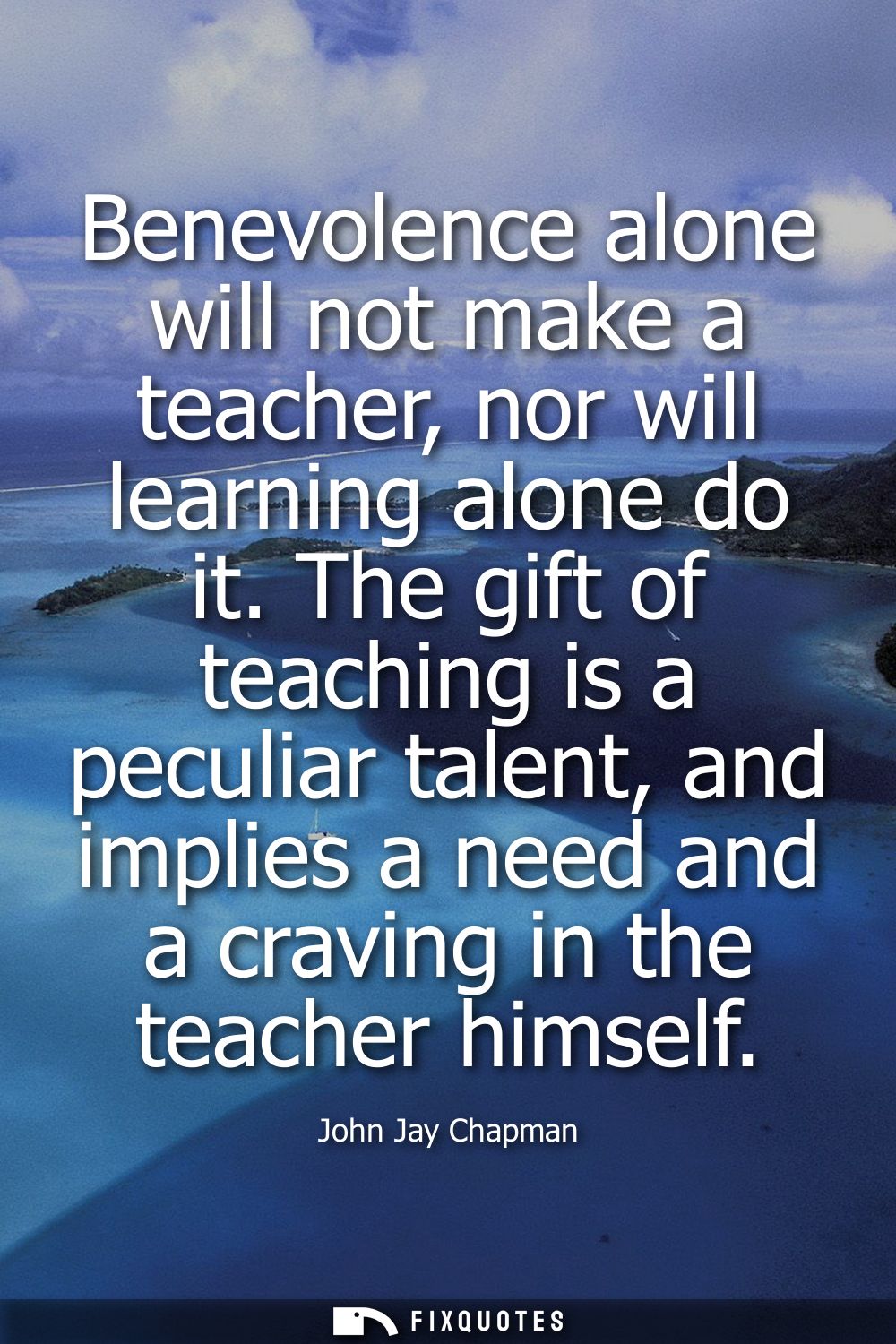
"Benevolence alone will not make a teacher, nor will learning alone do it. The gift of teaching is a peculiar talent, and implies a need and a craving in the teacher himself"
About this Quote
Then he smuggles in the more unsettling claim: teaching isn’t just a service; it’s an appetite. Calling it “a peculiar talent” gives the gift an eccentric edge, something not fully rational or domesticated. Chapman doesn’t romanticize the classroom as pure altruism. He insists on “a need and a craving in the teacher himself,” a phrase that re-centers the educator’s interior life. The subtext: great teaching has a selfish engine. Not greed or vanity, but a hunger to order chaos, to translate, to witness understanding flicker on. That hunger can produce generosity, patience, even charisma - but it also means the teacher is implicated, not merely virtuous.
In Chapman’s era, American schooling was professionalizing, while the “moral uplift” tradition still lingered. His line reads as a corrective to both: ethics and intellect are prerequisites, not guarantees. What makes it work is its refusal to flatter teachers. It suggests that the best ones teach partly because they cannot not teach, and the classroom, at its best, is where that private craving becomes a public good.
Quote Details
| Topic | Teaching |
|---|---|
| Source | Help us find the source |
| Cite |
Citation Formats
APA Style (7th ed.)
Chapman, John Jay. (2026, January 16). Benevolence alone will not make a teacher, nor will learning alone do it. The gift of teaching is a peculiar talent, and implies a need and a craving in the teacher himself. FixQuotes. https://fixquotes.com/quotes/benevolence-alone-will-not-make-a-teacher-nor-114166/
Chicago Style
Chapman, John Jay. "Benevolence alone will not make a teacher, nor will learning alone do it. The gift of teaching is a peculiar talent, and implies a need and a craving in the teacher himself." FixQuotes. January 16, 2026. https://fixquotes.com/quotes/benevolence-alone-will-not-make-a-teacher-nor-114166/.
MLA Style (9th ed.)
"Benevolence alone will not make a teacher, nor will learning alone do it. The gift of teaching is a peculiar talent, and implies a need and a craving in the teacher himself." FixQuotes, 16 Jan. 2026, https://fixquotes.com/quotes/benevolence-alone-will-not-make-a-teacher-nor-114166/. Accessed 13 Feb. 2026.