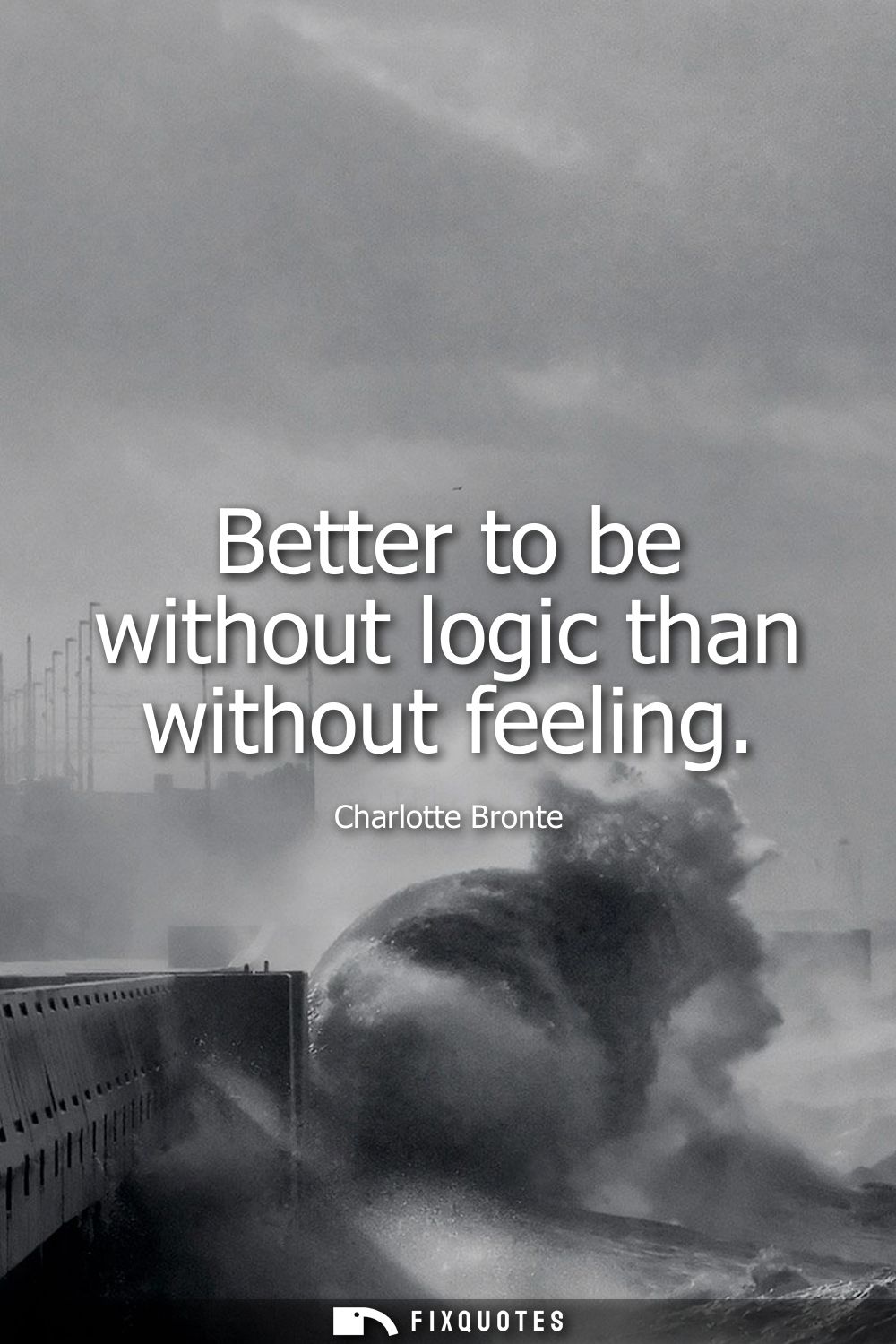
"Better to be without logic than without feeling"
About this Quote
A Victorian novelist staking a claim for the heart over the head is easy to dismiss as sentimental, but Bronte’s line is sharper than it looks. “Better to be without logic than without feeling” isn’t an argument against reason so much as a warning about what passes for reason in a world eager to police women’s inner lives. Logic, in Bronte’s century, was often coded as masculine authority: the calm voice that explains why your desires are “improper,” why your anger is “hysterical,” why your ambitions should be scaled down to fit the room.
The provocation is in the word “without.” Bronte doesn’t say feeling is superior to logic; she suggests that a life stripped of feeling is a kind of spiritual anemia, while a life short on logic still contains the raw material of personhood. Feeling, here, is not mere mood. It’s conscience, hunger, grief, love, the stubborn knowledge that something is true because it’s lived. Bronte’s novels repeatedly turn on this tension: characters surrounded by tidy moral reasoning and social rules that sound coherent until you notice who they serve.
The line also functions as a quiet defense of intensity. Victorian culture prized composure, especially for women, as a sign of virtue and class. Bronte counters: numbness is not refinement; it’s capitulation. If logic becomes a tool for self-erasure, then choosing feeling is choosing survival. That’s why the sentence lands with such bite: it dares the reader to imagine that the “irrational” might be the only honest response to an irrational world.
The provocation is in the word “without.” Bronte doesn’t say feeling is superior to logic; she suggests that a life stripped of feeling is a kind of spiritual anemia, while a life short on logic still contains the raw material of personhood. Feeling, here, is not mere mood. It’s conscience, hunger, grief, love, the stubborn knowledge that something is true because it’s lived. Bronte’s novels repeatedly turn on this tension: characters surrounded by tidy moral reasoning and social rules that sound coherent until you notice who they serve.
The line also functions as a quiet defense of intensity. Victorian culture prized composure, especially for women, as a sign of virtue and class. Bronte counters: numbness is not refinement; it’s capitulation. If logic becomes a tool for self-erasure, then choosing feeling is choosing survival. That’s why the sentence lands with such bite: it dares the reader to imagine that the “irrational” might be the only honest response to an irrational world.
Quote Details
| Topic | Reason & Logic |
|---|---|
| Source | Help us find the source |
| Cite |
Citation Formats
APA Style (7th ed.)
Bronte, Charlotte. (2026, January 15). Better to be without logic than without feeling. FixQuotes. https://fixquotes.com/quotes/better-to-be-without-logic-than-without-feeling-150285/
Chicago Style
Bronte, Charlotte. "Better to be without logic than without feeling." FixQuotes. January 15, 2026. https://fixquotes.com/quotes/better-to-be-without-logic-than-without-feeling-150285/.
MLA Style (9th ed.)
"Better to be without logic than without feeling." FixQuotes, 15 Jan. 2026, https://fixquotes.com/quotes/better-to-be-without-logic-than-without-feeling-150285/. Accessed 1 Apr. 2026.
More Quotes by Charlotte
Add to List