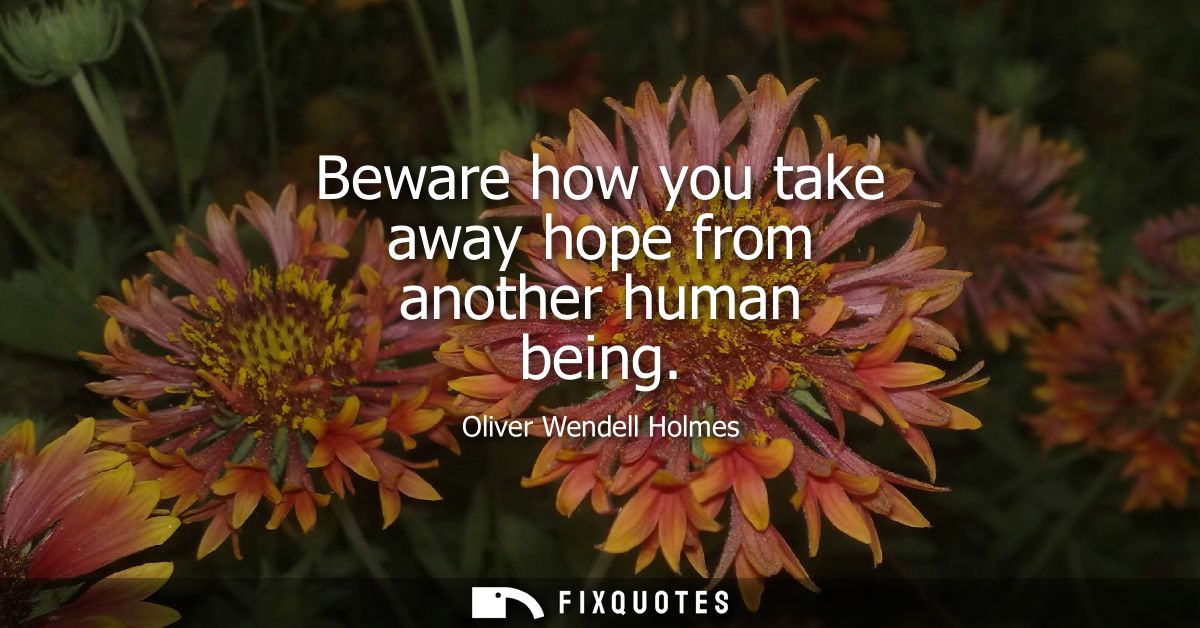
"Beware how you take away hope from another human being"
About this Quote
Hope is treated here less like a private feeling and more like a life-support system - and Holmes issues the warning in the language of moral hazard: beware. The verb matters. He is not pleading for kindness in the abstract; he is flagging the everyday power people wield over each other, often casually, through ridicule, dismissal, or the cold efficiency of “just being realistic.” The line reads like a physician’s bedside counsel because Holmes was one, and that medical sensibility sharpens the stakes: remove hope and you may not just sour someone’s mood, you may worsen their outcome.
As a poet of the 19th-century American mainstream, Holmes lived in an era fascinated by progress, science, and self-making, but also shadowed by fragility - illness, war, and social hierarchy deciding who got to imagine a future. The admonition smuggles in a democratic ethic: “another human being” flattens rank. Your cynicism doesn’t become nobler because it’s aimed downward.
The subtext is uncomfortable: hope is not merely found; it is granted, sustained, and sometimes stolen. That makes the speaker complicit. Holmes suggests that words can function like interventions - either stabilizing or iatrogenic, harm caused by the healer. The quote endures because it indicts a modern reflex: mistaking bluntness for virtue. It asks for a different kind of rigor, one that measures truth not only by accuracy, but by what it does to someone’s will to keep going.
As a poet of the 19th-century American mainstream, Holmes lived in an era fascinated by progress, science, and self-making, but also shadowed by fragility - illness, war, and social hierarchy deciding who got to imagine a future. The admonition smuggles in a democratic ethic: “another human being” flattens rank. Your cynicism doesn’t become nobler because it’s aimed downward.
The subtext is uncomfortable: hope is not merely found; it is granted, sustained, and sometimes stolen. That makes the speaker complicit. Holmes suggests that words can function like interventions - either stabilizing or iatrogenic, harm caused by the healer. The quote endures because it indicts a modern reflex: mistaking bluntness for virtue. It asks for a different kind of rigor, one that measures truth not only by accuracy, but by what it does to someone’s will to keep going.
Quote Details
| Topic | Hope |
|---|
More Quotes by Oliver
Add to List