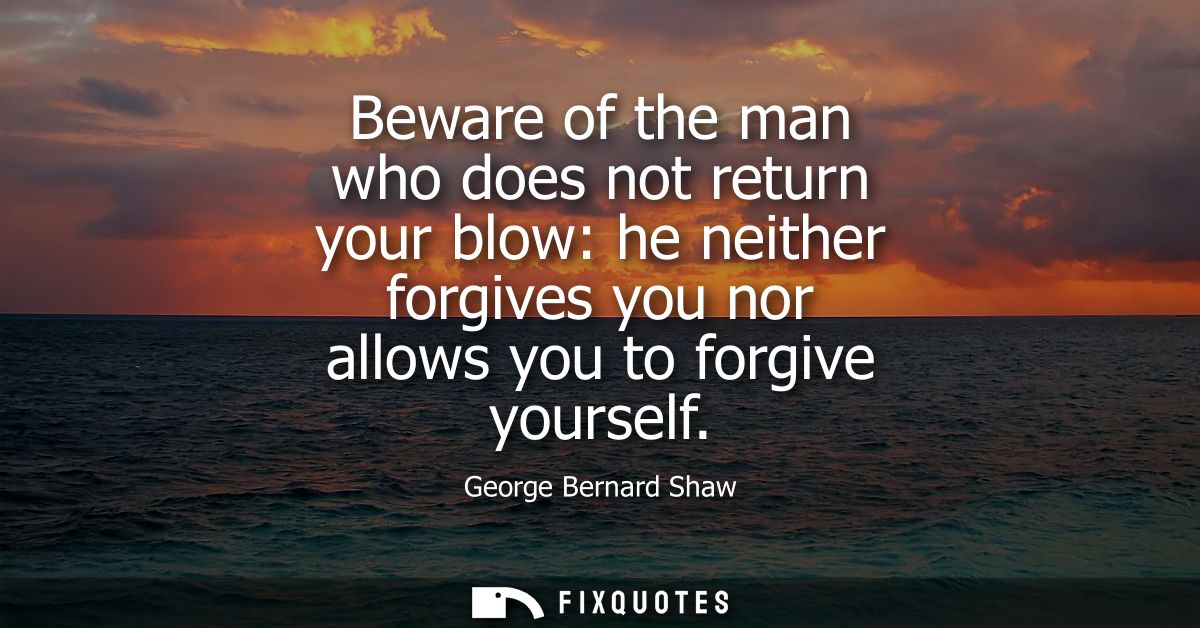
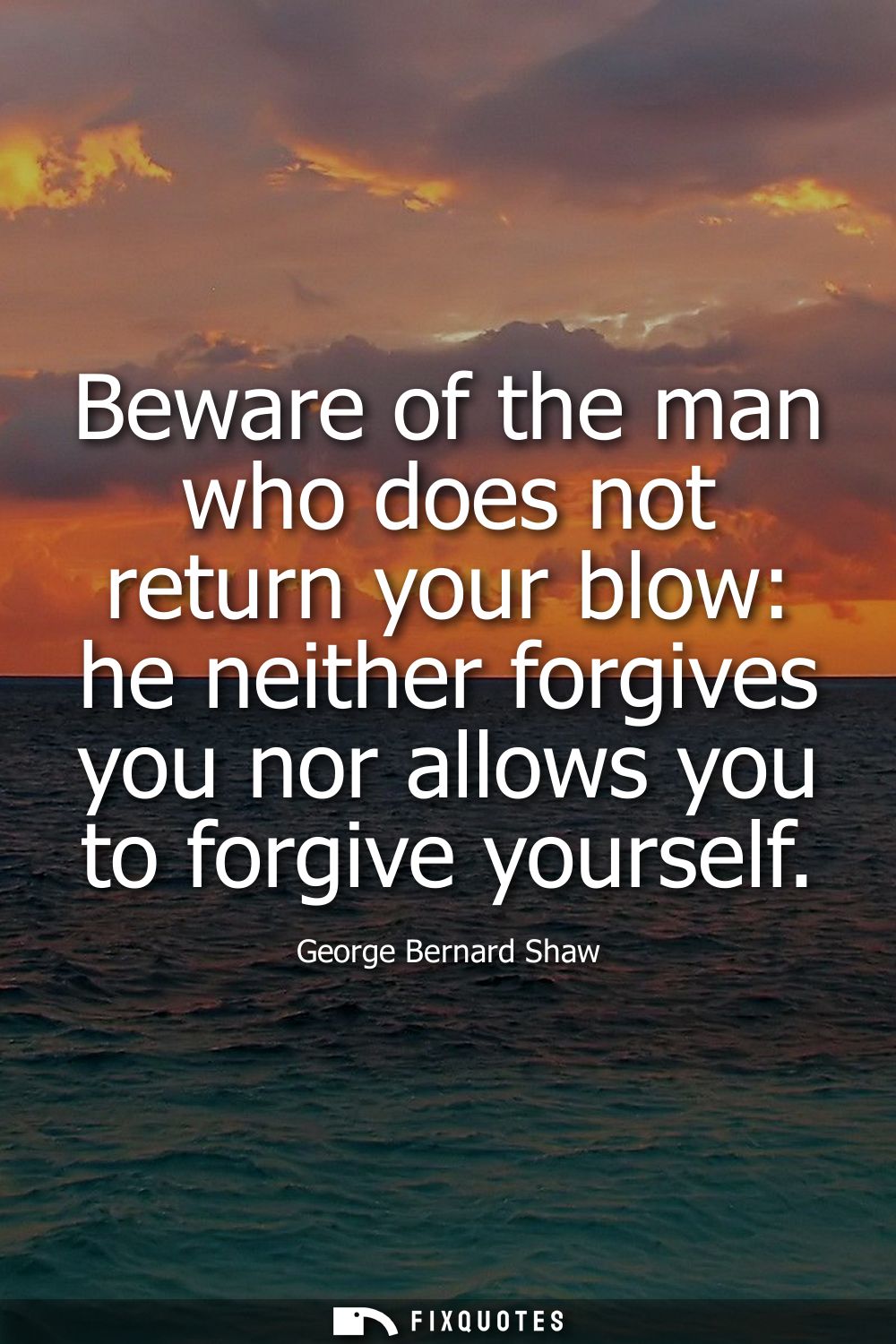
"Beware of the man who does not return your blow: he neither forgives you nor allows you to forgive yourself"
About this Quote
The line is engineered as a trap: it sounds like praise for restraint until Shaw snaps it into menace. “He neither forgives you” denies the comforting fiction that silence equals absolution. Then the real cruelty: he “nor allows you to forgive yourself.” That clause targets the psychology of guilt. If the wronged party won’t strike back, won’t scold, won’t even dramatize their hurt, you’re left alone with your conscience, with no external punishment to metabolize into closure. The aggressor becomes their own jailer.
As a dramatist steeped in social comedy and moral combat, Shaw understood that power often lies in withholding the expected line. In the drawing-room worlds he skewered, etiquette can be a weapon: politeness as pressure, composure as indictment. The “blow” is as likely a slight, betrayal, or public humiliation as a literal punch. Shaw is diagnosing a particular kind of moral jiu-jitsu: the injured party refuses the vulgar satisfaction of revenge and instead forces the offender to live with the discomfort of being unredeemed. That’s not forgiveness; it’s a sentence without an end date.
Quote Details
| Topic | Forgiveness |
|---|---|
| Source | Help us find the source |
| Cite |
Citation Formats
APA Style (7th ed.)
Shaw, George Bernard. (2026, January 14). Beware of the man who does not return your blow: he neither forgives you nor allows you to forgive yourself. FixQuotes. https://fixquotes.com/quotes/beware-of-the-man-who-does-not-return-your-blow-29112/
Chicago Style
Shaw, George Bernard. "Beware of the man who does not return your blow: he neither forgives you nor allows you to forgive yourself." FixQuotes. January 14, 2026. https://fixquotes.com/quotes/beware-of-the-man-who-does-not-return-your-blow-29112/.
MLA Style (9th ed.)
"Beware of the man who does not return your blow: he neither forgives you nor allows you to forgive yourself." FixQuotes, 14 Jan. 2026, https://fixquotes.com/quotes/beware-of-the-man-who-does-not-return-your-blow-29112/. Accessed 16 Feb. 2026.