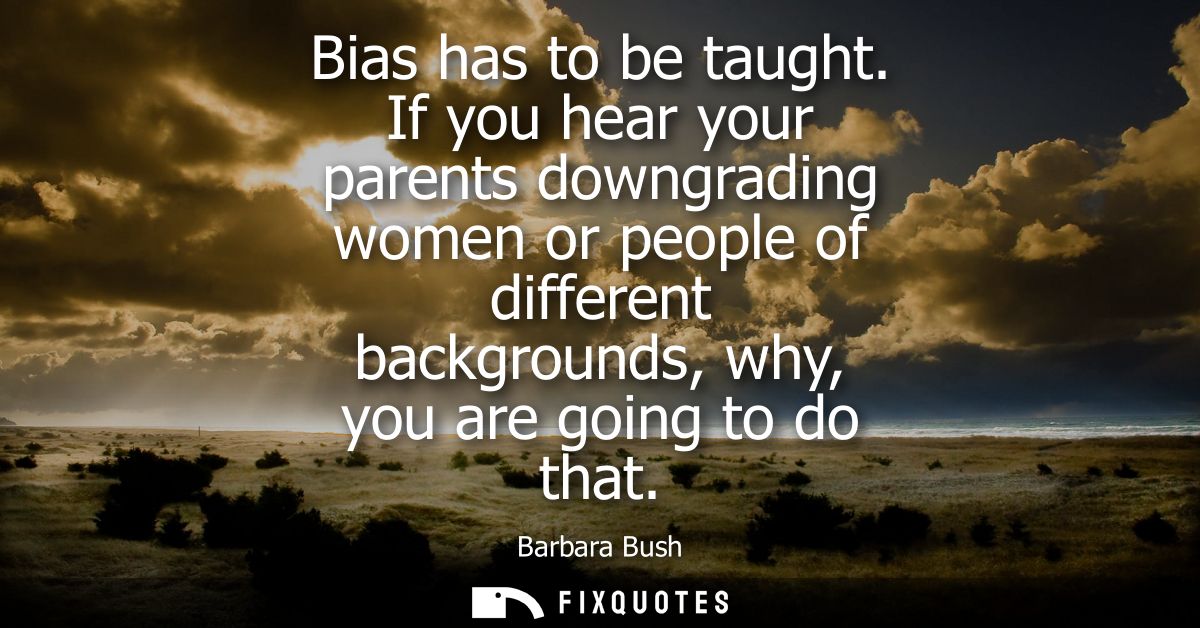
"Bias has to be taught. If you hear your parents downgrading women or people of different backgrounds, why, you are going to do that"
About this Quote
Bias isn’t framed here as a mysterious flaw in human nature but as a household skill, passed down like table manners or small talk. Barbara Bush’s line is doing something rhetorically shrewd: it relocates prejudice from ideology to imitation. The verb “taught” makes bias sound uncomfortably ordinary, less a moral monstrosity than a learned habit. That shift matters because habits can be interrupted; it also implicates the listener without sermonizing. If you’re offended, it’s not because she called you a bigot, it’s because she suggested you might be repeating your parents.
The plain-spoken conditional - “If you hear... you are going to do that” - carries the subtext of inevitability. She isn’t arguing about whether discrimination is wrong; she’s describing how it reproduces itself, quietly, in the background noise of family life. “Downgrading” is a telling choice, too: it’s not only slurs or explicit hatred. It’s the everyday diminishment, the joke, the dismissal, the “not leadership material” aside.
As a First Lady, Bush’s authority is domestic and symbolic more than legislative, and she leans into that lane. This is civic education delivered through the family unit, a way of making social harm legible without naming parties or policies. In late-20th-century America, when public discourse often treated racism and sexism as edge cases rather than ambient systems, her point lands as both gentle and quietly indicting: the origin story isn’t out there. It’s at home, and that makes change both more possible and more personally uncomfortable.
The plain-spoken conditional - “If you hear... you are going to do that” - carries the subtext of inevitability. She isn’t arguing about whether discrimination is wrong; she’s describing how it reproduces itself, quietly, in the background noise of family life. “Downgrading” is a telling choice, too: it’s not only slurs or explicit hatred. It’s the everyday diminishment, the joke, the dismissal, the “not leadership material” aside.
As a First Lady, Bush’s authority is domestic and symbolic more than legislative, and she leans into that lane. This is civic education delivered through the family unit, a way of making social harm legible without naming parties or policies. In late-20th-century America, when public discourse often treated racism and sexism as edge cases rather than ambient systems, her point lands as both gentle and quietly indicting: the origin story isn’t out there. It’s at home, and that makes change both more possible and more personally uncomfortable.
Quote Details
| Topic | Parenting |
|---|---|
| Source | Help us find the source |
More Quotes by Barbara
Add to List