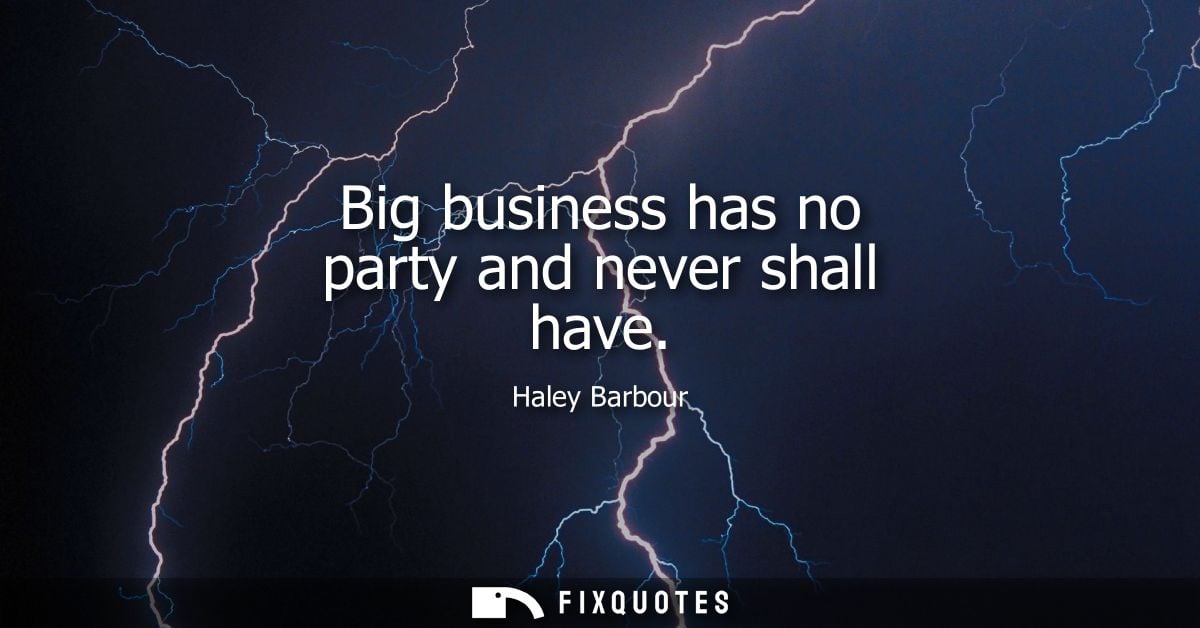
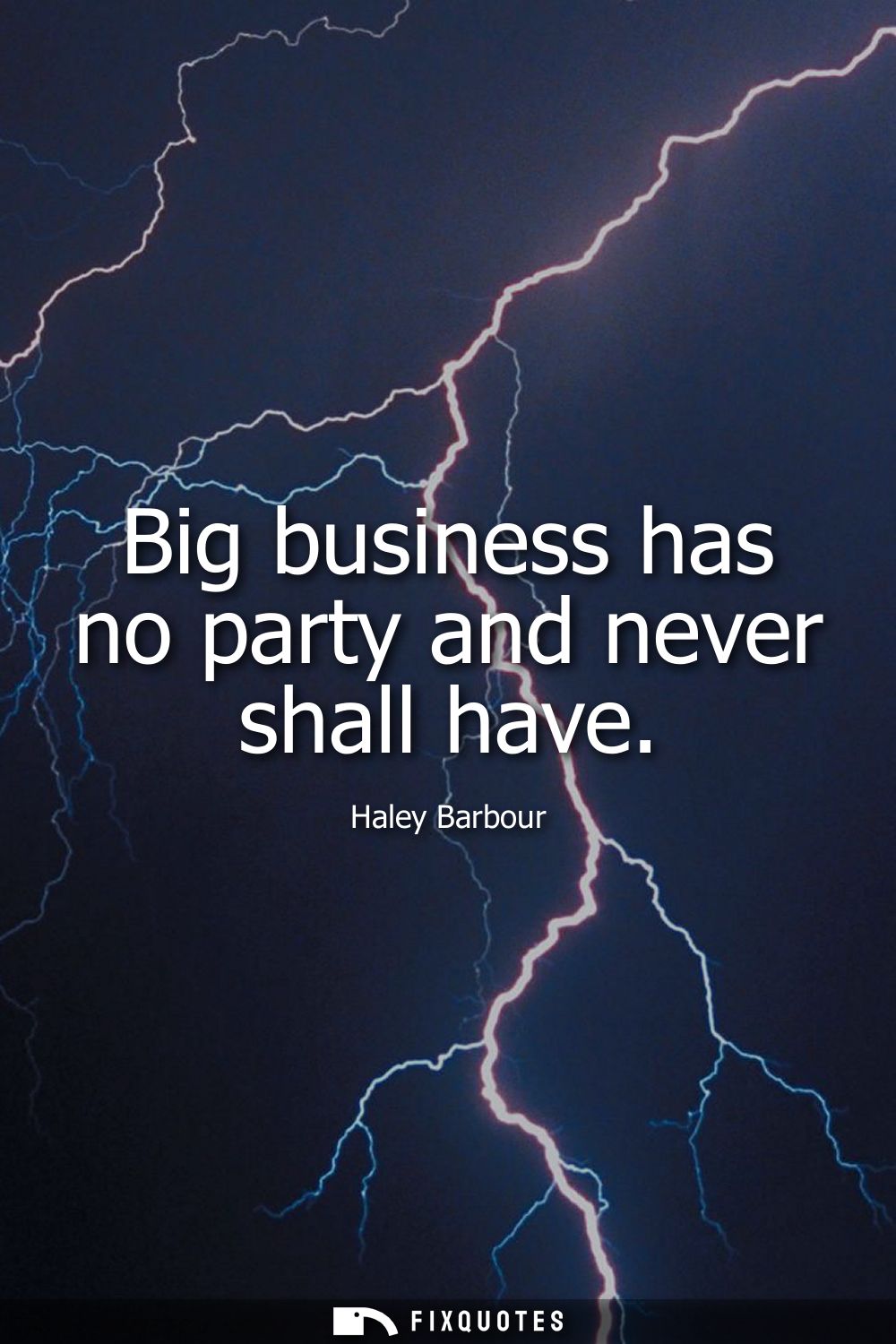
"Big business has no party and never shall have"
About this Quote
Big business has no party because it doesn’t need one; it can rent whichever party is closest to power. Haley Barbour’s line lands like a shrug with teeth: stop pretending corporate America is a loyal voter bloc and start recognizing it as a mobile lobbying operation. Coming from a Republican power broker who made a career inside the party-and-influence ecosystem, the quote reads less like populist outrage and more like insider realism. It’s a warning and a permission slip at once.
The intent is defensive. By insisting that “big business” is politically promiscuous, Barbour pushes back against the recurring conservative story that corporations are natural Republicans and, therefore, should behave like dependable allies. If a business backs a Democrat, the implication goes, it isn’t “betraying” anyone; it’s doing what it always does: hedging. That framing also conveniently absolves the GOP of responsibility when corporate money and corporate priorities fail to line up with cultural conservatism.
The subtext is the part that stings: parties are temporary vehicles, not moral homes. Barbour’s “never shall have” isn’t descriptive, it’s fatalistic. It suggests an economy where ideology matters less than access, and where policy is shaped by transactions that outlive election cycles. It also hints at the double game politicians play with corporate power: publicly courting “small business” rhetoric while privately acknowledging that large firms follow incentives, not flags.
Contextually, this fits the post-Reagan era of business-friendly politics, K Street’s maturation, and the growing corporate habit of donating across the aisle. Barbour isn’t condemning the system; he’s naming its operating manual.
The intent is defensive. By insisting that “big business” is politically promiscuous, Barbour pushes back against the recurring conservative story that corporations are natural Republicans and, therefore, should behave like dependable allies. If a business backs a Democrat, the implication goes, it isn’t “betraying” anyone; it’s doing what it always does: hedging. That framing also conveniently absolves the GOP of responsibility when corporate money and corporate priorities fail to line up with cultural conservatism.
The subtext is the part that stings: parties are temporary vehicles, not moral homes. Barbour’s “never shall have” isn’t descriptive, it’s fatalistic. It suggests an economy where ideology matters less than access, and where policy is shaped by transactions that outlive election cycles. It also hints at the double game politicians play with corporate power: publicly courting “small business” rhetoric while privately acknowledging that large firms follow incentives, not flags.
Contextually, this fits the post-Reagan era of business-friendly politics, K Street’s maturation, and the growing corporate habit of donating across the aisle. Barbour isn’t condemning the system; he’s naming its operating manual.
Quote Details
| Topic | Business |
|---|---|
| Source | Help us find the source |
| Cite |
Citation Formats
APA Style (7th ed.)
Barbour, Haley. (2026, January 15). Big business has no party and never shall have. FixQuotes. https://fixquotes.com/quotes/big-business-has-no-party-and-never-shall-have-148500/
Chicago Style
Barbour, Haley. "Big business has no party and never shall have." FixQuotes. January 15, 2026. https://fixquotes.com/quotes/big-business-has-no-party-and-never-shall-have-148500/.
MLA Style (9th ed.)
"Big business has no party and never shall have." FixQuotes, 15 Jan. 2026, https://fixquotes.com/quotes/big-business-has-no-party-and-never-shall-have-148500/. Accessed 14 Mar. 2026.
More Quotes by Haley
Add to List