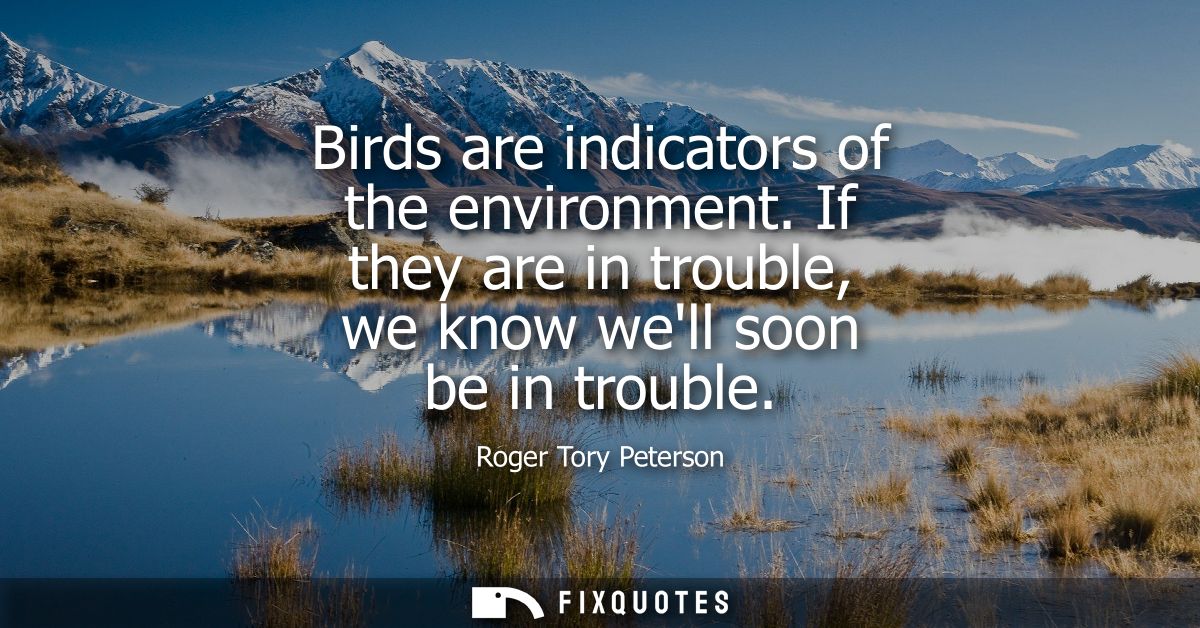
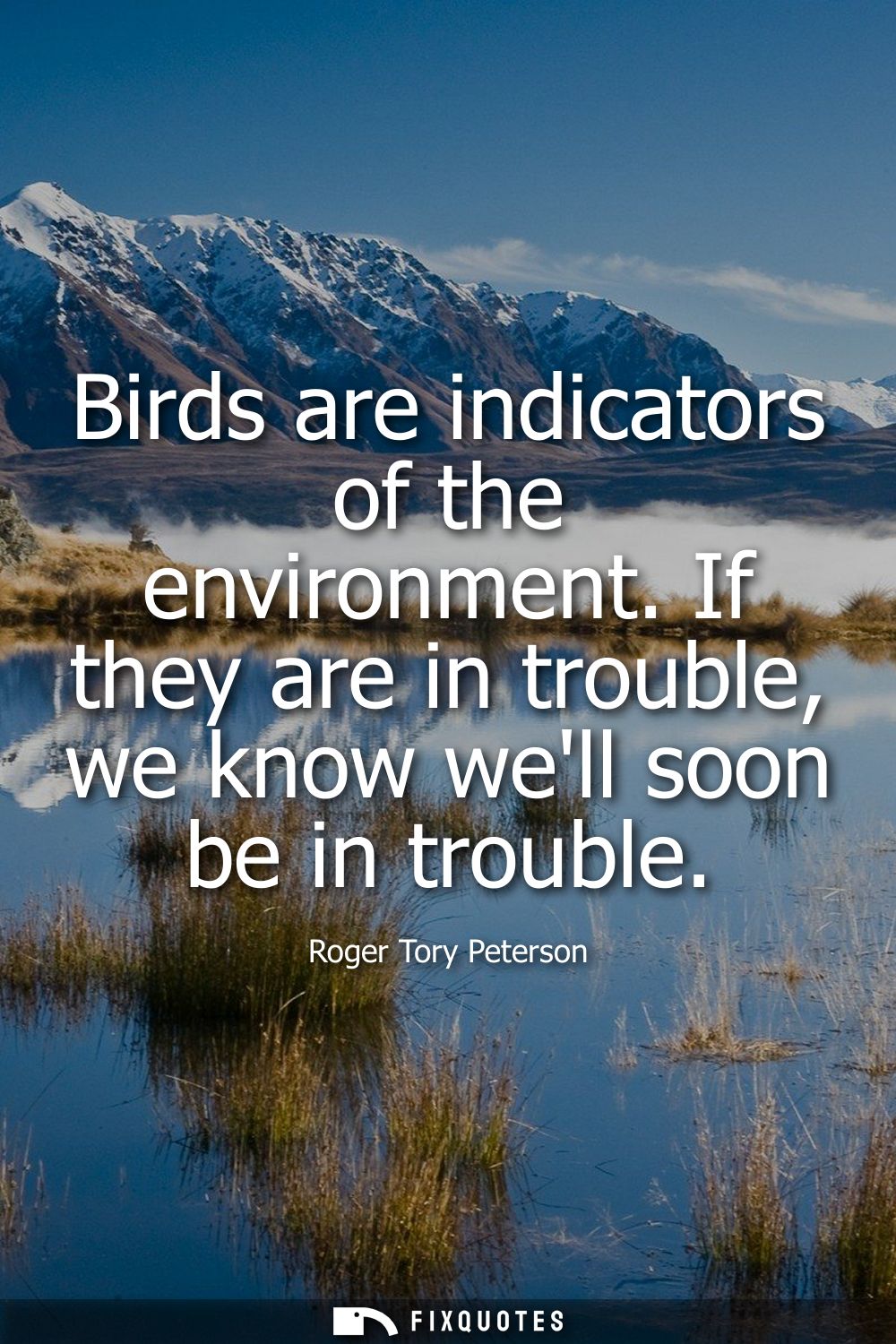
"Birds are indicators of the environment. If they are in trouble, we know we'll soon be in trouble"
About this Quote
The intent is strategic, almost pedagogical. Peterson, a master communicator as much as a naturalist, chooses birds precisely because ordinary people notice them. You don’t need a lab to register fewer swallows in summer or silence where there used to be song. That accessibility is the subtext: environmental crisis isn’t only a specialist’s data set; it’s a public experience, if we’re paying attention.
Context matters. Peterson’s career spans the period when American conservation shifted from scenic preservation to confronting industrial toxicity and habitat loss. The quote echoes the logic that would animate mid-century environmentalism and later “canary in the coal mine” rhetoric around pesticides, pollution, and ecosystem fragmentation. It’s also a quiet rebuke to human exceptionalism. If birds - mobile, adaptable, evolution’s little survival machines - are “in trouble,” then the problem isn’t localized bad luck. It’s systemic.
The line persuades without preaching: it leverages self-interest, but it also smuggles in humility. The environment isn’t a backdrop. It’s a shared body, and birds are among its first symptoms.
Quote Details
| Topic | Nature |
|---|---|
| Source | Later attribution: The "How to" of performance management (Management Training Australia, 2015) modern compilationID: H4AIBgAAQBAJ
Evidence:
... Birds are indicators of the environment . If they are in trouble , we know we'll soon be in trouble . - Roger Tory Peterson Indicators are not measures of what you have done , but simply something that indicates that you have done ... |
| Cite |
Citation Formats
APA Style (7th ed.)
Peterson, Roger Tory. (2026, March 2). Birds are indicators of the environment. If they are in trouble, we know we'll soon be in trouble. FixQuotes. https://fixquotes.com/quotes/birds-are-indicators-of-the-environment-if-they-8256/
Chicago Style
Peterson, Roger Tory. "Birds are indicators of the environment. If they are in trouble, we know we'll soon be in trouble." FixQuotes. March 2, 2026. https://fixquotes.com/quotes/birds-are-indicators-of-the-environment-if-they-8256/.
MLA Style (9th ed.)
"Birds are indicators of the environment. If they are in trouble, we know we'll soon be in trouble." FixQuotes, 2 Mar. 2026, https://fixquotes.com/quotes/birds-are-indicators-of-the-environment-if-they-8256/. Accessed 7 Apr. 2026.