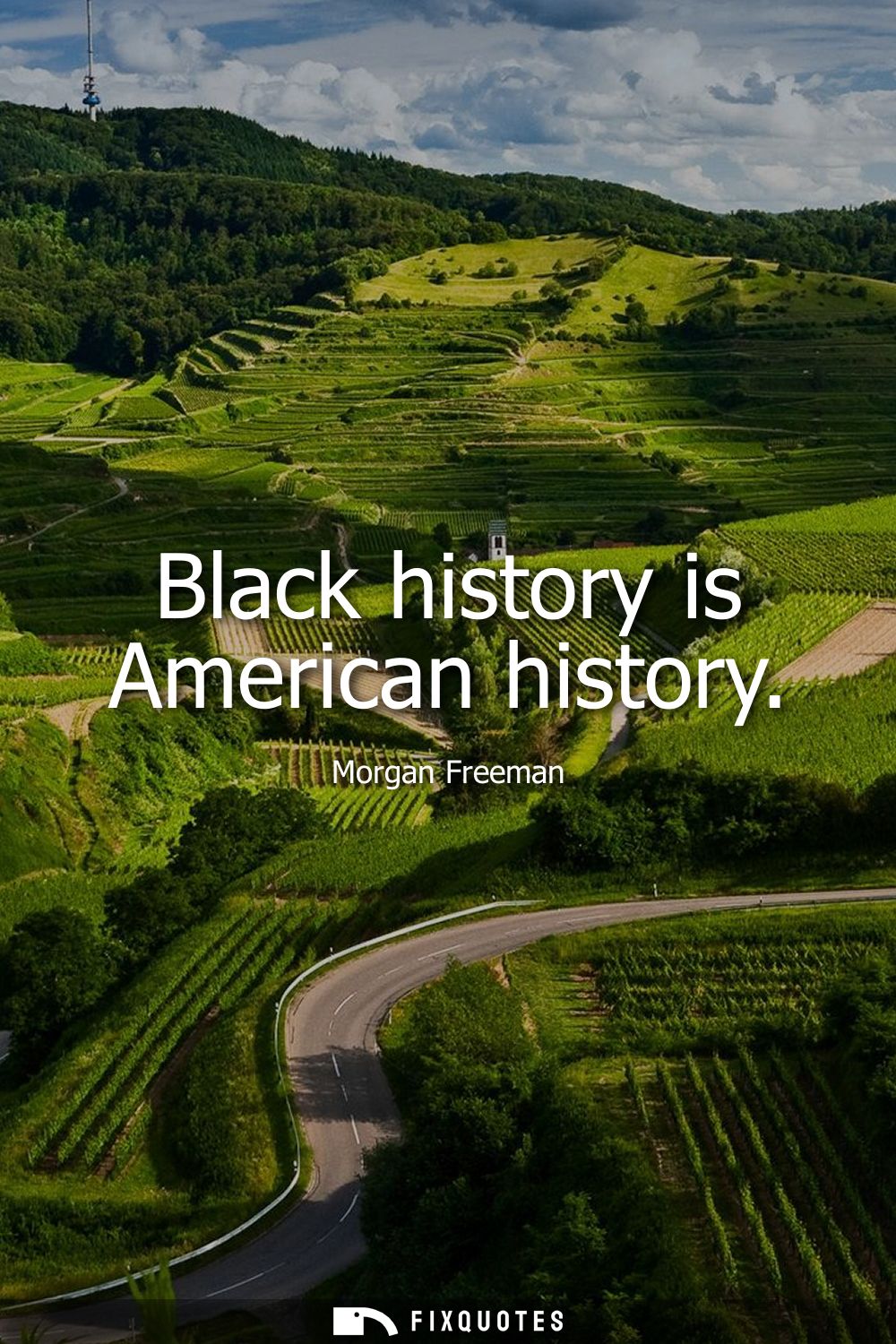
"Black history is American history"
About this Quote
Freeman’s line lands like a correction delivered in plain clothes: not a plea for inclusion, but a refusal of the premise that Black history sits off to the side as a specialty unit. The power is in its grammatical simplicity. No metaphors, no heroic flourish, just an equation that makes “separate but equal” sound as absurd in the classroom as it always was in law. Coming from an actor with the cultural authority of a national narrator, it doubles as a performance note to the country: stop treating Black life as a guest appearance in the American story.
The intent is strategic. By collapsing “Black history” into “American history,” Freeman aims at the institutional habit of containment: one month, one museum wing, one elective course, one obligatory montage. The subtext is impatience with tokenism, but also a challenge to the comforting version of national identity that depends on selective memory. If Black history is American history, then slavery isn’t a preface, Reconstruction isn’t a detour, Jim Crow isn’t regional trivia, and civil rights isn’t an inspiring finale; they’re central plot mechanics that shaped wealth, law, culture, and power.
Context matters, too. Freeman has voiced skepticism about commemorative rituals that can feel like quarantines of conscience. His phrase works as both bridge and provocation: it offers unity, but on terms that demand re-reading the archive. It’s an invitation to stop asking whether Black history “belongs” and start asking why America keeps trying to edit its own credits.
The intent is strategic. By collapsing “Black history” into “American history,” Freeman aims at the institutional habit of containment: one month, one museum wing, one elective course, one obligatory montage. The subtext is impatience with tokenism, but also a challenge to the comforting version of national identity that depends on selective memory. If Black history is American history, then slavery isn’t a preface, Reconstruction isn’t a detour, Jim Crow isn’t regional trivia, and civil rights isn’t an inspiring finale; they’re central plot mechanics that shaped wealth, law, culture, and power.
Context matters, too. Freeman has voiced skepticism about commemorative rituals that can feel like quarantines of conscience. His phrase works as both bridge and provocation: it offers unity, but on terms that demand re-reading the archive. It’s an invitation to stop asking whether Black history “belongs” and start asking why America keeps trying to edit its own credits.
Quote Details
| Topic | Equality |
|---|
More Quotes by Morgan
Add to List