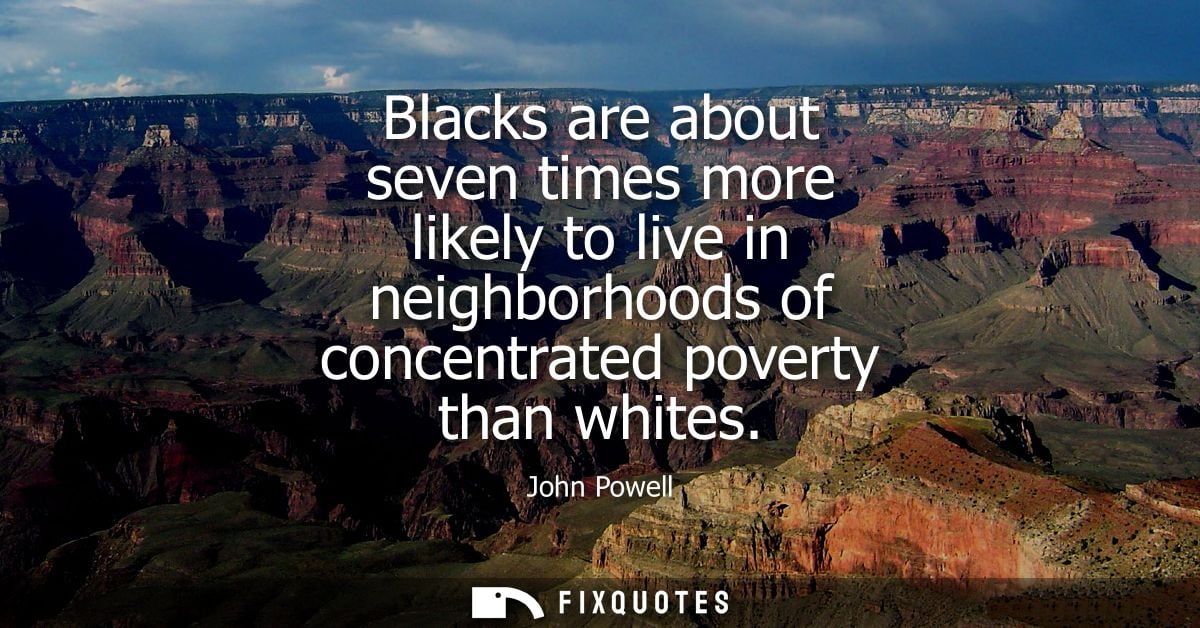
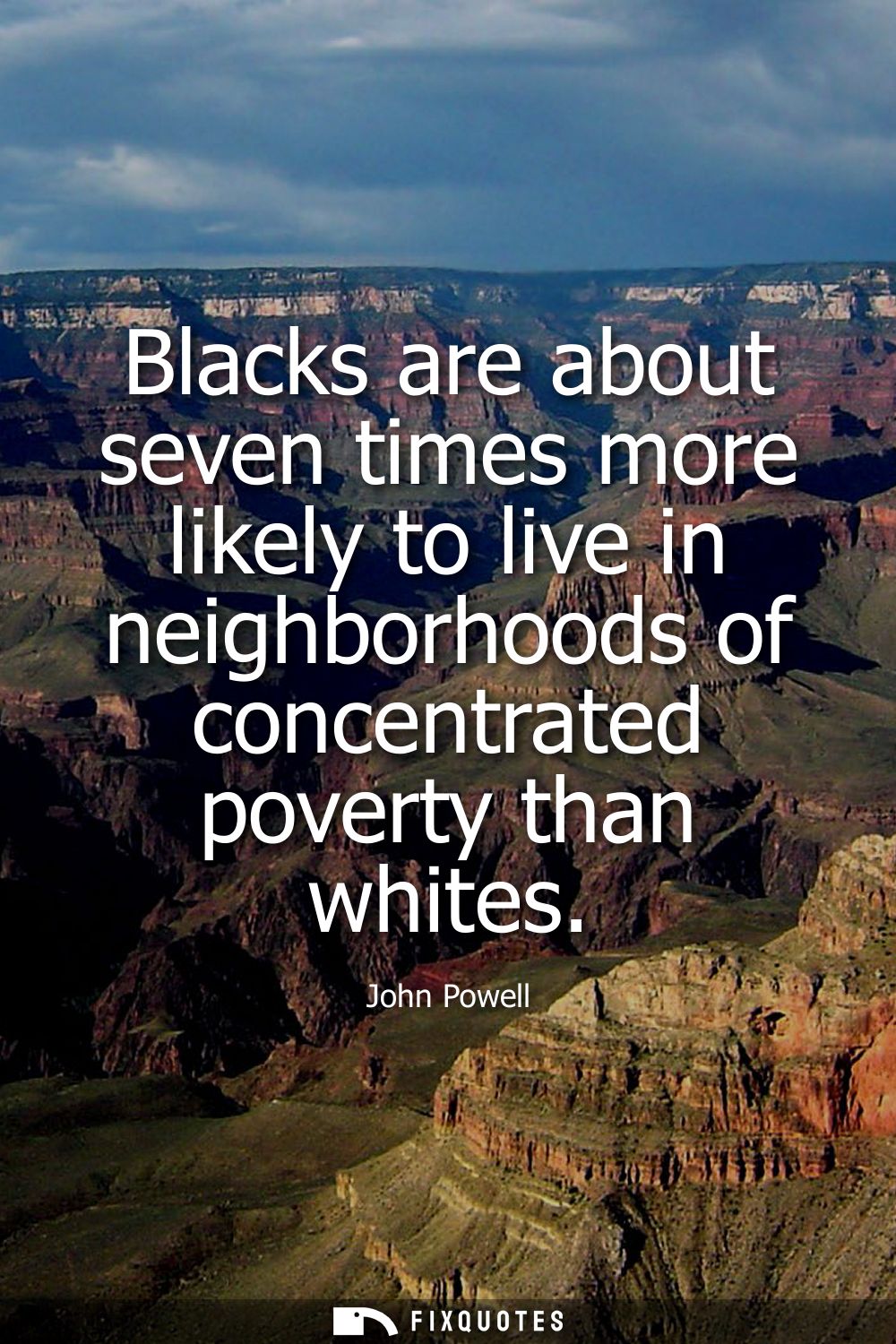
"Blacks are about seven times more likely to live in neighborhoods of concentrated poverty than whites"
About this Quote
The key phrase is “neighborhoods of concentrated poverty.” Not poverty in general, but poverty stacked on itself: places where underfunded schools, weaker job networks, environmental hazards, aggressive policing, and predatory lending aren’t separate problems but a single ecosystem. “Concentrated” signals design. It evokes redlining, exclusionary zoning, highway placement, disinvestment, and the subtle bureaucracy of who gets approved, valued, protected. The subtext is that segregation is not a historical artifact; it’s a living infrastructure.
Powell’s intent reads as political clarity disguised as measurement. By tethering racial disparity to geography, he shifts the conversation from attitudes to systems: where opportunity is physically located, who can access it, and who is fenced out by policy that can claim to be “race-neutral” while staying racially predictable in effect. It’s an argument for responsibility without the comfort of a single villain - the kind of truth that makes denial harder because it refuses to be sensational.
Quote Details
| Topic | Equality |
|---|---|
| Source | Help us find the source |
| Cite |
Citation Formats
APA Style (7th ed.)
Powell, John. (2026, January 15). Blacks are about seven times more likely to live in neighborhoods of concentrated poverty than whites. FixQuotes. https://fixquotes.com/quotes/blacks-are-about-seven-times-more-likely-to-live-60889/
Chicago Style
Powell, John. "Blacks are about seven times more likely to live in neighborhoods of concentrated poverty than whites." FixQuotes. January 15, 2026. https://fixquotes.com/quotes/blacks-are-about-seven-times-more-likely-to-live-60889/.
MLA Style (9th ed.)
"Blacks are about seven times more likely to live in neighborhoods of concentrated poverty than whites." FixQuotes, 15 Jan. 2026, https://fixquotes.com/quotes/blacks-are-about-seven-times-more-likely-to-live-60889/. Accessed 12 Feb. 2026.