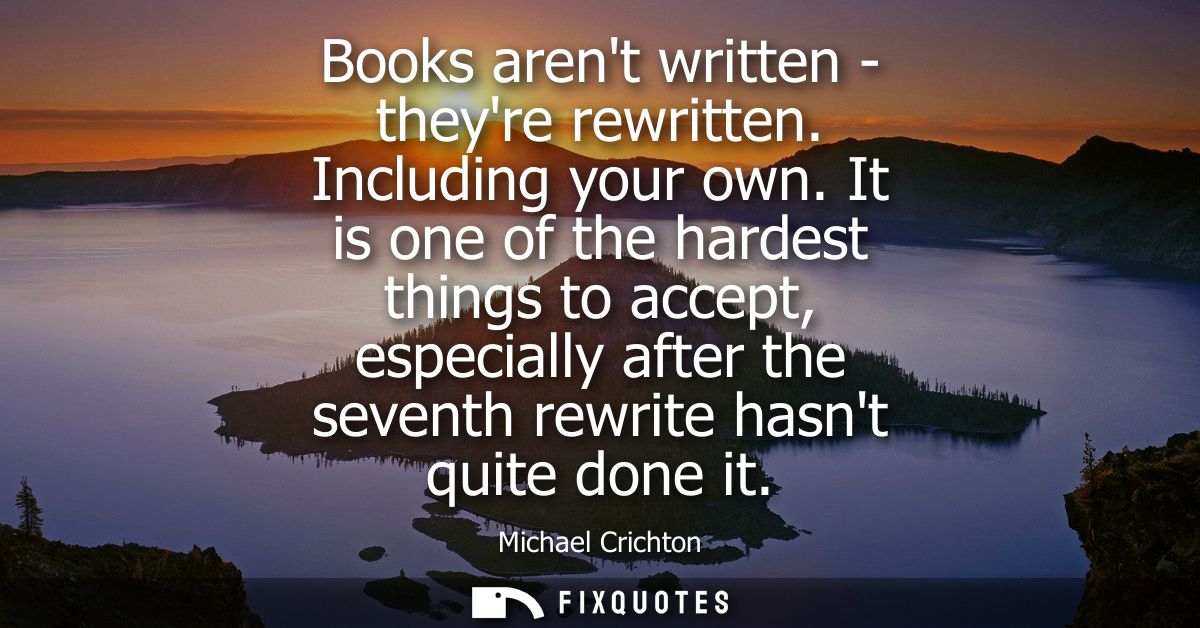
"Books aren't written - they're rewritten. Including your own. It is one of the hardest things to accept, especially after the seventh rewrite hasn't quite done it"
About this Quote
The sly sting is in “Including your own.” It’s a small clause that drags the ego into the room. Most writers can accept that drafts need editing; fewer accept that their cherished sentences are the first things that should be questioned. Crichton’s intent isn’t to discourage so much as to reframe failure: the messy middle isn’t evidence you lack talent, it’s the job.
Then he tightens the screw with “especially after the seventh rewrite.” The specificity is comic, but it’s also a psychological truth. By draft seven, you’re no longer fueled by novelty. You’re dealing with boredom, self-doubt, and the creeping suspicion that the problem isn’t the prose, it’s you. That’s the subtext: persistence isn’t glamorous; it’s repetitive, and it asks you to keep working without the reward of feeling “done.”
Context matters here. Crichton wrote high-concept, heavily researched page-turners where clarity and pacing are everything; those books only look inevitable because enormous labor has been hidden. He’s offering craft advice that doubles as emotional triage: accept rewriting as the real creative act, or you’ll confuse the process with a verdict.
Quote Details
| Topic | Writing |
|---|---|
| Source | Help us find the source |
| Cite |
Citation Formats
APA Style (7th ed.)
Crichton, Michael. (2026, January 15). Books aren't written - they're rewritten. Including your own. It is one of the hardest things to accept, especially after the seventh rewrite hasn't quite done it. FixQuotes. https://fixquotes.com/quotes/books-arent-written-theyre-rewritten-including-168111/
Chicago Style
Crichton, Michael. "Books aren't written - they're rewritten. Including your own. It is one of the hardest things to accept, especially after the seventh rewrite hasn't quite done it." FixQuotes. January 15, 2026. https://fixquotes.com/quotes/books-arent-written-theyre-rewritten-including-168111/.
MLA Style (9th ed.)
"Books aren't written - they're rewritten. Including your own. It is one of the hardest things to accept, especially after the seventh rewrite hasn't quite done it." FixQuotes, 15 Jan. 2026, https://fixquotes.com/quotes/books-arent-written-theyre-rewritten-including-168111/. Accessed 5 Mar. 2026.