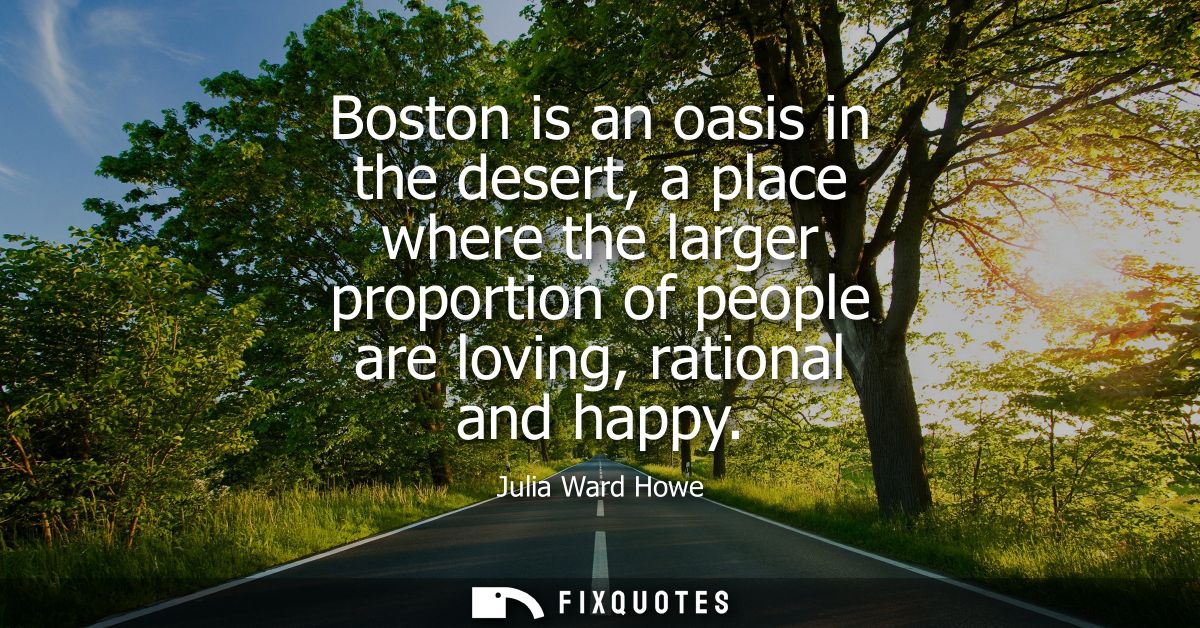
"Boston is an oasis in the desert, a place where the larger proportion of people are loving, rational and happy"
About this Quote
Her triad - "loving, rational and happy" - reads like a manifesto in miniature, and it’s pointed. "Rational" signals the era’s faith in moral progress through education, debate, and institutions; it’s also a jab at the passions and prejudices that propped up slavery and gender hierarchy. "Loving" wraps reform in warmth, countering the stereotype of the Boston moralist as cold or punitive. "Happy" is the boldest claim: not just virtuous, but thriving. It sells reform as a way of life, not a burden.
The subtext is aspirational and defensive. Boston was hardly free of class conflict, racism, and nativism, but Howe’s sentence functions like a recruitment poster for a movement ecosystem. Praise becomes pressure: if Boston is rational and loving, it must keep proving it.
Quote Details
| Topic | Happiness |
|---|---|
| Source | Help us find the source |
| Cite |
Citation Formats
APA Style (7th ed.)
Howe, Julia Ward. (2026, January 17). Boston is an oasis in the desert, a place where the larger proportion of people are loving, rational and happy. FixQuotes. https://fixquotes.com/quotes/boston-is-an-oasis-in-the-desert-a-place-where-47302/
Chicago Style
Howe, Julia Ward. "Boston is an oasis in the desert, a place where the larger proportion of people are loving, rational and happy." FixQuotes. January 17, 2026. https://fixquotes.com/quotes/boston-is-an-oasis-in-the-desert-a-place-where-47302/.
MLA Style (9th ed.)
"Boston is an oasis in the desert, a place where the larger proportion of people are loving, rational and happy." FixQuotes, 17 Jan. 2026, https://fixquotes.com/quotes/boston-is-an-oasis-in-the-desert-a-place-where-47302/. Accessed 6 Apr. 2026.