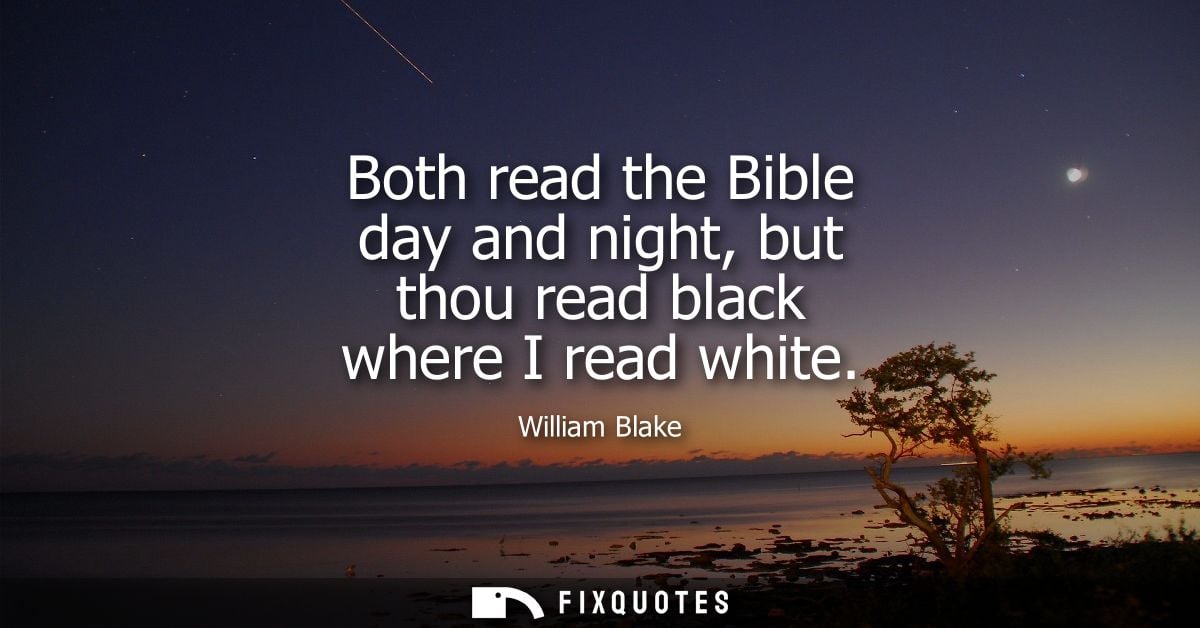
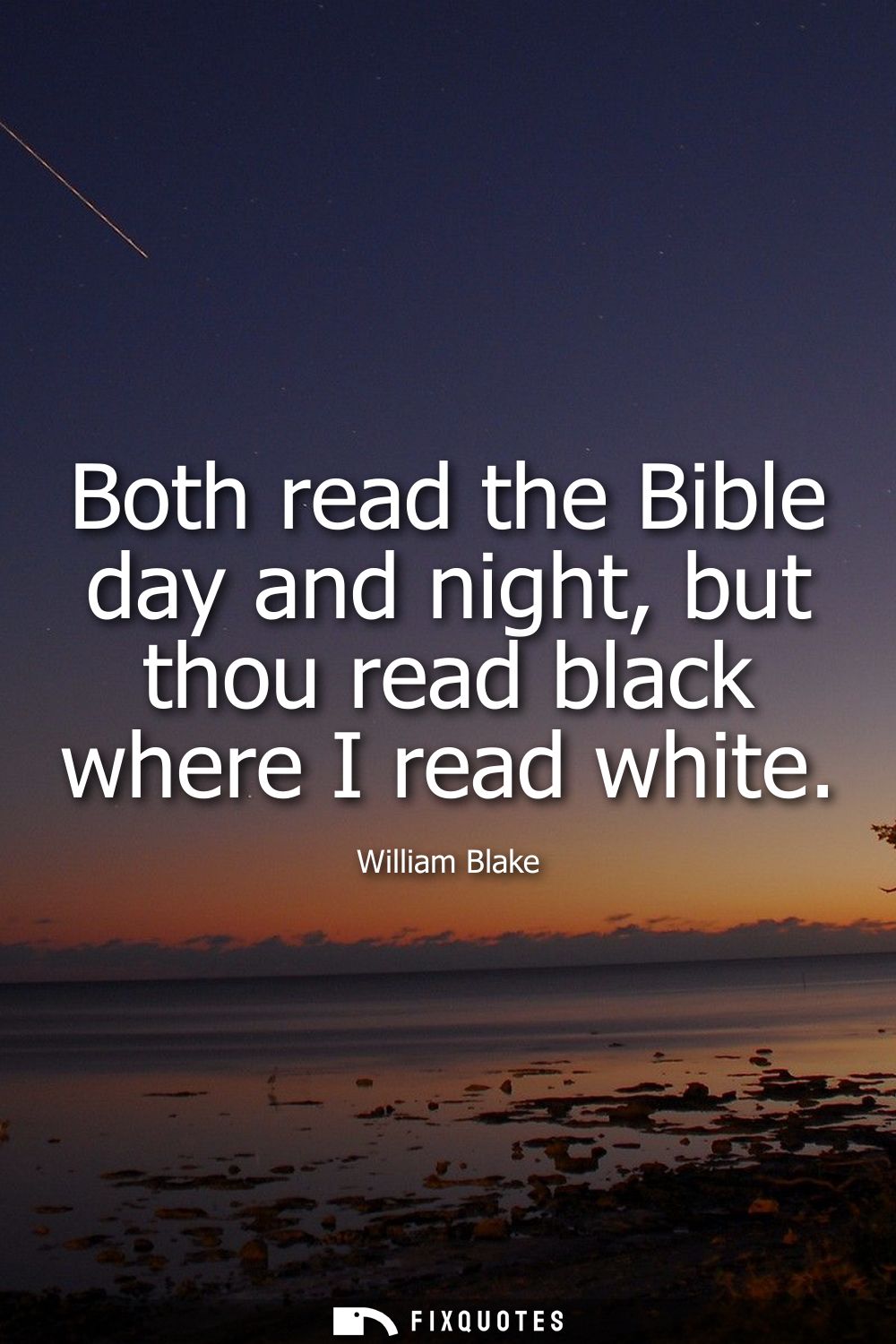
"Both read the Bible day and night, but thou read black where I read white"
About this Quote
Blake wrote in an England where the Bible was not just a spiritual text but a political instrument, routinely marshaled to bless hierarchy, discipline, and social order. His larger project (think Songs of Innocence and of Experience, and The Marriage of Heaven and Hell) treats institutional religion as a machine that turns living vision into rule-following. “Black” and “white” aren’t merely opposing meanings; they’re moral pigments. One reader finds sin, threat, and prohibition; the other finds mercy, liberation, and imaginative fire. The subtext is brutal: both readers can claim fidelity while producing contradictory ethics.
There’s also a sly, modern epistemology here. Blake implies that reading is never neutral; it’s shaped by temperament, class, fear, desire, and the needs of the moment. The line compresses a whole critique of sectarian culture: people don’t just disagree about what God wants, they recruit God to endorse what they already want. By making the conflict about ink-on-page rather than doctrine, Blake turns religious certainty into something embarrassingly human: a projection dressed up as revelation.
Quote Details
| Topic | Bible |
|---|---|
| Source | Verified source: Life of William Blake, “Pictor Ignotus” (Vol. II) (William Blake, 1863)
Evidence: Both read the Bible day and night; But thou read'st black where I read white. (Page 96 (section: “THE WOMAN TAKEN IN ADULTERY.”)). Primary-author attribution: William Blake wrote these lines as part of the poem generally known as “The Everlasting Gospel” (an unfinished/fragmentary poem surviving in manuscript). Blake did not publish this poem in his lifetime; the line is therefore not from a speech or interview. The earliest publication I could directly verify for this specific wording is in Alexander Gilchrist’s biography, Life of William Blake, “Pictor Ignotus” (Vol. II), published in 1863 by Macmillan, where it appears under the heading “THE WOMAN TAKEN IN ADULTERY.” and is explicitly described as “Extracted from a Fragmentary Poem, entitled 'The Everlasting Gospel.'” (page 96 in the printed book). Other candidates (1) Dan Brown’s Robert Langdon Series (Dan Brown, 2017) compilation95.0% ... William Blake hinted that we should read between the lines . " Langdon was familiar with the verse : BOTH READ TH... |
| Cite |
Citation Formats
APA Style (7th ed.)
Blake, William. (2026, March 2). Both read the Bible day and night, but thou read black where I read white. FixQuotes. https://fixquotes.com/quotes/both-read-the-bible-day-and-night-but-thou-read-2358/
Chicago Style
Blake, William. "Both read the Bible day and night, but thou read black where I read white." FixQuotes. March 2, 2026. https://fixquotes.com/quotes/both-read-the-bible-day-and-night-but-thou-read-2358/.
MLA Style (9th ed.)
"Both read the Bible day and night, but thou read black where I read white." FixQuotes, 2 Mar. 2026, https://fixquotes.com/quotes/both-read-the-bible-day-and-night-but-thou-read-2358/. Accessed 2 Apr. 2026.